



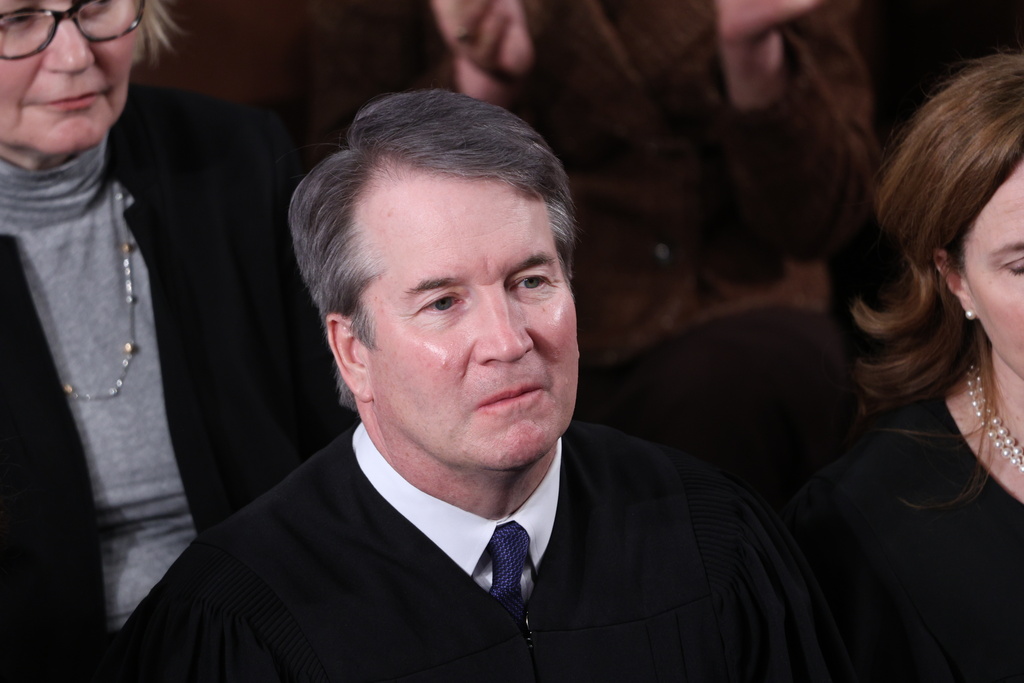
Justice Brett Kavanaugh did not participate in a Supreme Court decision involving a federal inmate’s challenge to the denial of post‑conviction relief, according to a court order list released Monday.
The court declined to hear the case. The order states, “Justice Kavanaugh took no part in the consideration or decision of this petition.”
Why It Matters
The case, Gezo G. Edwards v. United States, asked the court to overturn lower court rulings rejecting post-conviction challenges by Edwards, a federal inmate serving a life sentence for conspiring to distribute large quantities of cocaine.
Edwards asked the court to consider whether his trial and appellate counsel were “constitutionally ineffective” and whether courts can uphold indictments with misplaced language.
What To Know
Edwards was sentenced to life in prison in 2024 for conspiring to distribute large quantities of cocaine in the Washington, D.C., metropolitan area. He was indicted following a 15-month investigation by law enforcement resulting in the recovery of 29.5 kilograms of cocaine, which had an estimated wholesale value of $1 million and an estimated street value of more than $3 million.
The Appeals Court for the District of Columbia affirmed Edwards’ conviction on direct appeal on July 8, 2016. The Supreme Court declined to hear the case in 2017.
Edwards then filed a pro se motion to vacate, set aside or correct his sentence, based on multiple allegations of ineffective counsel. A district court denied the motion, and an appeals court dismissed the appeal.
Edwards filed another motion in 2023, which he said was “misconstrued” as a second pro se motion to vacate, set aside or correct his sentence. After the motion was denied at the district and appellate courts, he filed a petition with the Supreme Court.
Edwards’ most recent challenge argued that the indictment charging him was “defective” because it did not allege he “had any present knowledge of the nature of the substance.”
The government waived its right to file a response in the case unless requested to do so by the court.
What People Are Saying
Gezo G. Edwards, petitioner, in a December 2025 petition for a writ of certiorari: “Not only does the indictment fail to allege an essential element of the offense, it also accuses EDWARDS, literally, of an impossible crime. That is it alleges that EDWARDS had the skill or ability to know future facts, thereby being able to form a plan with future knowledge not yet possessed. This defies common sense and logic.”
The Supreme Court, in an order list Monday: “The petition for a writ of certiorari is denied.”
What Happens Next
The Supreme Court’s denial means that lower-court rulings in the case will remain in effect.
Do you have a story that Newsweek should be covering? Do you have any questions about this story? Contact LiveNews@newsweek.com.
In a polarized era, the center is dismissed as bland. At Newsweek, ours is different: The Courageous Center—it’s not “both sides,” it’s sharp, challenging and alive with ideas. We follow facts, not factions. If that sounds like the kind of journalism you want to see thrive, we need you.
When you become a Newsweek Member, you support a mission to keep the center strong and vibrant. Members enjoy: Ad-free browsing, exclusive content and editor conversations. Help keep the center courageous. Join today.
Read the full article here


