



As missiles streaked across the sky above the United Arab Emirates last weekend, the first images seen by the outside world largely came from hotel balconies and luxury apartments.
The city’s booming influencer community and tourists filmed air defence systems light up the night’s sky as they barricaded themselves inside hotel rooms, many pleading for help.
But in the days since, a counter narrative has emerged from the those who call the United Arab Emirates home.
Western expats have flooded social media with images of heaving cafes, crowded malls and busy beach clubs, pushing back against what they say is a distorted picture of life inside the Gulf’s expat hubs.
For decades, Dubai has drawn thousands of Western professionals to its shores.
Bankers, airline crew, engineers, teachers and more recently influencers have moved to the Gulf states chasing adventure, tax-free salaries, career opportunities and a lifestyle built on global travel and year round sunshine.
Roughly nine out of 10 people living in the United Arab Emirates are foreign born, making it one of the most international societies anywhere in the world. While British and American expats form some of the largest Western communities, more than 20,000 Australians – roughly the combined population of the Victorian towns of Echuca and Seymour – form a small but visible presence in that mix.
Lured by its strategic location between Europe, Africa and the Asia-Pacific, the United Arab Emirates and its neighbours have reinvented themselves as a place where foreigners can find lucrative career opportunities, travel and avoid income tax.
Dubai has also cultivated the image of a place where global business can operate largely insulated from the geopolitical tensions of the world’s most volatile neighbourhoods.
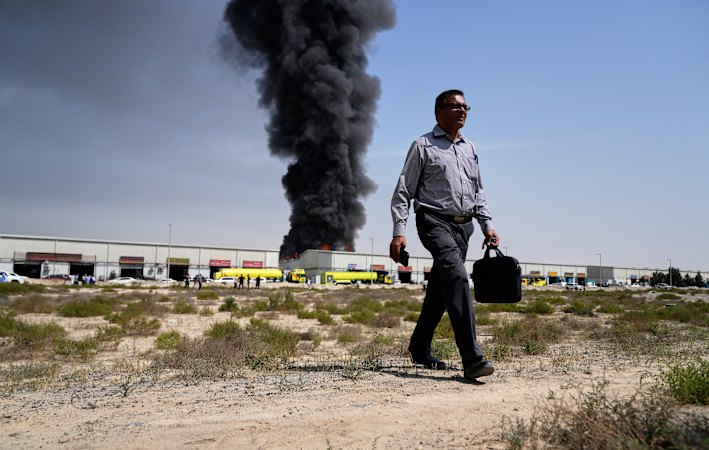
But last weekend that mirage began to disintegrate as Iranian missiles and drones targeted the United Arab Emirates. The UAE’s air defence systems lit up the skies. Fires broke out at Dubai and Abu Dhabi airports from falling debris.
On the Palm Jumeirah – the artificial island better known for luxury resorts and influencer photo shoots – fragments of intercepted missiles struck the Fairmont The Palm hotel in Dubai.
For a city whose prosperity depends heavily on its reputation for stability, the images challenged the perception of a city insulated from the geopolitical tensions that surround the region.
Residents, including the city’s booming influencer community, filmed interceptions from apartment balconies and hotel terraces as streaks of light cut across the skyline.
The backlash was swift.
The UAE’s information environment is tightly controlled. Social media influencers have been warned that they could face hefty fines for posting material about the conflict that authorities deem harmful to public order or national unity.
Critics accused some influencers of turning a geopolitical crisis into content, while others inside the UAE accused them of exaggerating the danger and spreading unnecessary fear.
Some residents who spoke to this masthead were cautious about speaking publicly about the conflict, yet even privately the overwhelming view from those that live and work in the UAE was one of confidence in the government’s response.
According to the Ministry of Defence, since the onset of the Iranian attack, the UAE has successfully engaged and destroyed 137 ballistic missiles and 209 drones launched towards the country’s territory.
As recently as Thursday night, residents reported heavy blasts with windows and doors shaking as the intercepts continued.
This week, online expat forums tell a more mundane story. Posts about the missile warnings exist, but are difficult to find among the stream of usual requests for information about apartments, nannies, school, visas and public transport.
Many residents say the international coverage – and videos circulating online – give the impression daily life has ground to a halt. Residents in Dubai and Abu Dhabi acknowledge that while there has been a few hairy moments, the atmosphere on the ground is calm.
For some expatriates, the frustration runs deeper. Several residents said that Dubai’s image abroad has increasingly been shaped by influencers who portray the city as little more than a tax-free playground for the wealthy.
For many Australians who have set up their lives in the UAE, financial opportunities are only part of the region’s appeal. Expat life, they say, is far more ordinary – built around jobs, schools, families and community. That sentiment has partly fuelled the counter narrative now emerging online, with expats challenging what they see as a caricature of life in the Gulf state.
In response to the barrage, the UAE has requested workplaces shift to remote arrangements, and school holidays have been brought forward. As the sun sets, the intercepts continue night after night. But overwhelmingly residents say they trust the UAE authorities to keep them safe.
Australian woman Ellecia Saffron, a former chair of the Australian Business Group in Abu Dhabi, said she had been enormously impressed by the “measured response”.
“They have just dealt with it, protected everyone and carried on,” Saffron said. “They have had the ultimate test here and it is safe, they have stood by what they have said.”
Saffron had just returned from Surf Ski Paddling last weekend when news began to spread about a missile attack.
“Initially, there was shock and confusion, and the next 24 hours were surreal, but most people started to see and trust that the UAE had this under control,” she said.
She said her view is shared by most Western expats in the region.
“The majority are standing in solidarity, this is their home.”
Some feel differently. On Friday morning, Annabelle Williams was among those on the first Emirates flight to Melbourne since the start of the war. The 26-year-old had recently moved to the UAE for work, but when her new home came under fire, she knew she wanted to return to Australia.
“It was completely terrifying, to be honest. I’ve never experienced anything like it,” she said.
“On Saturday, around midday, my mum actually called me, and she said, ‘Are you OK?’. I was out with a friend. I’m like, ‘I’m fine. I don’t know what you’re talking about’.
“And she said, ‘Oh, there’s missiles flying overhead’. And then, yeah, it all kind of kicked off from there. I could see them from my apartment.”
Like many expats in the UAE, Saffron had only planned to stay in the region for a few years when she first left Australia in 2007. Almost two decades later, she said she has fallen in love with the country and its people and the recent conflict has only made her feel safer.
”It’s not all about the glitz and glamour and the money. I love the ocean and it’s on the ocean, [it’s] an international melting pot, [with] amazing leadership …” Saffron said. “There is something really nice about being in a place that is moving forward positively all the time. Being around that is a good feeling.“
The UAE’s rapid rise over the past 50 years has largely been driven by its international workforce, many chasing lucrative tax-free jobs that often come with high salaries, housing allowances, medical insurance and flights.
Thousands of Australian pilots, engineers and cabin crew have built careers with Gulf carriers such as Emirates and Etihad. Australian companies have followed that workforce into the region with more than 300 Australian businesses now operating in the UAE.
Australian engineering, architecture and environmental consultant GHD has a presence in the UAE, as does Macquarie. Retail brands have also expanded into the UAE market with Cotton On, Chemist Warehouse and Jeanswest opening stores in Dubai and Abu Dhabi.
The University of Wollongong in Dubai, one of the city’s earliest international campuses, has operated there since 1993, while Murdoch and Curtin Universities also have campuses in the Gulf state.
In October, Australia and the UAE reached a trade agreement. Negotiated in just nine months, it was Australia’s first free trade agreement with any country in the Middle East and North Africa.
Brett Evans, a financial adviser with Atlas Wealth Management, which works with Australians living and working overseas, said a week into the conflict there had been no meaningful change in inquiries from Australians considering a move to the region.
“In our experience the UAE is generally viewed quite distinctly from other parts of the Middle East. For many expatriates, it is seen as a very stable and well-governed environment that has consistently prioritised safety, economic development and international cooperation,” he said.
“From the conversations we have had with clients over the past week, the sentiment has largely been one of calm and confidence in the authorities.”
Evans said while the tax advantages were often part of lure for expats, it was rarely the sole motivation.
“What we typically see is that people are drawn to the UAE because it offers a rare combination of career opportunity, international mobility and lifestyle,” he said. “The UAE has invested heavily in transport, healthcare, education, and public safety. For many expats, especially those with families, the fact that the country is stable, organised and forward-looking is a major drawcard.”
Despite the dramatic images circulating online, Evans said expatriates already living in the UAE appear to be taking a measured view.
“Day-to-day life across Dubai and Abu Dhabi has continued relatively as normal with some minor amendments like work from home and online schooling purely out of an abundance of caution.”
“The economic opportunities, career pathways and lifestyle advantages remain very strong, and for many people those factors continue to outweigh broader geopolitical concerns.”
To scholars who study the Gulf, moments like this sit within a much longer history of regional tensions – a background reality that has existed alongside the region’s reputation for safety and stability.
For many Western professionals contemplating a move to the Gulf, the attraction ultimately rests on economics. “I think finances almost always have something to do with it,” said Professor Andrew Gardner, an expert in migration and labour in Gulf economies at the University of Puget Sound.
At the same time, most expatriates are not naive about the region they are moving to.
“Dubai kind of has this image … as a safe place,” Gardner said. “I would say at least for daily life it is extraordinarily safe, but you would have to be a new arrival not to catch some of the geopolitical aspects that have shaped life in the Gulf over the years.”
The latest escalation may feel alarming without being entirely unprecedented.
“This moment feels fearsome and particularly worrisome,” Gardner said, “but it also sits within a longer history of regional tensions that expatriates have navigated before.”
Those tensions have included militant attacks targeting Western interests in Kuwait and Bahrain in the early 2000s, the diplomatic rupture between Qatar and several neighbouring Gulf states in 2017 that disrupted trade routes and supply chains, and the sweeping travel restrictions imposed during the COVID-19 pandemic.
“I can imagine that this kind of event will have some kind of legacy in the minds of people who might be thinking about working there,” Gardner said. “But people also move on from these things fairly quickly.”
From our partners
Read the full article here


