



Calgary city council will decide whether hundreds more properties across the city should be exempt from the repeal of citywide rezoning.
The exemptions stem from the original motion, co-signed by six city councillors and Calgary’s mayor to kick-start the process of repealing citywide rezoning.
According to city administration, an additional 247 properties could be exempt from the policy’s repeal and retain their higher density zoning, which allows for more housing types on a single property including rowhomes and duplexes.
The properties could be exempt because they have an approved development permit, or a development permit application has been submitted or under review ahead of the repeal of citywide rezoning, city administration said.
Although city council voted to repeal citywide rezoning after a lengthy public hearing in April, it won’t take effect until Aug. 4.
The move re-designated more than 306,000 residential properties across the city back to their original low-density residential districts, but properties that met the criteria for development applications submitted or approved between August 2024 and Dec. 31, 2025 were already exempt from the repeal.
According to city administration, the 247 properties included in the exemption discussion met the exemption criteria between Jan. 1, and April 8, 2026.


Get daily National news
Get daily Canada news delivered to your inbox so you’ll never miss the day’s top stories.
“Obviously, I don’t love that we’re in this situation,” said Calgary Mayor Jeromy Farkas. “But from my perspective, I want to make sure that we’re in compliance with our legal and our legislative obligations.”
More than 100 people signed up to speak at a public hearing Tuesday to have their say on the matter, with many voicing concerns over properties in their neighbourhoods retaining higher density zoning.
Janice Grant told Global News she didn’t think she’d be back at city hall to discuss citywide rezoning after the repeal earlier this year.
“We felt really relieved when all of that was (repealed), and thinking this was behind us,” she said. “Here we are again, just really trying to make it go away.”
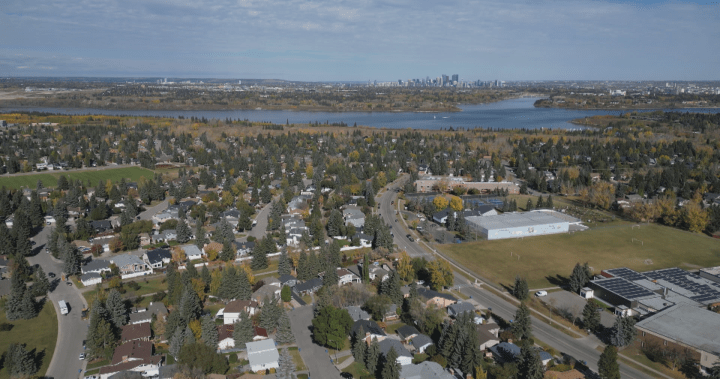
Grant is among several residents who are concerned about a proposed property exemption in Lake Bonavista that residents claim is strictly to keep the lot upzoned.
“There’s no plans in place so what he’s doing is preserving future development rights at the expense of the neighbours,” said Maureen Haight.
However, city administration told councillors that development permit applications continued to pour in, even when council scrapped the policy.
“The files did not stop coming, so even on the day the repeal went, we received… 76 development permit files for any number of different things in our city,” said City of Calgary director of community planning, Teresa Goldstein.
“That is a right of the landowner to make a development permit and the land-use bylaw also says that we, as administration, where it’s deemed to be complete, we must review it.”
City officials claim a change in zoning midway through a project may impact the legality of a development that is in progress, and could place the city in a risky position.
“The blanket rezoning repeal has continued, the challenge always was the projects that were in mid-flight,” Farkas said. “Us as a council, we need to weigh the community concerns but also the legal risks to the City of Calgary.”
Citywide rezoning was approved in May 2024 by the previous city council after the longest public hearing in city history, in which the majority of speakers voiced opposition to the plan.
The move meant Calgary’s land-use bylaw was amended to make residential grade-oriented infill (R-CG) the default residential zoning district across the city.
R-CG allows a variety of housing types including single-detached, semi-detached, duplexes and rowhouses.
Read the full article here


