



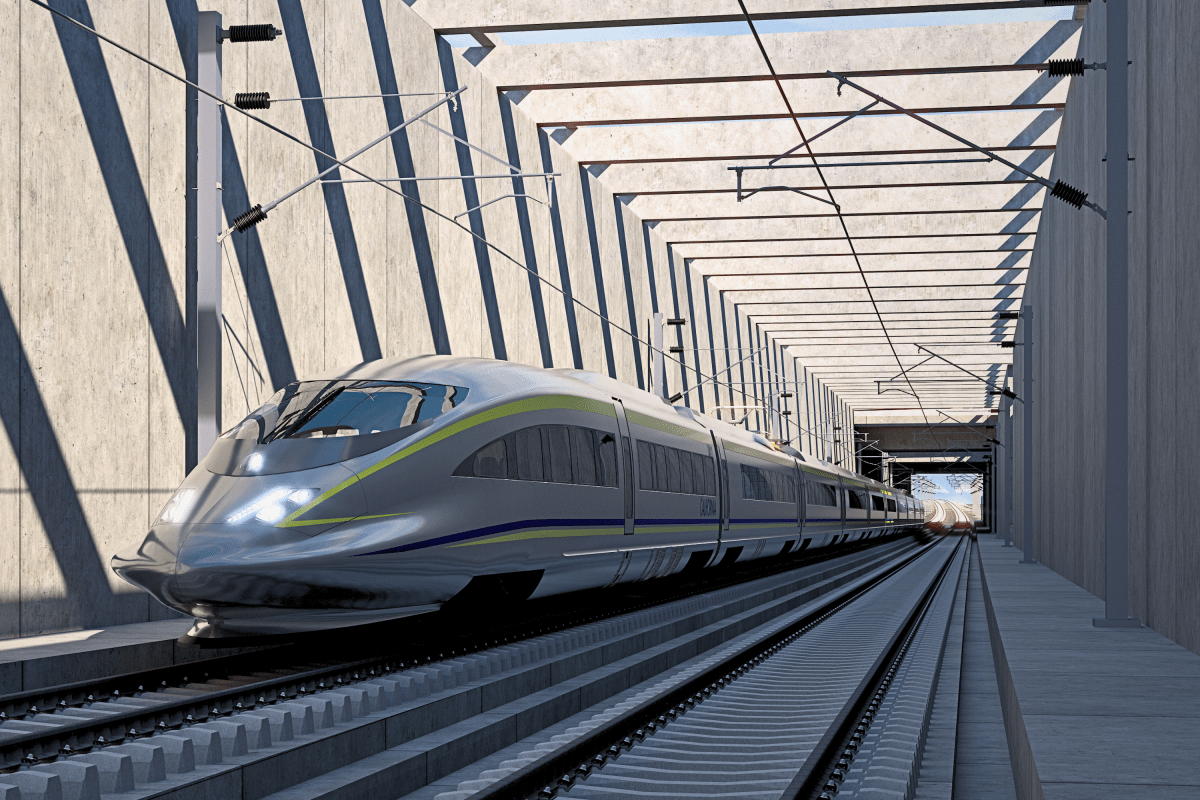
Nine California mayors have warned that they could sue the state’s High-Speed Rail Authority over plans to capture local tax growth and zoning control within a half-mile radius of future station sites.
- In cities like Fresno, the proposals would encompass large parts of the downtown core, highlighting the policy’s local impact.
- “It represents an unprecedented intrusion into local governance,” Central Valley mayors warned, calling the proposal a “legally dubious scheme” that could trigger lawsuits.
- Cities argue that diverting tax growth would hit funding for public safety, transport, and other essential services relied on by local communities.
- The High-Speed Rail Authority says it would take only a share of new tax revenue to fund infrastructure, insisting “the rest stays with the local jurisdiction.”
Escalating legal threats could complicate efforts to fund and deliver a long-delayed rail project already facing financial pressure.
Cities hosting stations risk losing a share of rising property and sales tax revenues that help fund essential local services.
Newsweek contacted the California High Speed Rail Authority outside of regular working hours via email for comment.
Why It Matters
California’s high-speed rail project has struggled for years with funding gaps, cost pressures, and political scrutiny, prompting officials to explore new ways to raise money.
Efforts to tap into local tax growth signal a potentially significant shift in how the state funds major infrastructure—and how much control it exerts over local government finances.
Mayors Signal Legal Fight Over Tax Plan
Tensions between California’s high-speed rail officials and local leaders have sharpened into the clearest sign yet of a looming legal fight.
Nine mayors from across the state, including Fresno’s Jerry Dyer and leaders in several Central Valley cities, say they are prepared to take the California High-Speed Rail Authority to court if it proceeds with its latest funding proposal.
At the center of the dispute is a plan to capture a share of local tax revenues and influence zoning decisions in areas surrounding future stations.
City leaders outlined their concerns in a letter sent April 23 to rail authority CEO Ian Choudri, arguing the proposal is likely unconstitutional and describing it as an attempt to divert local tax growth, which they argued could threaten to “erode the fiscal stability of California’s cities.”
They warned that the proposal is a “direct attempt to divert locally controlled tax revenues” that could “undermine voter-approved constitutional protections” of cities hosting rail stations.
Local governments rely heavily on sales and property tax revenues to fund essential services.
Any redirection of those funds, the mayors argue, would directly affect their ability to maintain services in communities already preparing for the disruption and opportunity that rail construction may bring.

Rail Authority Defends Funding Strategy
The rail authority has stressed it is not proposing new taxes.
Instead, it wants access to a portion of future increases in property values and sales tax revenues—known as tax increments—generated within roughly half a mile of station sites.
Those funds, officials say, would be reinvested into infrastructure improvements and station-area development.
That approach, known as tax-increment financing, is widely used in infrastructure projects.
It rests on the idea that major developments can drive up surrounding property values and economic activity, generating new revenue to help pay for the project itself.
For the High-Speed Rail Authority, the proposal is part of a broader effort to find alternative funding streams.
Choudri, who has led the agency since 2024, has floated several ideas over the past year as officials try to advance a project that has lost federal funding and has never been fully financed.
Current plans focus on completing a 171-mile segment between Merced and Bakersfield, which the authority estimates will cost $34.76 billion.
Yet even that initial stretch sits within a wider project that has grown more controversial over time, particularly as costs have climbed since voters first approved the system 17 years ago.
Opposition to the tax proposal has been notable not just for its intensity but for where it is coming from.
Dyer, for example, has long supported high-speed rail as a potential economic boost for downtown Fresno.
Even so, he joined mayors from cities including Merced, Bakersfield, Hanford and Stockton in signing the letter opposing the plan.
“The responsibility for funding a state megaproject lies with the state, not with local taxpayers whose revenues are constitutionally protected for local purposes,” the group wrote.
Their argument rests in part on Proposition 1A, a 2004 amendment to California’s constitution that limits the state’s ability to redirect local government revenues.
Analysis from the state’s Legislative Analyst’s Office has found the amendment restricts changes to the allocation of local sales taxes and places strict requirements on altering how property tax revenues are shared.
As a result, the mayors warn that any mandatory diversion of those funds to a state agency could trigger extensive litigation.
They also caution that the proposal could leave communities financially worse off, even as they are asked to accommodate a major infrastructure project.
“Simply put,” the letter states, “the state cannot solve a state funding problem by raiding local tax bases.”
Concerns about the legality of the plan are not confined to city halls.
State Senator Tony Strickland, a Republican from Huntington Beach, told rail officials during a late-April oversight hearing that he believes the proposal is unconstitutional, suggesting legislative changes would be required to move it forward.
Rail authority officials, however, have emphasized that the idea remains in its early stages.
Choudri and Chief of Staff Mark Tollefson told lawmakers they intend to work with cities to develop financing districts through agreements rather than impose a blanket policy.
“We want to continue working with communities around how we actually execute on that,” Tollefson said.
Choudri has argued that the approach reflects standard practice for infrastructure projects globally and is justified by the scale of the state’s investment in station areas.
He has also sought to reassure local leaders that the authority is not looking to capture all new tax revenues, but rather a portion that can be reinvested into further development.
“What we are proposing is to have some of it shared back so that we can build more,” he said.
Read the full article here


