



A prominent U.K.-based Chagossian leader who has pledged to rename one of the islands after U.S. President Donald Trump, said the Republican should “veto” the British government’s decision to cede sovereignty over the remote Indian Ocean archipelago that hosts a joint British-American military base.
Trump had bashed a long-negotiated deal for the United Kingdom to hand the Chagos Islands over to Mauritius in a late-night social media post into Tuesday, deeming the agreement “an act of great stupidity” for “no reason whatsoever.”
The stance was a dramatic pivot from the administration’s previous support for the agreement, which is still yet to clear all its final hurdles and be made official. A spokesperson for the U.K. government said on Tuesday that London would “never compromise on our national security.”
Trump “needs to veto it as soon as possible,” Misley Mandarin, who heads the Chagos Islands’ government in exile, told Newsweek. Mandarin was picked by Chagossians who settled in the U.K. as a “first minister” in late 2025 to campaign for the islands to stay British.
Mandarin said he was “100 percent” certain that Trump would block the deal, and floated renaming one of the archipelago’s islands after the Republican as “a gesture of thank you, a gesture of honor” that could also boost American tourism.
Mandarin said he had written to Trump personally last week and considered Trump’s social media post a response to his letter. The Oval Office has not directly replied to the missive, he said.
Newsweek reached out to the White House for comment.
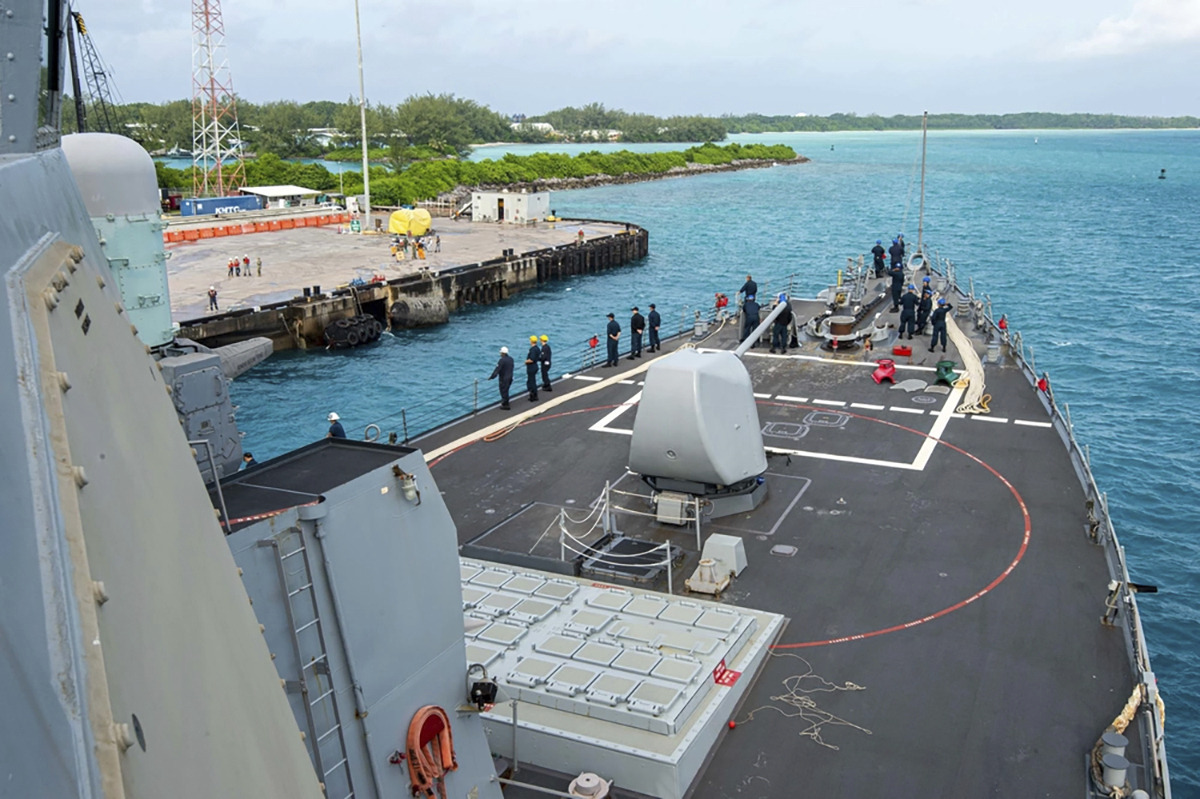
The Chagos Islands host the joint U.S.-U.K. Diego Garcia naval and air base. It is one of the U.S. military’s main ways of projecting power into the Indo-Pacific, a region toward which the Trump administration has publicly turned its attention at the expense of its long-standing relationship with Europe.
There are no permanent Chagossian residents in the archipelago, barring the military and associated personnel stationed at Diego Garcia. The British government forcibly evicted all Chagossians in the 1960s and 1970s to make space for the base, and some Chagossians have opposed the agreement, saying they were not consulted.
The U.K.’s Labour government said in fall 2024 that its roughly $4.5 billion deal would return sovereignty of the islands to Mauritius, but that London would lease back Diego Garcia for at least 99 years.
The agreement “secures the operations of the joint U.S.-U.K. base on Diego Garcia for generations, with robust provisions for keeping its unique capabilities intact and our adversaries out,” the U.K. government spokesperson said on Tuesday. The base was “under threat” from legal challenges, they said.
Trump suggested to reporters during a meeting with British Prime Minister Keir Starmer last February that he supported the British plan, remarking: “I have a feeling it’s going to work out very well.”
The deal went through in May 2025, when U.S. Secretary of State Marco Rubio said Washington “welcomed the historic agreement.”
“Following a comprehensive interagency review, the Trump Administration determined that this agreement secures the long-term, stable, and effective operation of the joint U.S.-UK military facility at Diego Garcia,” Rubio said in a statement at the time. “President Trump expressed his support for this monumental achievement during his meeting with Prime Minister Starmer at the White House.”
Kemi Badenoch, the leader of the opposition Conservatives in the U.K., said on Tuesday the deal was “not just an act of stupidity, but of complete self sabotage.”
“On this issue President Trump is right,” Badenoch said. The political leader said she had met Republican House Speaker Mike Johnson on Monday and the two were “united in that view.” Johnson, in separate remarks on Tuesday, urged calm in trans-Atlantic relations, including the deepening rift between the U.S. and a host of its closest allies over Greenland.
“There is no doubt that China and Russia have noticed this act of total weakness,” Trump said in his Truth Social statement, before explicitly linking the British decision to the Republican’s rationale with Greenland.
Trump’s post “made us very, very happy,” said Mandarin. “I’m very, very happy that President Trump is taking that stance right now.”
“When our prime minister, Keir Starmer, is saying the decision of Greenland is up to the Danish Kingdom and the Greenlanders, but what about British territory? What about British overseas territory? What about British Chagossians?”
European leaders have for weeks attempted to balance criticizing aggressive U.S. overtures toward Greenland with keeping NATO’s biggest player onside. Danish, Greenlandic and European officials—as well as the U.K. government—have insisted Greenland’s future is for Nuuk and Copenhagen to decide, not the U.S. Denmark retains control over Greenland’s defense and foreign policy as a semiautonomous territory.
Trump officials say the U.S. needs Greenland for its own national security, to protect NATO more broadly, and to make sure Russia and China don’t get the chance to use the mostly ice-covered expanse to beef up their Arctic footprints. Also built into the rationale, experts say, are the benefits of Greenland’s natural resources and cementing the U.S.’s dominance in the Western Hemisphere.
European NATO members have said Beijing and Moscow do not pose an immediate threat and there is no need for the U.S. to take the island by force.
Greenlandic leader Jens-Frederik Nielsen said in an unambiguously worded statement last week: “Greenland is not for sale. Greenland does not want to be owned by the United States.”
Trump said a 10 percent tariff would come into force at the start of next month against eight of America’s closest allies, which would then rise to 25 percent by the beginning of June if no deal to sell Greenland is reached.
The U.K., as well as Denmark, Finland, France, Germany, the Netherlands, Norway and Sweden condemned the announcement as risking a “dangerous downward spiral.” Ursula von der Leyen, the president of the E.U.’s executive arm, the European Commission, said on Tuesday the bloc’s response would be “unflinching” if Trump’s tariffs enter force.
“Do not retaliate,” U.S. Treasury Secretary Scott Bessent said during an appearance at the World Economic Forum in Davos, Switzerland, on Tuesday. “The president will be here tomorrow, and he will get his message across.”
In a polarized era, the center is dismissed as bland. At Newsweek, ours is different: The Courageous Center—it’s not “both sides,” it’s sharp, challenging and alive with ideas. We follow facts, not factions. If that sounds like the kind of journalism you want to see thrive, we need you.
When you become a Newsweek Member, you support a mission to keep the center strong and vibrant. Members enjoy: Ad-free browsing, exclusive content and editor conversations. Help keep the center courageous. Join today.
Read the full article here


