



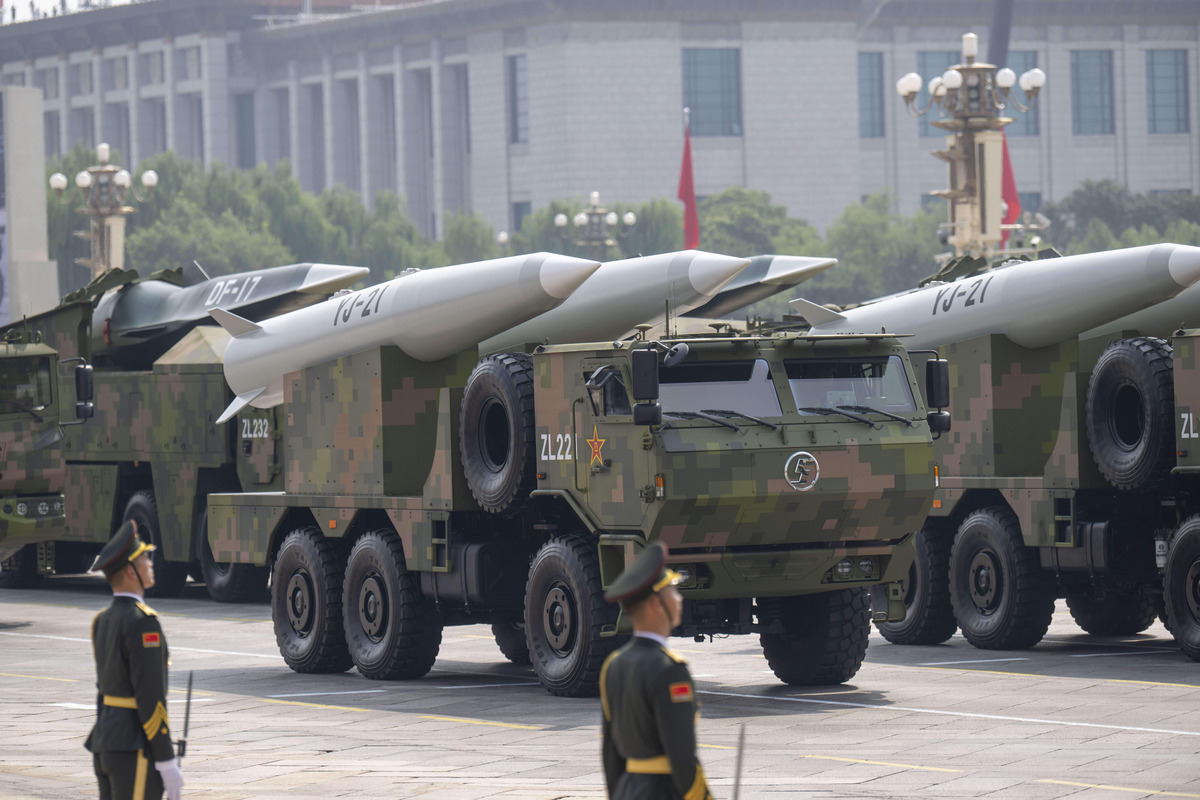
China’s production of advanced missiles shot up in 2025 by the largest amount since Chinese leader Xi Jinping rose to power in 2013, a sign of Beijing’s success in expanding its formidable military to rival the United States ahead of President Donald Trump’s highly anticipated summit with Xi this week.
Corporate filings show a total of 81 Chinese firms publicly said they were producing parts for missiles, with more of these companies reporting record revenues last year than at any other point during Xi’s premiership, Bloomberg reported on Tuesday.
China has beefed up and modernized its missile arsenal at a blistering speed, part of its broader plan to make its armed forces a dominant world power, complete with a cache of hundreds of nuclear weapons.
U.S. officials have said China poses a major challenge to an “increasingly vulnerable” U.S., which is now faced with depleting missile stockpiles after more than 10 weeks of war in the Middle East. U.S. defense companies were already wrestling with increasing pressure to backfill American and European shelves, emptied of in-demand equipment like air defense missiles that ended up in Ukraine.
The Trump administration says the U.S. needs a new system to counter next-generation attacks, drawing up plans for the so-called “Golden Dome” that would intercept fast-moving ballistic missiles and hypersonic weapons, which travel at more than 5 times the speed of sound.
Unlike China, the U.S. doesn’t have any operational hypersonic missiles.
In any future conflict, the number of missiles a country has would be crucial to overpowering the other side’s defenses and ultimately winning the war. Exact stockpiles are not public, but the U.S. assesses that China has more than 3,100 ballistic missiles, according to the Bloomberg report.
Separately, on Tuesday, in a blow to the administration, the Congressional Budget Office (CBO)—the nonpartisan agency that advises American lawmakers on funding—said the “Golden Dome” will cost roughly $1.2 trillion over the next 20 years.
This far exceeds the initial $175 billion allocated to the ambitious project, which Trump announced in an executive order in January 2025.
Although the designs aren’t finalized, the Golden Dome will be an elaborate web of sensors, trackers and interceptors designed to take out threats before they reach U.S. soil.
It is expected to cover the U.S. mainland, Alaska and Hawaii. Canada is in talks to come under the Golden Dome’s umbrella, although the U.S. has said previously that its northern neighbor would need to pay tens of billions to be included.
Currently, both the U.S. and Canada’s defenses against long-range intercontinental ballistic missiles are handled by the bi-national North American Aerospace Defense Command (NORAD).
The Golden Dome will include weapons and early-warning systems in space, which the CBO said would account for up to 70 percent of the missile defense shield’s acquisition costs.
Enormously expensive programs like Golden Dome, as well as the White House’s plans to build a new class of large vessels known as battleships, are likely behind a U.S. government request to increase the defense budget to $1.5 trillion dollars—a nearly 50 percent surge in proposed funding for the world’s top military spender.
The CBO analysis was requested by Oregon Senator Jeff Merkley, the top Democrat on the Senate Budget Committee, who has criticized the Golden Dome as a waste of billions of taxpayer dollars, susceptible to corruption and likely to ignite a new arms race.
Advocates for the Golden Dome say technology is now advanced enough to build a partially space-based system and that the U.S. needs better defenses against increasingly sophisticated Chinese, Russian and North Korean weapons.
Trump has framed the Golden Dome as the result of an ultimately ill-fated program kicked off by President Ronald Reagan in the 1980s, popularly known as “Star Wars.”
China, the world’s second-biggest defense spender, hiked its own military expenditure by more than 7 percent in 2025, according to researchers with the Stockholm International Peace Research Institute (SIPRI). While China dedicated $336 billion last year to the military, amounting to little over a third of the U.S.’s total defense spending in U.S. dollars, it’s the 31st consecutive year of increased Chinese military spending, the SIPRI figures show.
The U.S., however, spent 7.5 percent less on its military in 2025 compared with the previous year.
Trump arrived in Beijing on Wednesday ahead of a two-day summit with Xi to discuss trade, investment and the U.S.’s longstanding military support for Taiwan, which Beijing opposes.
China sees Taiwan, which has for decades elected its own democratic government, as a breakaway part of the mainland to be eventually reabsorbed. Taipei, meanwhile, sees the U.S. as its main security partner and relies on the threat of U.S. involvement to deter a Chinese invasion of the island.
While the U.S. only has formal diplomatic ties with Beijing, Washington sells billions of dollars’ worth of weapons to Taiwan each year, and has long assured Taipei it will not taper off arms deals nor discuss these sales with Beijing. These promises later popped up in legislation passed by Congress.
Before Trump touched down in the Chinese capital to fanfare, a red carpet and a brass band, senior U.S. officials and experts said the U.S. was unlikely to change its positions on arms sales to Taiwan.
But Trump’s confirmation that he would discuss the matter with Xi raised concerns in Taipei, among Taiwan’s regional allies, and among several U.S. lawmakers that the U.S. president could compromise on arms deals to secure better trade terms with Beijing.
Read the full article here


