



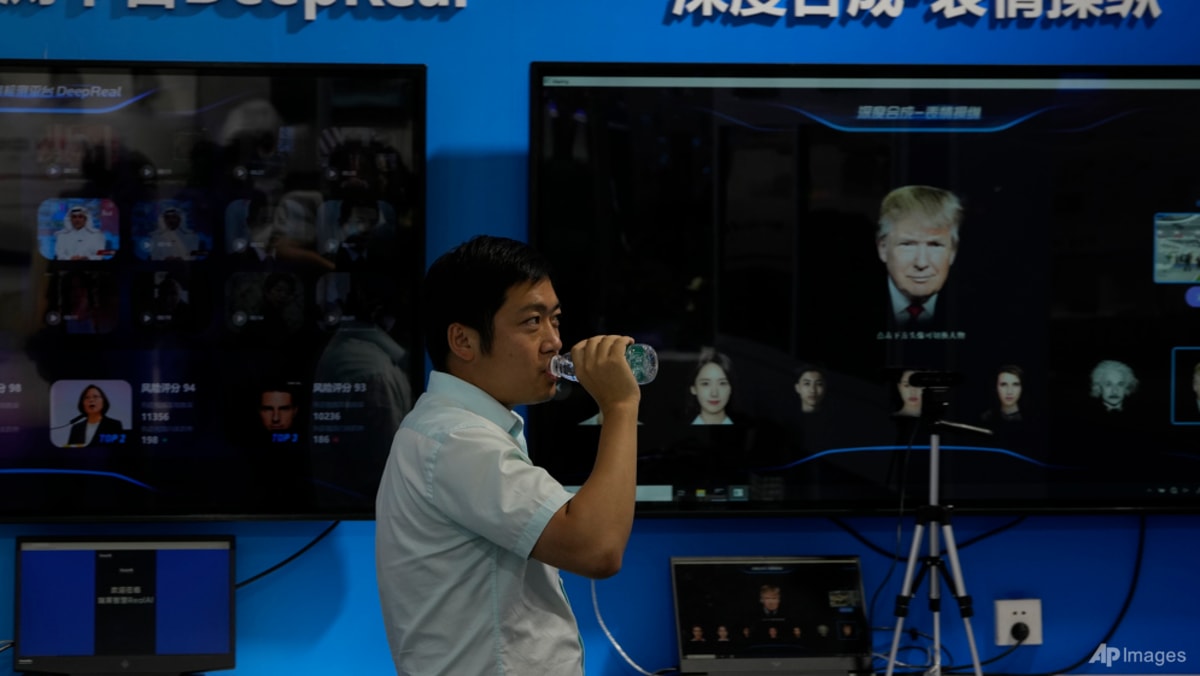
BEIJING: China’s top court issued guidelines on Monday (Sep 7) covering a range of emerging pitfalls associated with artificial intelligence, including unauthorised deepfakes and voice cloning, state media reported.
The move provides judicial guidance for AI-related disputes in China, which is currently engaged in an intense competition with the United States for dominance in the key technology.
The guidelines released by the Supreme People’s Court “make clear that people cannot use AI to create or distribute recognisable digital replicas of others without their consent, including cloned faces and voices”, state news agency Xinhua reported.
Other disputes targeted include “algorithmic price discrimination and AI-generated false information”, Xinhua said.
Recent years have seen widespread adoption of AI technologies that allow individual users to easily create content that convincingly replicates the appearance and voices of real humans.
Chinese authorities have invested heavily in domestic AI, seeking to build up the country’s prowess in the increasingly crucial sector.
But President Xi Jinping has also warned of potential dangers, urging attendees at a conference in July to “strengthen risk-awareness and ensure that AI is secure and controllable”.
Under the new rules, service providers can be found legally liable if they fail to “take timely action” once notified that their systems have generated content infringing on others’ rights, Xinhua reported.
The guidelines offer legal recourse for “someone whose face has been digitally altered and used to spread false and defamatory sexual claims”, it added.
The court’s Vice President Tao Kaiyuan said that the guidelines seek to “balance development and security”, according to a transcript of a press conference on Monday published on the court’s website.
They seek to clarify rules for procedural matters in AI-related disputes, said Tao.
“For issues where consensus is currently difficult to reach, (the guidelines) leave room for clarification, allowing for further experience accumulation and appropriate clarification when conditions are ripe,” she added.
Read the full article here


