



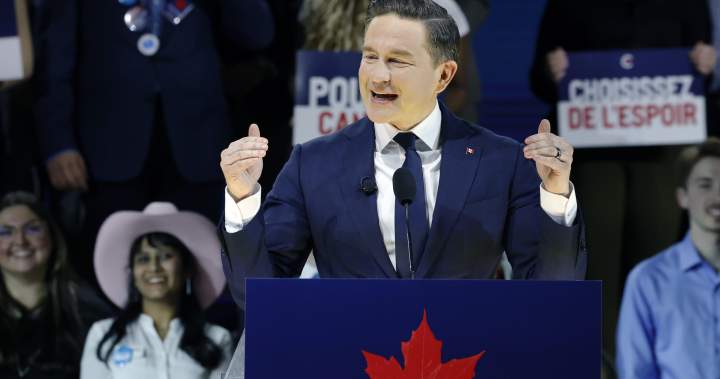
Members of the Conservative Party of Canada have overwhelmingly voted to keep Pierre Poilievre on as their leader, the party revealed Friday after a late-night vote at its annual convention in Calgary.
More than 87 per cent of voting members cast their ballot for Poilievre to stay on as leader, the Conservative Party said in a statement.
He’s now the first Conservative leader since Stephen Harper to be given a second chance by the party faithful as they seek to regroup from a disappointing loss in April’s federal election. He beat the strong result Harper earned in 2005 by three points.
The vote result came after Poilievre delivered a speech to Conservative members Friday evening where he struck a hopeful message and laid out his vision for a future Conservative government.
“When you start something, you never give up,” he said to a cheering crowd. “I’ll never give up.”
Poilievre faced a critical leadership review under the party’s bylaws after leading the Conservatives to a fourth-straight election loss against the Liberals.
The party opted instead to forego a vote on whether to hold a review and simply asked delegates whether they support Poilievre remaining as leader.
The result is a boost of confidence for the Conservative leader who, a year ago, appeared almost certain to become the next prime minister as polls showed collapsing support for then-prime minister Justin Trudeau.
That certainty faded after Trudeau announced his resignation last January, and Liberals chose Mark Carney as their next leader. Carney brought the Liberals back from a double-digit polling deficit to the Conservatives and managed to prevail in the election by focusing on the tariff threat from U.S. President Donald Trump.
Poilievre also lost the Ottawa riding he had held for two decades to a Liberal challenger, forcing him to run in a byelection in his home province of Alberta – a process that kept him out of the House of Commons for the first months of Carney’s new government.
Since returning to Parliament, he has lost two caucus members who cross the floor to join the Liberals late last year, bringing Carney even closer to a majority government. Liberals suggested more Conservative MPs were considering quitting due to Poilievre’s combative style and concerns he couldn’t grow the party and win the next election.
Speaking to Conservative members at the convention Friday, Poilievre sought to paint a more positive picture of the country’s future if he becomes prime minister while making clear he wouldn’t back down or change course.


Get breaking National news
For news impacting Canada and around the world, sign up for breaking news alerts delivered directly to you when they happen.
“One of the most important lessons I have gained from listening to you throughout this convention is that you told us to ignore the voices who keep telling us to abandon our Conservative principles,” he said.
“We will remain true to our principles.
Poilievre said “hope” was the theme of this weekend’s convention, where the party will now move from considering its leadership to preparing for the next election.
“Hope is the knowledge that your work will fulfil your purpose,” he said, before becoming emotional while speaking about being away from his young family and hoping to see his autistic daughter, Valentina, speak for the first time.
He also appealed to Canadians “who have felt unseen for too long” by Ottawa, who he said Conservatives will listen to and fight for.
“When I become prime minister, these great Canadians will not need to ask my permission to succeed,” he said.
Those hopeful messages came after a lengthy takedown of Carney, who he said has not addressed the concerns of Canadians after nearly a year in power and 10 years of Liberal government.
He and Conservative MPs who spoke ahead of him argued Carney’s best ideas were taken directly from his platform.
“We won the debate in the last election on every single one of the big issues,” he said, listing the consumer carbon tax and ideas to solve housing, infrastructure and crime.
“The best part of being Conservatives is that eventually everyone admits that we were right all along.”
Indeed, much of the promises Poilievre outlined Friday struck many of the same priorities as Carney — more energy infrastructure, accelerated homebuilding, lowering costs — but on a faster timetable with less regulation.
While Poilievre focused much of his speech on domestic priorities, he also underscored the need for “autonomy and independence” in the face of sovereignty threats on Canada and other NATO allies by U.S. President Donald Trump, although he did not mention Trump by name.
“In this dangerous and uncertain world, Canadians must stand united so we can stand on our own two feet. United and strong Canadians will bow before no nation anywhere on earth,” he said.
“We must be a nation that protects our seas, skies, and soil, without depending on the U.S. or anyone else to do it for us. … We will take back control of our North and ensure no foreign powers ever threaten our territory.”
Poilievre dipped into cultural issues while discussing his plans for expanding Canada’s military, promising members will be hired “based on merit and not political correctness.”
And he previewed fights to come with the Liberal government on the federal firearm buyback program and the industrial carbon tax, as well as continuing to push for an oil pipeline from Alberta to the Pacific.
Addressing the brewing separatist and independence movements in Quebec and Alberta, Poilievre blamed Liberals for “stomping on” Alberta’s energy sector and Quebec’s sovereignty while sowing discontent in Canadian identity among young people.
“We can simply attack people who feel this way, or we can ask them why,” he said.
“Our message to those youth and to all of the people in Alberta and Quebec who are losing hope in our country: You will again have a country that respects your autonomy, is proud of your industries, unites us around our common identity and history, a country that will afford you the hopeful future that you have earned.”
He said uniting around “our common history” rather than various groups and “labels” will “heal the divisions” fueling those independence movements.
Poilievre’s tone on immigration appeared to echo sentiments expressed by members of the Trump administration amid a controversial crackdown on immigrants accused of being in the U.S. illegally and committing violent crimes.
“We will deport criminals, end fraud, end abuse and handouts to phony refugees. We will no longer allow foreign conflicts to spill onto our streets,” he said, while promising to welcome skilled immigrants who can help a struggling health-care system.
The speech came at a critical moment for Poilievre as he seeks to unite Conservatives and chip away at Carney’s support, which polls suggest remains high.
Surveys from Leger and Abacus Data this week suggest the Liberals have increased their share of support — in particular since Carney’s trade mission to China and his well-received speech at the World Economic Forum in Davos, Switzerland.
Carney, Poilievre said Friday, was acting like a “big shot” in his multiple trips abroad but struggling at home.
Recent Ipsos polling has shown Canadians continue to worry about the cost of living and the likelihood of owning a home, themes that dominated Poilievre’s speech.
Ipsos has also found Carney’s popularity outpaces Poilievre’s by double digits, despite their parties being effectively tied in support.
Read the full article here


