



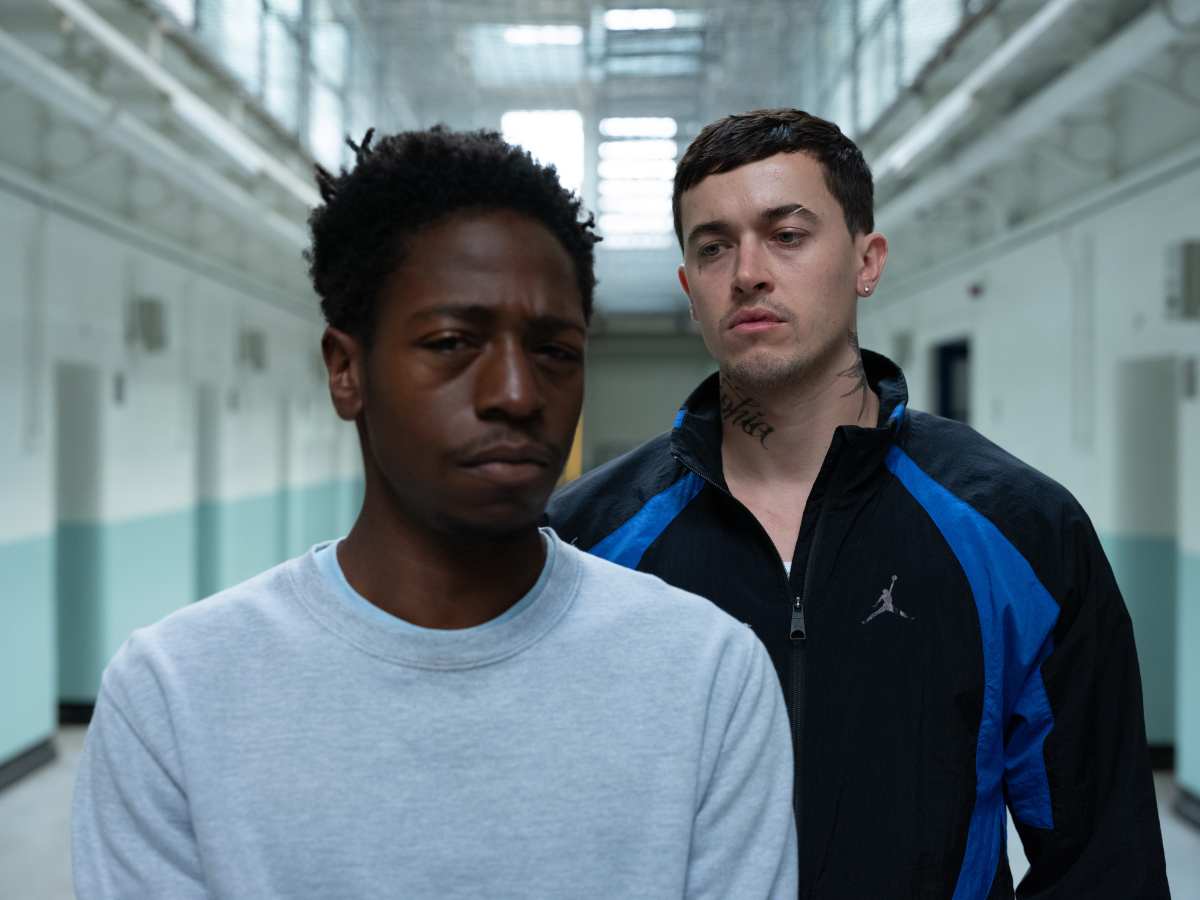
David Jonsson and Tom Blyth lead the directorial debut of Cal McMau, “Wasteman,” which tells the story of Taylor (Jonsson), a soon-to-be parolee whose hopes of getting out are quickly put at risk when his new cellmate, Dee (Blyth), arrives.
Following an incident between Dee and another man in the prison, the stakes rise exponentially for Taylor, and the film swiftly turns into a pressure cooker of emotion, both heartfelt and raw, in this thoughtful reflection on the justice system.
“Wasteman” earned a BAFTA nomination at this year’s ceremony for Outstanding Debut by a British Writer, Director, or Producer, and it’s easy to see why, as the film was a triumph for McMau, whose 90-minute drama is one of the most intense watches of the year so far.
Newsweek sat down with Jonsson and Blyth to discuss the responsibility that comes with telling a story like this, the advisors they collaborated with to make it authentic, and what they took away from their time on set.
Interview With David Jonsson and Tom Blyth for ‘Wasteman’
You’ve said in previously that you felt like you were playing people that you’ve grown up with, or people that you know really well. I wanted to hear from you both, what kind of responsibility – if any – did you feel when telling Dee and Taylor’s stories?
David Jonsson: I think responsibility is even maybe the wrong word. We’re making movies, and hopefully we entertain people in doing so. There’s a reverence that you want to show. Or even just honouring the system that we contribute to. We got a charity called Switchback who really helped us find what it was. In doing that, they shared their stories of these former prisoners who are now finding their way back to real life. It just really helped us ground it. So, I think it was more about trying to honour what this real subject matter is.
Tom Blyth: Having Switchback on board was next level in terms of giving the project meaning. I think David and I both came in with our own meaning as to who we were doing this for, or what we were doing it for. Often with a job, or a character, you’ll find a way in that is personal and you’re dedicated to something or someone in some way or another. But, this one, I think no matter what David and I came in with, because Switchback was on board, and because we had recently incarcerated people in front of us, working with us, you had someone right there to dedicate it to. It just kept us true the whole time. I think anytime we had doubts, we’d look left and right and see guys who were so gracious and humble and giving us their time and energy when they didn’t have to. I think it kept us wanting to, like David said, make it true and make it honour their experience.
I hadn’t heard about Switchback before researching your film, and while watching the film it reminded me of a quote from a friend of a friend, whose name is Glenn E. Martin. He says “People closest to the problem are also the people closest to its solution, but further from the power and resources.” That’s what I loved about this film was you gave people the resources and tools to take ownership of the story. How important do you feel it is that artists like yourself make an effort to break down those barriers and advocate to include people whose lived experience you’re recounting on screen?
DJ: That is such a beautiful quote.
TB: I think it’s really important, but I think we also have to be careful because time and time again we see, especially actors – actors and musicians – speaking from their pedestal, and speaking from their pulpit of privilege in a way, and I sometimes I think everyone can feel a bit lectured to when someone in a position of, at least perceived, privilege is telling them how to go about things in terms of society and politics. But, on the flip side, we are in this unique position where our job is to tell stories. Like James Baldwin said, the job of the artist is to hold a mirror up to society. So, it’s a Catch 22. You’re damned if you do it, and you’re damned if you don’t. I do think it’s about how you do it. It’s about doing it in a way that is not glorifying or lecturing or speaking from some sort of pedestal, but actually just trying to understand people. I think our job is to interpret and to understand. With this, even though we’re telling a story that is thrilling and it’s action packed – and hopefully you’re on the end of edge of your seat the whole time – we’re also telling it in a really real place, which is a prison in a really real circumstance, which is people who have lost their freedom and are supposedly being reformed. So, I think, our job really is just to get down in the trenches with real people and understand them and hopefully then reflect them in a really honest way and then let the audience make up their mind how they feel about it. So, we’re not the ones telling them how to feel, but we’re reflecting honest, human experiences, then letting the people who watch it decide their take away. I think that’s the best thing we can possibly do. If you do that with humility and you do it with the aim of honestly reflecting these people, I think usually the audience takes away something really deep and rewarding from it.
That presence is deeply felt in the film. Not just in your performances, but everything from make-up to production design. How did that real life atmosphere differ from previous sets that you’d been on, and how do you feel it helped elevate your performance?
DJ: Maybe differed because we genuinely didn’t have the money to. It was cheap. We couldn’t afford it. It worked, because that was the truth of the scenario. I think, honestly, there’s something about this kind of filmmaking that was really special for myself, and I think for Tom, and everyone making this. It’s not lo fi, but it’s like… it’s true indie spirit. It’s true independent filmmaking. I think that part of it is what makes the best filmmakers. When I think about the other films that I’ve been lucky enough to do, those have a bit more of a bigger budget, and time and a bit more space. This was a bit ragtag, and that was exactly what it was meant to feel like. It lent itself perfectly to the spirit of this movie, which is a bit mental, but grounded nonetheless.
Sometimes those budget constraints can actually be beautiful in a way that’s unexpected. What did each of you learn through this experience? How did it change your perspective, and did it give you anything that you’ll take into future projects?
TB: Ooh, so much. I do think that constraint thing was a big takeaway for me. We had 18 days to shoot it. No time at all. We didn’t have the budget to overshoot, or to add on any extra days, or even hours at the end of a long day. So, if we didn’t get something, we lost it. Everyone was working really hard, and really quick to just make sure we got everything that was on the page. I think, at the beginning, David and I were both kind of like slightly sh****g ourselves, going like ‘Are we gonna get this? Are we actually gonna get this film? Is it gonna be good? Or is it gonna feel rushed?’ Actually, what we realised was, when you hire the right people around you, as Sophia our producer and Cal, our director did, you end up with this amazing crew and cast, who rallied together to make it work despite the constraints. And, actually, the constraints end up making it better. They end up making it more thrilling, more of a pressure cooker. I think, for me, the massive take away was just… boundaries and constraints when making art can be really good. It can really force you to think outside the box, especially when you’re shooting within this tiny literal box. Just watching the ingenious ideas that Lorenzo [Levrini] our DP was coming up with, and then us having to play with him on the fly just because we’ve only got 15 minutes to get a scene. I suppose what I’m saying is if you do something because it’s a labour of love, and you do it for the right reasons, no matter how small the budget or limited time, you can make something really special if you all rally around the vision.
DJ: I have to jump on the back of that one. It’s all for the love of filmmaking. When you work with people that you love, and you work with people that are pouring themselves into something that is bigger, you’re always gonna be fine. All for the love of.
When Is ‘Wasteman’ Out in the US?
“Wasteman” hits theaters on April 17, 2026.
Read the full article here


