



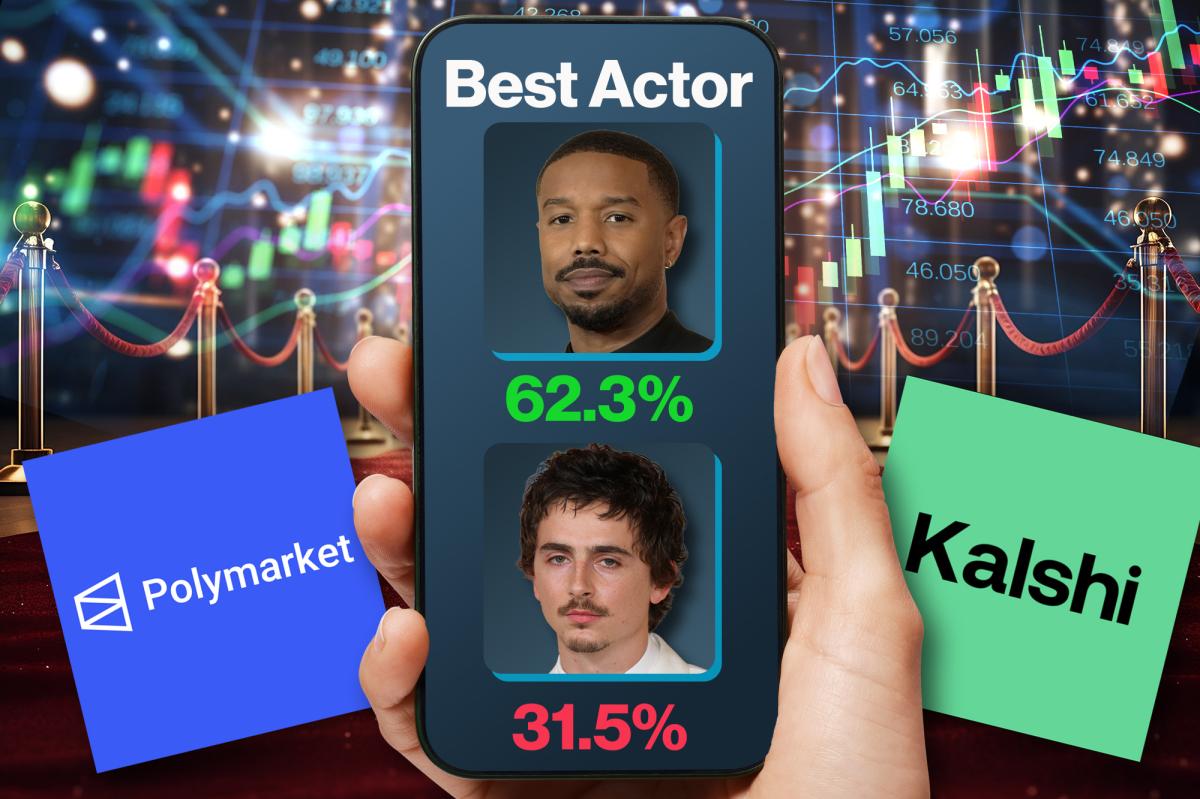
It was a gamblers paradise on Oscar night.
Prediction market betting sites like Kalshi and Polymarket had a bumper academy awards — with gamblers predicting all the winners correctly in the hours preceding the announcement of the winners.
But did some gamblers know more than they let on?
“Historically, one of the reasons people love prediction markets is that they encouraged insiders to basically show their hand,” said sports bettor and blog writer Isaac Rose Berman.
“You can come in and win money, and it’s very hard for people to resist that. The result of that is you actually get that information (out to) the public.” Who of course, can then follow suit with their betting too — if they’re tracking closely enough.
On Polymarket and Kalshi, the categories of Best Actor, Best Supporting Actress, Best Supporting Actor, and Best Live Action Short showed betting spikes in the days, and even hours, leading up to the opening of the iconic envelopes.
These spikes could also be due to actors winning their categories at other award ceremonies — such as Michael B. Jordan and Amy Madigan at the SAG awards. However, Timotheé Chalamet picked up almost all the other major awards in the best actor category this season, and Teyana Taylor beat out Madigan for the BAFTA and Golden Globe.
The expected winner for Best Actor at the start of awards season was largely predicted on Kalshi to be Timothée Chalamet for his role as Marty Mauser in “Marty Supreme”. But despite his award season streak, the betting on him experienced a dramatic shift.
On February 15 at 6am, Chalamet’s odds peaked at 78.7 percent. But they began dropping in the following days, as Michael B. Jordan’s likelihood of winning for his roles of twin brothers Smoke and Stack in “Sinners” started to climb. By March 15 at 6am — pre awards night — Chalamet had dropped to 35.1 percent and Jordan had risen to 55.1 percent. The Oscars ceremony started at 7pm EST, with The Academy’s X account posting Jordan’s win at 10:27 pm.
For Best Supporting Actress, another odd trend in predictions occurred. While “One Battle After Another” actress Teyana Taylor was long predicted to snag the award, with her odds spiking to a whopping 75.4 percent on January 27 at 7pm, they took a dip to 30.9 percent on March 2 at 3am, around the same time as Amy Madigan’s odds for “Weapons” started to climb.
By March 15 at 7pm, Taylor had dropped to 26.5 percent, while Madigan had risen to 56.6 percent. X says Madigan won at 7:21pm.
For Best Supporting Actor, the flip occurred between Stellan Skarsgård and Sean Penn. On February 21, at 8am, Sean Penn had a 16.9 percent odds of winning, while Skarsgård was at 65.9 percent. Skarsgård won the Golden Globe in that category, with Jacob Elordi winning the Critics Choice award.
But a switch occurred at February 22 at 8am, in the hours before the British Academy of Television and Film Awards were aired (and where Penn picked up the Best Supporting Actor award), when Sean Penn started climbing to 24.9 percent and Skarsgård had a slight dip to 60 percent.
The shift became more pronounced by 5pm that day, when Penn jumped to 55.9 percent and Skarsgård fell to 33.1 percent. By academy awards night at 8pm, Penn was at a whopping 79.3 percent while Skarsgård had dropped to a measly 14.7 percent. The award was announced on X at 8:34 pm.
Lastly comes the infamous seventh tie in Oscars history, between “The Singers” and “Two People Exchanging Saliva” for Best Live Action Short Film. While both had similar trajectories for the majority of the lead up to the big night, the former ended at 46 percent on 8am on March 15, and the latter ended up at 28.5 percent. The tie was announced on X at 8:18 pm.
Berman sees it as normal that nearly all of the Oscar categories were predicted correctly, even with unexpected spikes — citing that prediction markets are generally “quite accurate,” even though the question of prediction market insiders is a hotly debated topic.
Berman also explained the irony of some companies like Kalshi, which are regulated by the CFTC, now being “on this big anti-insider trading push.”
“Generally, there is a decent amount of insider trading in these types of markets, whether or not there was in this specific market. But any kind of market like this, where some people know the answer, or have a very good idea of what the answer would be, they can monetize it.
He also noted that it was “not exactly clear” to him if this was the case here, based on the data.
“Any kind of market like this, where some people know the answer or have a very good idea of what the answer would be, (people) can monetize it,” Berman said. “There’s not really any rules in place about what you can and can’t do. The prediction markets — Kalshi in particular — have made a big stink about how they’re regulated and that they’re sort of trying to stamp out insider trading, but most people recognize that’s kind of all for show.”
The Post reached out to Polymarket and Kalshi for comment.
Read the full article here


