



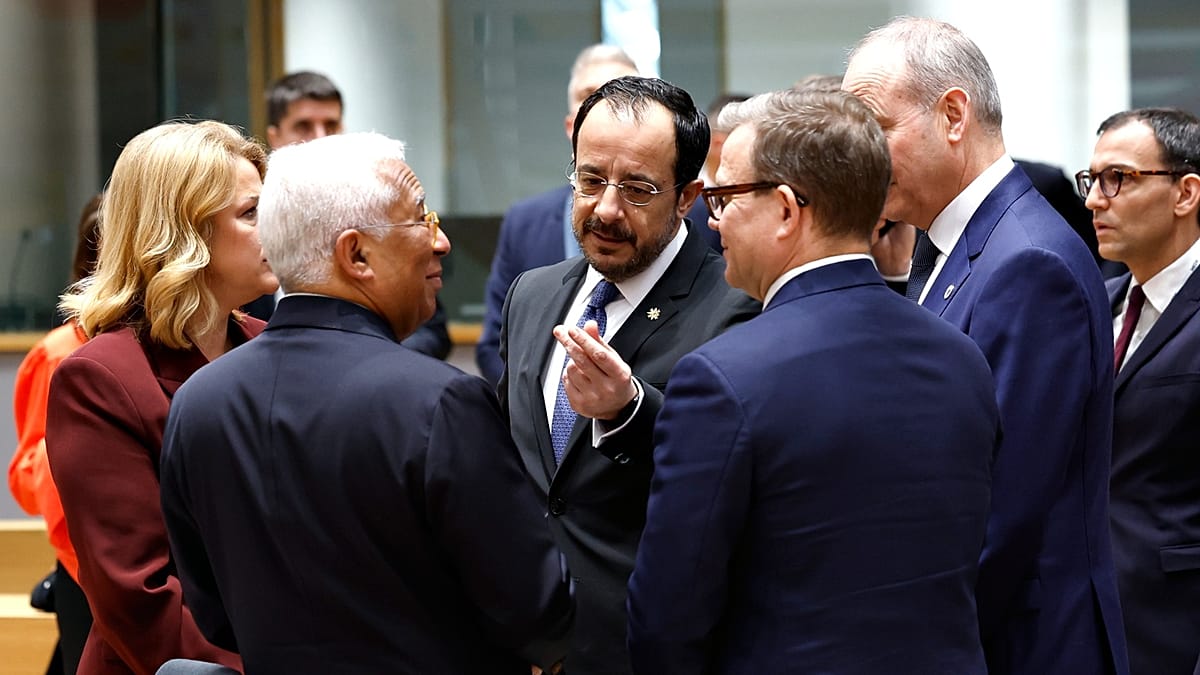
European Union leaders have gathered in Cyprus for an informal summit that will kick off an internal process to establish a mutual assistance clause that could, one day, stand in for NATO’s Article 5, should the United States withdraw from the alliance, something that President Donald Trump has repeatedly threatened.
Russia’s full-scale invasion of Ukraine, the war in the Middle East, the worsening energy crisis and the fate of the EU long-term budget will also be on the table. However, no decisions will be made on Thursday or Friday due to the meeting’s informal nature.
As the holder of the rotating EU Council presidency, Cyprus will serve as host.
The get-together will have one conspicuous absence: Viktor Orbán, the longest-serving member of the European Council, who was roundly defeated at the Hungarian election earlier this month, ending his 16-year premiership.
Orbán, who will leave office sometime next month, has decided to skip what would have been his last summit. His office says this is due to the handover of power.
Most EU leaders are looking forward to turning the page on Orbán’s era, which has been characterised by near-constant disruption, obstruction and opposition. The Hungarian premier’s notorious use of his veto power to block EU action infuriated heads of state and government and, at times, left the bloc paralysed at critical moments.
Two of his outstanding vetoes, on the €90 billion loan for Ukraine and the 20th package of sanctions against Russia, were lifted earlier on Thursday following the resumption of Russian oil flows through the Soviet-era Druzhba pipeline.
Still, others remain active, notably on Ukraine’s EU accession process.
Ukrainian President Volodymyr Zelenskyy, who clashed bitterly with Orbán, is set to attend the leaders’ dinner in Ayia Napa on Thursday evening to make the case for his country’s membership bid, which is seen as a post-war security guarantee.
Although Orbán was the lead critic of Ukraine’s accession, other countries are reluctant to make substantial progress on EU enlargement, a divisive topic among voters. An inventive proposal to speed up Kyiv’s process through a “reversed” methodologywas firmly rejected, with member states asking for credible alternatives instead.
Ukraine wants to, at least, unblock the thematic clusters of negotiations.
“Undoubtedly, this process requires, as they say in Europe, unanimity, so that all of Europe’s voices are heard. I think that in the near future, weeks (and) months, we’ll see how things go, how the partners will come together,” Zelenskyy said on Wednesday.
“We also very much hope and believe that this issue will be resolved.”
Another issue high on the agenda will be the war in the Middle East and the closure of the Strait of Hormuz, where Iran and the United States have imposed duelling blockades. Europeans have floated the creation of a multinational force to escort commercial ships and demine the narrow waterway, but the plan is still at a very early stage and might never happen.
The disruption in Hormuz has sent energy prices soaring across Europe, prompting fears of shortages, poverty and economic decline. Leaders will discuss a series of new measures unveiled by the European Commission earlier this week, such as social schemes, tax reductions, investments in grids and subsidies for clean technologies.
Building on the experience of the 2022 energy crisis, which drastically increased public debt levels, the Commission is calling on member state governments to provide targeted and temporary relief that can be quickly phased out when prices begin to decrease.
A NATO-like protection?
Cyprus President Nikos Christodoulides wants to use the summit to begin an in-depth reflection on Article 42.7 of the EU treaties, which obliges mutual assistance in case of an armed aggression against a member state.
It has been used only once: by France in 2015.
Cyprus is one of the few EU countries that does not belong to NATO and therefore cannot benefit from the alliance’s Article 5. The thorny question arose in the early days of the Iran war when a Shahed drone struck a British military base on the island.
“We have Article 42.7 and we don’t know what is going to happen if a member state triggers this article,” Christodoulides told AP ahead of the summit.
A senior EU official said the idea is for leaders to freely debate Article 42.7, its compatibility with NATO and its practical dimension. The EU treaties leave the door open for different types of assistance, from economic and diplomatic to military.
While in Nicosia, leaders will also tackle the future shape of the long-term EU budget, with the Commission proposing €2 trillion over a seven year period covering 2028 to 2034. Most EU countries are keen to cut down the headline figure, but they disagree on which envelopes should be reduced.
The goal in Brussels is to have an agreement on the new budget by the end of the year, as 2027 will see important elections in France, Italy, Spain and Poland.
Read the full article here


