



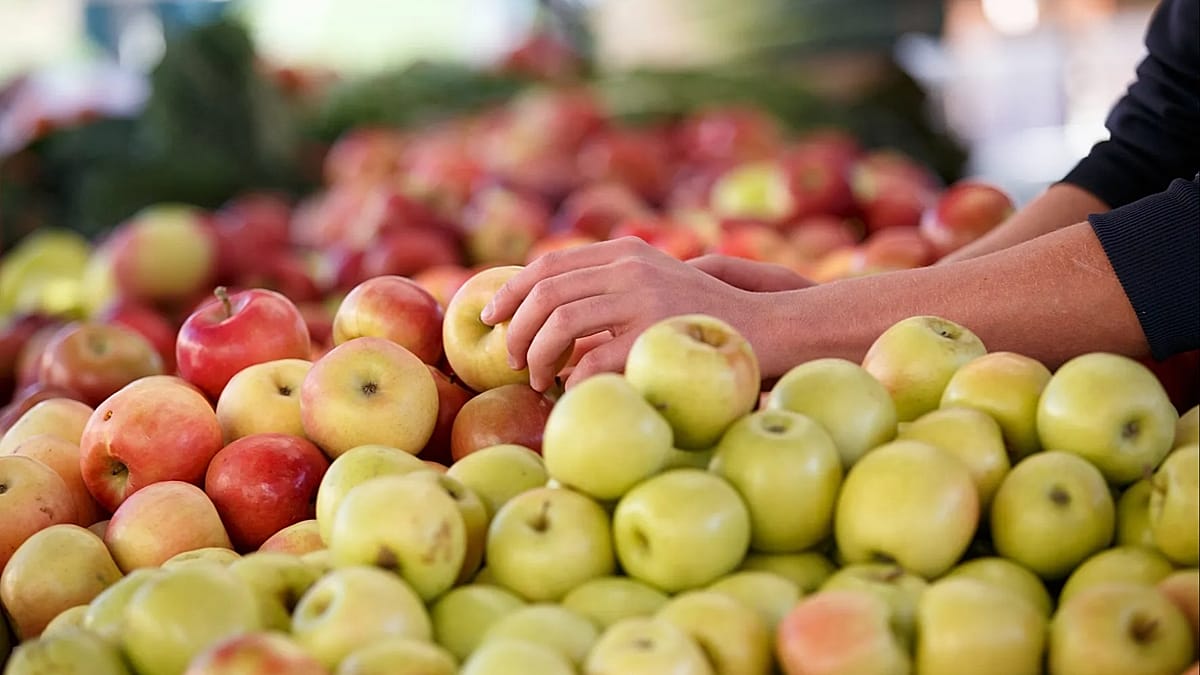
Thirteen European countries are selling apples in markets and supermarkets with a concerning abundance of pesticide residues, commonly known as “cocktails of pesticides”, according to an NGO report urging the European Union to regulate exposure to these chemicals.
Belgium, Croatia, Czechia, Denmark, France, Germany, Hungary, Italy, Luxembourg, the Netherlands, Poland, Spain, and Switzerland have reported contamination in apples, according to the latest report from Pesticide Action Network (PAN) Europe, which criticises the EU’s risk assessment procedure for looking at pesticides in silos and disregarding the “cocktail” effect.
“One of the most striking results is that 85% of the tested apples contained multiple pesticide residues,” said Gergely Simon, campaigner at PAN Europe. “The European Food Safety Authority (EFSA) was tasked 20 years ago to develop a methodology to regulate the cocktail effects of pesticides, but they still do not fulfil this legal obligation.”
The report points out that if these apples were to be sold as processed baby food, 93% of them would exceed the EU legal limit of pesticide levels for children under 3 years old.
“Young parents are not aware that feeding their children with fresh conventional fruits or vegetables strongly increases their exposure to pesticides, sometimes more than 600 times,” said Simon. “Public authorities should inform them and promote organic food in priority.”
The damning report comes as EU rules to address “cocktails of pesticides” remain in limbo, with numerous campaign groups urging the European Commission and EFSA to speed up cumulative risk assessment of pesticides.
While the issue of assessing the combined effects of multiple pesticides was first acknowledged in 2005, it was only in 2020 that EFSA conducted a pilot assessment of combined effects on the thyroid and nervous systems.
Since 2021, the Commission and EFSA have been working to expand cumulative risk assessments to more pesticide groups, aiming to fully integrate them into law by 2030.
An EFSA spokesperson told Euronews that the work to assess the “pesticide cocktail” problem is “complex”, involving large datasets, new software tools and extensive collaboration with EU and international partners.
“We are currently preparing guidance on how to perform ‘prospective’ cumulative risk assessment – before the intended use of the pesticide is authorised – in the context of applications for maximum residue levels,” the spokesperson said.
A pilot exercise with EU countries is planned for the end of 2026 to allow national experts to test the tool and methodology under development by the EU’s food agency, EFSA’s spokesperson said.
Pesticides and “forever chemicals”
PAN Europe’s scientific study was conducted between 1 and 20 September 2025, during which researchers selected three to five samples of different locally produced conventional apples from supermarkets or markets, for a total of 59 nationally grown apple samples, according to the report.
The findings reveal that 71% of apple samples contained at least one residue of the EU category of the most toxic pesticides, 64% contained at least one residue of PFAS pesticides, also known as “forever chemicals“, and 36% contained a neurotoxic pesticide.
Fludioxonil, a PFAS pesticide, was found in nearly 40% of the samples, according to the report, which noted the hazardous chemical was classified as an endocrine disruptor in the EU in 2024.
“It should have been banned, but EU member states have been blocking this for a year now. It is toxic to the liver and kidneys for humans, and it decimates fish and amphibians in aquatic environments,” PAN Europe said in a statement launching the report.
The Commission proposed changes in December 2025 that would weaken pesticide regulation by allowing approvals to last indefinitely and removing the requirement to reassess pesticide toxicity against new scientific evidence every 10 to 15 years.
The proposal would also allow EU countries to ignore the latest scientific findings when evaluating pesticide risks.
“There is mounting scientific evidence that exposure to pesticides via food is related to infertility, and possibly to cancers,” said Simon. “The constant exposure of citizens to mixtures of toxic substances via food, air or dust is not taken into account; this important issue must be tackled by regulatory bodies.”
Euronews asked the European Commission for comment, but did not receive a response before publication.
Read the full article here


