



Published on
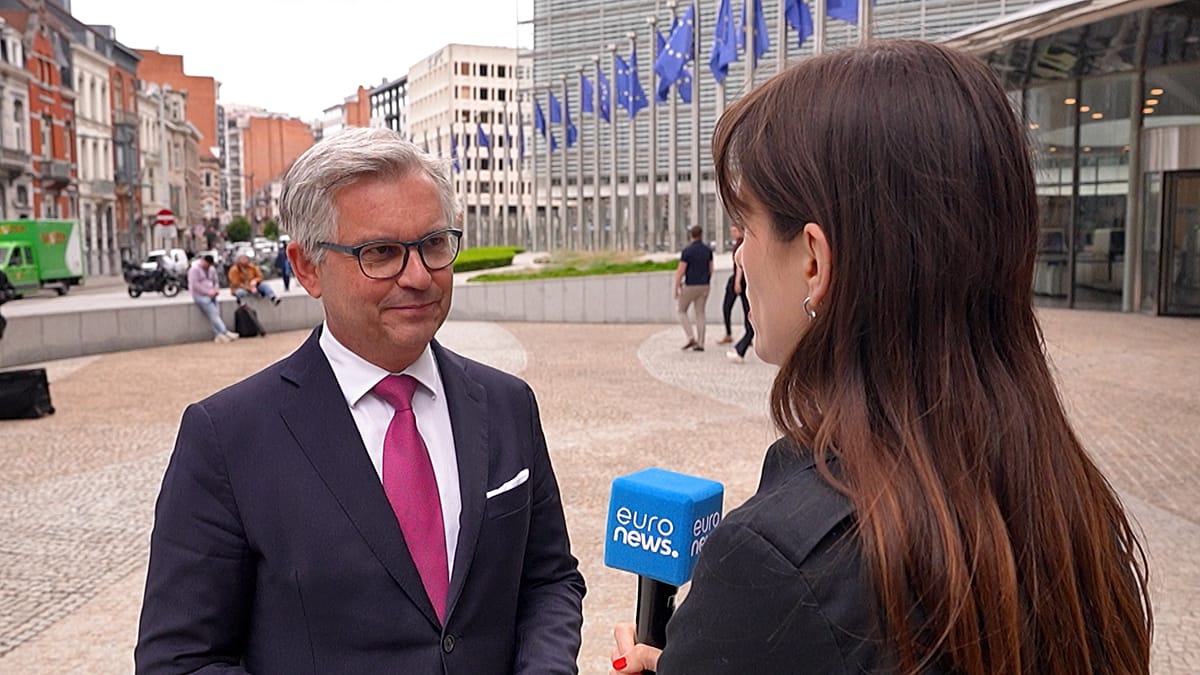
As EU member states prepare to implement the bloc’s most comprehensive migration reform in a decade, European Commissioner for Migration Magnus Brunner told Euronews he recently discussed the issue with Pope Leo XIV.
“I had the chance to meet the Pope myself some months ago and I had a conversation with him on exactly that topic,” Brunner told Euronews’ flagship morning programme Europe Today.
“Human dignity, international law, this is all in the centre also of the reforms. We’re not negotiating about these facts. That is really important for us also as lawmakers as a European Commission.”
The head of the Vatican, Pope Leo XIV, recently visited the Canary Islands in Spain — a former major migration hotspot.
“Human dignity has no passport and does not lose its value when crossing a border,” he said on Thursday, flanked by rescue ships docked and a wooden cross made from a shipwrecked migrant boat.
The comments come days after the Pope received a seven-minute standing ovation in the Spanish Parliament calling for greater protection and “love” for the lives that are most fragile, among other statements.
Euronews asked Brunner if the views of the Pope and Brussels, particularly in line with the comments that received rapturous applause in Madrid, are compatible. He answered, “Definitely, yes”.
The pact
The pact has been welcomed by certain capitals, with German Chancellor Friedrich Merz said in a post on social media platform X that as of Friday, there will be “better control and order, faster procedures, and a fair distribution of responsibility”.
But it has also been panned, with Amnesty International describing the proposal as “cruel” while former detainees of similar off-shore deportation centres in Australia previously warning EU lawmakers of the incoming “tragedy”.
The pact covers 10 major legislative files spanning from stronger border checks and faster processing procedures, and links to the EU’s return regulations which establish the opportunity to establish “return hubs”. These are deportation centres set up outside the EU, tasked with returning individuals back to their home countries after their claims to stay have been rejected.
The United Kingdom attempted to set up a return hub with Rwanda before it was legally struck down in 2022. Two years after, Italy established two return hubs in Albania, with Italian Prime Minister Giorgia Meloni subsequently stating this is the model that the EU has followed.
According to the latest data from the European Commission, only 29% of individuals whose applications to remain were ultimately rejected by the courts were returned in the last quarter. But data from Frontex, the European Union’s border force agency, shows that irregular border crossings have fallen year-on-year since 2021, currently at around 178,000.
“It’s just not acceptable that only one out of four at the moment who have no right to stay in the European Union are being returned,” Brunner told Euronews, adding the “return regulations” were the missing piece of the pact. “We have to bring our European house in order,” he said.
“We have firm but also fair new rules… This is the first time we have actually a comprehensive system, a European-wide comprehensive system, with better border controls, border checks at the external European border, asylum procedures at the border, which will be more efficient and quicker with the asylum procedures.”
Read the full article here


