



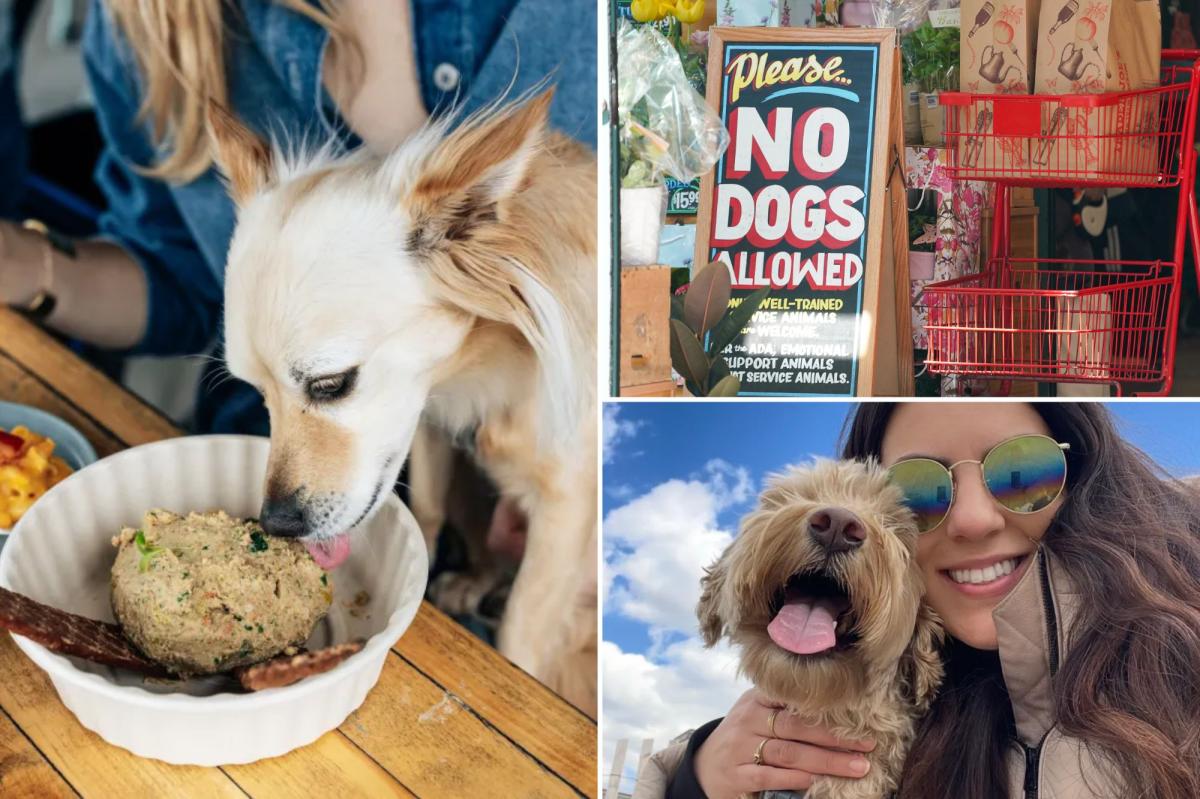
New York is going to the dogs — and nobody knows that like Tamara, an NYC med spa owner who is sick and tired of watching the Big Apple’s descent into canine-driven chaos.
Day after day, the pampering proprietress told The Post, she’s forced into confrontations with her privileged clientele who drag their furry friends into her pristine wellness sanctuary, leaving grubby paw prints — or worse – all over floors and furniture.
Tamara, who asked that her last name not be used to avoid any ire from angry customers, said she’s a dog mom herself — albeit one that feels permissiveness towards pets in the Big Apple has simply gone too far. Some particularly pushy clients even assume they can bring their non-service dogs into the room with them while they get Botox or filler, she complained.
“It’s a medical procedure at the end of the day,” Tamara said. “It’s really frustrating because then we have to be the bad guy. We have to say, not only is this against code, and it might make other people feel uncomfortable, it’s also a big distraction to the provider that’s performing the treatment.”
Tamara’s story is being repeated over and over again in New York, of late — people who love and claim four-legged friends of their own are simply fed up with the number of leash-toting Gothamites who insist on bending the rules.
Or, at least, they’re skirting the social contract by bringing their fur babies practically everywhere they go.
And boy, they do go everywhere. Once seen mostly in public parks, non-service pups are showing up in supermarkets, small businesses, big-box stores, and even inside restaurants (including some with dog-friendly menus) — where incidents like a high profile corgi bite in a trendy Williamsburg bakery and cafe are becoming more common, leaving a growing chorus of frustrated folks to paw back at a pets-first trend that shows no sign of slowing.
“If a dog’s not making noise and just hanging out with their owner, that’s totally fine, but we all know that’s not usually the case,” Ana Hernandez, a 35-year-old from Lower Manhattan, told The Post. “There’s this entitlement where it’s like, ‘My needs matter more than yours, I want my pet with me and I don’t care if you’re uncomfortable.’”
Hernandez, who owns a golden doodle, gets particularly peeved when she encounters dogs lounging on the floors of NYC bodegas, emphasizing that “I shouldn’t have to walk over a dog leash to get to where I need to be because you’re not holding your dog tightly next to you.”
She also gets annoyed when she sees pups in city grocery stores, sharing that she’s seen “a lot of them,” specifically at the Key Foods on Fulton Street in FiDi.
“It’s always like, alright, why are they here?” said Hernandez. “Even if they’re not doing anything, just knowing that maybe their tail could be wagging and hit some of the produce — it’s a weird situation to be in…We need to reinforce that dogs are still dogs, no matter how much we love them and treat them as our children.”
Johnny Gold, the manager at this Key Foods, responded to The Post’s request for comment and clarified that the 10 to 15 customers who regularly shop for food with their pups are “all service dogs,” and that the store asks to see certification.
While city and state health codes technically ban furry pets that aren’t licensed service dogs from joining their owners in certain indoor public spaces — especially ones that sell or serve food like grocery stores and restaurants — pressure to conform to social norms and a lack of rule enforcement have made the practice rampant in NYC.
Khris Black, a 28-year-old born-and-raised Brooklynite, has seen this uptick firsthand over the last ten years and shared that he’s seen local store owners have a “different kind of reaction” to people who are newer to the neighborhood, bringing their dogs into indoor public spaces.
“It’s that certain subset of people who are moving to more urban areas of Brooklyn, the Bronx, or certain parts of Queens, where [not bringing dogs in stores] is an understood thing — we don’t do that here. But then they’re like, ‘Well, this is what I do,’” Black told The Post.
“And because businesses see that as a new form of money, it’s like, ‘Let’s make them happy.’…It causes more of a problem to tell people, ‘Hey, I don’t want that dog around’ than to just let them do it,” he continued.
Service dogs, of course, are the exception to this. Under the federal Americans with Disabilities Act, originally passed in 1990 and updated with new requirements in 2010, a service animal is defined as “a dog that is individually trained to do work or perform tasks for a person with a disability.”
While this covers dogs who perform a range of tasks — from alerting the hearing impaired to calming a person with PTSD during an anxiety attack — it does not include dogs whose sole purpose is to provide comfort or emotional support.
According to the city, businesses can legally ask if a dog is a service dog and what task the dog performs, but they cannot ask for proof of disability or service animal certification (which the ADA doesn’t require for service dogs anyway) — leading some business workers to feel at a loss for how to handle customers they suspect may be fibbing about their dog’s status.
“We’re often caught in the middle of what we can legally ask and what people expect of us,” a Manhattan Trader Joe’s employee who asked to remain anonymous told The Post, adding that people do try to come into the store “a lot” with their dogs. “Customers want us to go up and yell at (these) people and hurl them out of the store, and be like, ‘What’s wrong with you?’ But that’s illegal.”
“It makes things difficult for people who actually have service animals and our customers,” the employee added. “People legitimately have heart conditions or can be visually impaired. If you have a bunch of animals around that aren’t trained, it just makes all those interactions more difficult.”
Sterling Quinn, a 30-year-old fashion designer and entrepreneur based in SoHo who has had her maltipoo, Petals, for eight of the nine years she’s lived in the Big Apple, said that she understands such concerns — but still takes Petals virtually everywhere she goes, from the subway to coffee shops, to the grocery store and the hair salon.
Though Quinn classifies her maltipoo as a service dog who is “trained to detect biochemical changes within the body and respond to them” when her PTSD flares — and even got a $50 badge that shows his status from servicedogscertifications.org — she admitted that she and Petals have regularly been met with resistance in indoor public settings.
“I had this experience at Trader Joe’s the other day where I had him in a bag in the cart, so he’s not touching anything — and I was (told), ‘Excuse me ma’am, we can’t have dogs in the cart,” Quinn told The Post. “I go, ‘He’s in a carrier.’ They go, ‘Well, there’s people who are allergic to dogs’ — I say, ‘He’s hypoallergenic.’”
“In (these situations), I respond that it is legally within my rights to have a service dog,” Quinn continued. “You are denying someone with a disability. That would be the same as denying someone in a wheelchair.”
Elle Edwards, a 21-year-old Brooklynite, also has an emotional support dog — a five-year-old toy poodle named Velour. While she takes him along for subway rides in a bag — a practice allowed by the MTA — she disagrees with the concept that emotional support dogs are true service dogs and doesn’t think run-of-the-mill pups should be allowed to go everywhere with their owners.
“Consider the service animals that need to be there, and what those people are going to go through because so many people are bringing their pets to the store — how they’re going to be questioned even though that’s their right to have and it’s helping them,” Edwards told The Post. “Sure, your dog can help you emotionally but I’m sorry — you can go to the grocery store for five minutes and you’ll be okay.”
Read the full article here


