



Do they see a bad moon rising?
After multiple delays this year, Artemis II is slated to blast off Wednesday night, April 1, marking the first crewed mission to the moon since the Apollo astronauts touched down in 1972.
The historic trial flight — with coverage aired on NASA’s YouTube channel, NASA+ and Amazon Prime — is set for 6:24 p.m. EDT, with a two-hour launch window.
NASA hopes the cosmic dress rehearsal will pave the way for future crewed missions with Artemis — that is, if the equipment holds together when the rubber hits the celestial road.
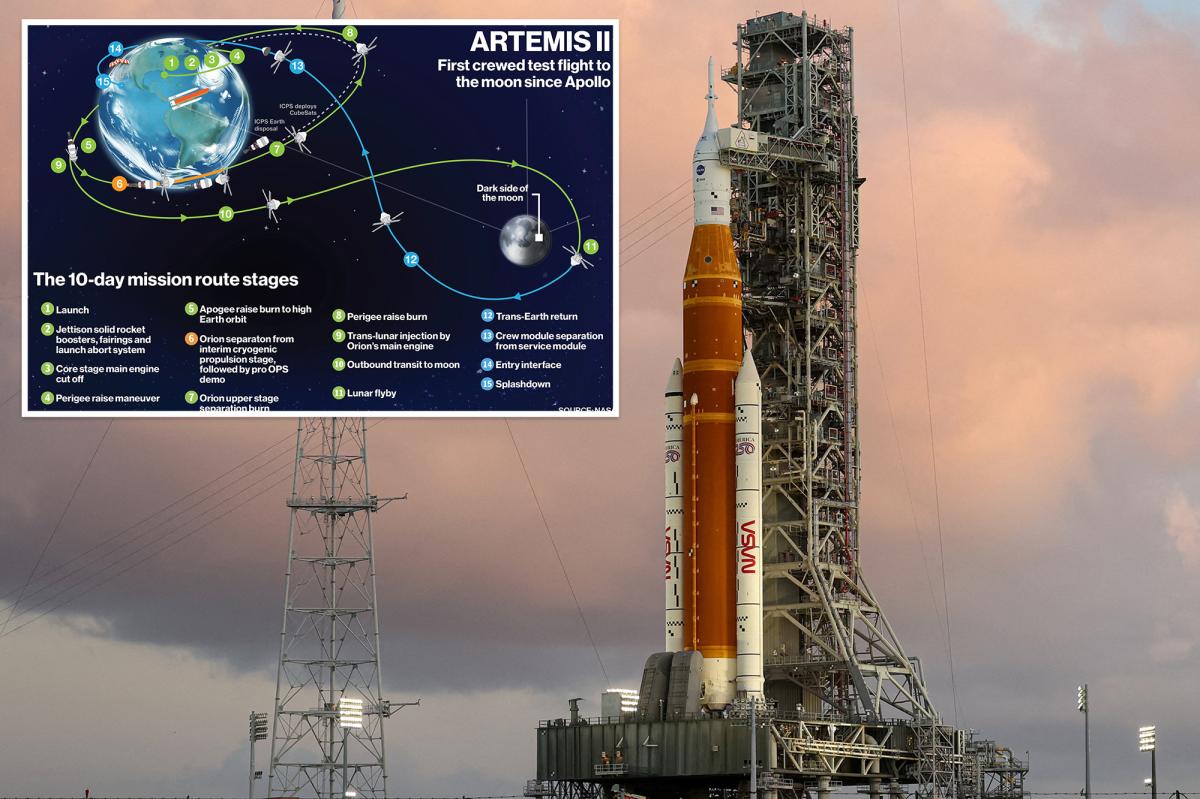
During the 10-day mission, four astronauts — Reid Wiseman, Victor Glover, Christina Koch and Jeremy Hansen — will journey to the moon in NASA’s SLS (Space Launch System) rocket. Upon arrival, they will circumnavigate our rocky satellite aboard the Orion, a cramped 11-foot-by-16½-foot capsule.
Some experts have floated concerns that there could be a host of issues with this first moon mission in half a century, and they could present one giant problem for “humankind.”
“There’s some concern that they may be overoptimistic,” British-American astrophysicist Jonathan McDowell, of the Center for Space Environmentalism, told The Post. “This is the second flight of a substantially new rocket and the first time with people on it.
“And so that’s always a concerning thing.”
Reeling in the heat
Experts pointed out that the Orion’s heat shield — the barrier that curtails sweltering temperatures during reentry into Earth’s atmosphere — is a dead ringer for the component present on the uncrewed Artemis I, which returned damaged with a chunk missing from it, CNN reported.
This has sparked fears that the current Artemis mission could experience a similar issue, which could potentially make it a one-way ticket.
Olivas, who served on an independent board that probed the accident, called the heat shield “deviant” and not something that NASA “would want to give its astronauts.”
This could be problematic given that crew will rely on a few inches of resin–coated silica to protect themselves against temps close to half that of the Sun’s surface, according to The Conversation.
“You have to have enough thickness [so] that in the time that it takes you to slow down from 26,000 miles an hour to a few hundred miles an hour, you burn away the [material],” explained McDowell, who’s also affiliated with the Space Research Centre (SPARC) at the University of Durham, UK.
“You make it thick enough that it hasn’t all burnt away by the time you’ve slowed down,” said the Brit, warning that there is no contingency plan if the heat shield fails. “And if you get that off by an inch, you’re in big trouble.”
In 2003, the Space Shuttle Columbia disintegrated after a piece of foam broke off and breached the heat shield, killing all seven members aboard.
Flight transfer
Thought making a connecting flight was stressful? Try transferring from a rocket to a space capsule whose life support system has never been battle-tested with a crew.
“They’ve had the life support system sort of tested out, but never with actual people sort of breathing it in space,” McDowell pointed out. “And so hopefully that all works well.”
He added that he wasn’t “too worried” because, unlike a rocket explosion, the timescale for dealing with a faulty life support system tends to be hours — as opposed to seconds.
“They can, if necessary, reboard and come back home, or maybe they can fix it,” he pointed out, adding that it’s not as difficult as a crewed lunar landing, which requires a “rendezvous and docking with a lander.”
Radiation sickness
The Artemis II crew will be the first humans in decades to fly beyond low-Earth orbit, meaning that they won’t be protected by our magnetic field. As such, the space cadets will be exposed to deep-space radiation, which can raise the astronauts’ risk of cancer, with extreme doses causing acute symptoms, according to New Scientist.
Fortunately, McDowell believes that the danger is fairly negligible, explaining that “if the radiation environment is, as we expect, it’s like taking some large number of plane flights.”
The scientist warned that the radiation risk could be heightened by a space weather event, such as an X-class solar flare and subsequent coronal mass ejection — large expulsions of plasma and magnetic particles from the sun.
“Even with a moderate solar flare, you might get an exposure to radiation that ups your risk of getting cancer later in life by some significant fraction,” McDowell said. “But there are things in everyday life that can give you cancer risk as well. And so it’s not quite as extreme. It’s not, like, oh, you’re immediately going to die.”
Fuel spill
The mission could be over even before it starts should the rocket start leaking fuel before liftoff, with the Artemis II itself getting postponed in February due to this very issue.
“Hydrogen’s a tiny molecule, and it likes to escape through very small holes, so it’s a beast to stop the leaks happening,” explained McDowell, who explained that due to budget pressures and other issues, the Marshall Space Flight Center hasn’t ironed out the kinks affecting its propellant.
“They weren’t able to just take a step back and go, ‘OK, let’s really test the hell out on this and make it robust,’” he said. “And so for that reason, it would not surprise me if Wednesday night we get down to 10 minutes before launch and suddenly it’,s like, ‘We got another leak. OK, we’ll try again another day.’”
Suiting up
Should this lunar dry run be successful, it will pave the way for an actual moon landing, which NASA has planned for 2028 on Artemis IV.
Ex-NASA astronaut Kate Rubins is concerned about those mission suits, designed by Houston-based Axiom Space. While certainly more advanced and flexible than their Apollo predecessors, allowing for longer spacewalks and increased comfort, the former space explorer said their bulk could make spacewalks a slog — a problem given the abundance of extravehicular activity during a moon landing.
“I think the suits are better than Apollo, but I don’t think they are great right now,” Rubins said, per Ars Technica. “They still have a lot of flexibility issues. Bending down to pick up rocks is hard. The center of gravity is an issue. People are going to be falling over.”
Her less-than-stellar overall assessment?
“I think when we say these suits aren’t bad, it’s because the suits have been so horrible that when we get something slightly less than horrible, we get all excited and we celebrate.”
Risks at every level
Like with a flagship surgical operation or deep-sea excursion, risk is part and parcel of boldly going where only a handful of people have gone before, in this case, 1,000 times farther than the distance from Earth to the International Space Station.
“They’ve got to be able to breathe, they’ve got to be at a good temperature, they’ve got to have electrical power, they’ve got to have working rocket engines,” explained McDowell. That includes making “course corrections to get to the moon correctly, get around the moon, and head on back.”
He added that on the return trip, “they’ve got to precisely target their approach so that they do this nice gentle reentry,” observing that, at 26,000 miles an hour, it is not really that “gentle.”
“And then there’s the parachutes. There’s always a bit of a worry [about’] parachutes when you’re coming in that fast.”
He said that he ultimately has “confidence” in the team, but acknowledges the challenges involved.
“There’s no reason to be particularly concerned, I think,” McDowell said. “The team has a lot of experience, but they haven’t done this in a while. So it’s going to be interesting.”
Earlier this month, John Honeycutt, chair of the Artemis II mission management team, claimed he hoped NASA would avoid succumbing to a failure of imagination.
“We use that term a lot in human spaceflight,” Honeycutt said.
“We want to be sure that we’re thinking about everything that can possibly go wrong — and have we assessed and adjudicated all the risk to put us in the best posture to be successful?”
Read the full article here


