



Glenn A. Baker
ROB HIRST
1955 – 2026
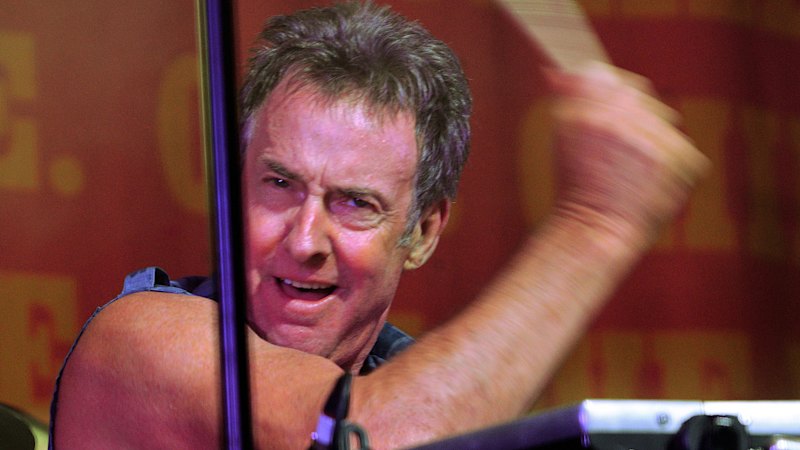
One of Australia’s greatest drummers, Midnight Oil’s Rob Hirst, has died aged 70.
His bandmates announced his death in a post to Midnight Oil’s Facebook page on Wednesday.
Described as a “ferocious and relentless” drummer, Hirst was also a talented songwriter, penning many of Midnight Oil’s most successful songs from Power and the Passion to Bed are Burning and Dead Heart.
For many years Hirst was also the only door into the hermetically sealed world that was Midnight Oil. Manager Gary Morris ran the tightest of ships. They not only famously refused to appear on Countdown but they assiduously shunned the media.
Hirst, along with guitarist Jim Moginie, were the human faces of the band, prepared to talk easily and without pretension to anybody who sought them out.
The common mistake was to presume that Midnight Oil was Peter Garrett and that Garrett was Midnight Oil. Of course, it was understandable – this towering bald behemoth was impossible to ignore.
As Hirst has said, “an extraordinary charismatic frontman – in my own opinion the greatest Australia’s ever had; people at gigs could not take their eyes off him”.
Hirst said this put more pressure on him to take “songwriting seriously and come up with something as good”.
“So we [he and Moginie] got stuck in and spent most waking moments when we weren’t touring, doing interviews or rehearsing, working up new material,” Hirst said.
“With each album we sold more and more copies. You sort of feel like if one person changes their mind by hearing Beds are Burning or Blue Sky Mine or some of the other great anthems of the Oils, there is a sense of job well done.”
Robert George Hirst, was born on September 3, 1955 and grew up in Camden, on the outskirts of Sydney. His parents were Peter and Robin, and he had two brothers, Stephen and Matthew.
In the early 1970s, schoolboys Hirst and friends Moginie and Andrew “Bear” James played their first public performance in a northern suburbs school hall under the name Schwampy Moose, dishing out mainly Beatles covers.
“I think we just wanted to get our schoolboy band happening, maybe get some gigs and then perhaps make an album, just humble dreams,” he said.

They gradually evolved into Midnight Oil, with singer Peter Garrett joining in 1975 (after responding to an ad in the Herald for a lead singer) and Martin Rotsey (guitar) coming on board in the following year. Founding bass player, “Bear” James, was replaced by Peter “Giffo” Gifford from 1980 until 1987 when Bones Hillman joined the band. At the heart of Midnight Oil’s music were social justice and environmental causes. Their music reflected the political times.
“I was very influenced by an American lecturer I had when I went to Sydney Uni for a while doing a course and she kind of turned me onto the civil rights movement which I knew very little about,” he told Tracee Hutchison in a 2025 interview.
“From there I was listening to the heroes of the day whether they be John Lennon or Bob Dylan or John Fogerty and then increasingly some of the great local songwriters of the time … Don Walker from Cold Chisel, Paul Kelly, Greg Macainsh from Skyhooks.
“The bands and the music that I loved most was music that actually meant something and was saying something – there was a narrative, a reason to make it other than just, you know, smashing up a guitar or a drum kit or whatever.”

The songs that Hirst wrote were essentially the bulk of the Midnight Oil songbook: the award-winning Power and the Passion, Beds Are Burning, Gadigal Land, First Nation, Blue Sky Mine, Read About It, Armistice Day, Put Down That Weapon, King of the Mountain, Don’t Wanna Be The One and The Dead Heart. His musical legacy has thrown the spotlight on important issues from Indigenous land rights through to nuclear disarmament, youth homelessness and asbestos-related diseases. He is also a published author and magazine contributor.
Hirst over the years also played, sung and wrote songs in The Ghostwriters, Backsliders, Hirst and Greene, The Angry Tradesmen and with the instrumental surf rock outfit, The Break which featured Moginie and Rotsey and bass player Brian Ritchie of the Violent Femmes.
From day one, Hirst was celebrated as a ferocious and relentless drummer, often compared to Keith Moon, Ginger Baker, John Bonham, Neil Peart, Jeff Pocaro and Phil Rudd.
As patron of the Sydney Blues Festival I was able to introduce his band The Break on the main concert stage – when Garrett was off being a government minister – and stood beside Rob’s drum kit as he played, an experience I will never forget. I also took Hirst out on Sydney Harbour where he told me about the Oil’s concert on Goat Island in 1985 where he humorously dispelled suspicions that he was wearing a pink jumpsuit behind his drum kit that day.
At the conclusion of the final ever Midnight Oil concert at the Hordern Pavilion in 2022 – a massive undertaking of more than three hours – Hirst never missed a beat. He then met with us backstage after the show to receive our humble accolades. Not every other member did.
The Oils reflected the “temper of the times” and never erred when it came to their support of environmental and social justice causes, pushing their messages on a global stage.
In 1990 the band parked a flatbed truck and sang eight traffic-stopping songs outside the Exxon building in New York, to protest the Exxon Valdez oil spill in Alaska; then there was the performance at the 2000 Sydney Olympics Games closing ceremony where they sang Beds Are Burning while wearing clothes emblazoned with the word “Sorry”. This act was a protest aimed at the Howard government who had refused to issue a formal apology for the mistreatment of Indigenous Australians.
“So we’ve been given this opportunity for a mass international audience. Howard and co refused to say sorry to the stolen generations that have suffered so much. We realised that this was an opportunity to right some wrongs and set the government straight,” Hirst said in a 2015 interview.
“It was all clothed in secrecy … cloak and dagger. But it felt like a matter of seconds we were up there and then off. I remember this massive wave of support from the stadium – people saw us on the big screen wearing ‘Sorry’ and getting the reference and then flashing to a very angry John Howard’s face. For that alone, it was worth it.”
Midnight Oil also toured the US soon after the September 11 terrorist attacks in New York. Hirst’s diaries formed the basis of his book Willie’s Bar & Grill, which captured a place-in-time perfectly.

“The results of the songs were often much bigger and better than I ever imagined. I always knew that however long the band would last the songs would last longer and that if we were lucky some of the songs people had grown up with would last generations,” Hirst said.
“While people might forget the gigs hopefully they have great memories of how we made the songs as good as possible … that we spent a lot of time crafting them.”
In 2017 Midnight Oil reunited for The Great Circle World Tour, a trek that spanned two years and circumnavigated the globe. It was The Oils’ first tour in over 15 years.
By the time the Oils called it a day in 2022, the group had logged six ARIA No. 1 albums, including Resist, their first full-length studio album in two decades. The group previously led the national tally with The Makarrata Project, an EP with First Nations collaborators, which topped the charts in November 2020.
The Oils also hit number one with Red Sails in the Sunset (November 1984), Diesel and Dust (August 1987), Blue Sky Mining (March 1990) and 20,000 Watt RSL: The Midnight Oil Collection (October 1997).
In 2024 Paul Clarke’s documentary biopic The Hardest Line: The Story of Midnight Oil covered all the major career milestones with a wealth of archival footage. Thanks to the Oils’ view that art and activism could be good for one another, we were treated to a headlong trip through 45 years of social, political and pop music history.
In 2006, the group was inducted into the ARIA Hall of Fame, and in 2018, its members were feted with the Ted Albert Award for Outstanding Services to Australian Music, one of the country’s highest music honours.
“If you are lucky enough to have that chemistry where you cover all bases – the massive, charismatic frontman that Pete was, the songwriting and musical genius of Jim Moginie, the effortless guitar player that Martin is, the bass playing prowess of Bear and Giffo and Bones, and their vocal abilities — and whatever I brought to the party — and Gary Morris, manager extraordinaire … and more than that to have 25 years where you are left completely alone to make music your way, here and overseas, well you can’t argue with that can you?” Hirst said in a 2015 interview.
Hirst is survived by wife Leslie Holland and their two daughters, Gabriella and Lexi. He also has another daughter, Jay O’Shea, a singer, who was adopted out when he was 17. They reunited in 2010 and subsequently collaborated on a number of music projects.
Hirst had been treated for pancreatic cancer since 2023.
From our partners
Read the full article here


