






Examine, a free newsletter covering science, is sent every Tuesday. You’re reading an excerpt – sign up to get the whole newsletter in your inbox.
Sometimes it feels as if all the fundamental questions about existence have been solved. Then you remember dark matter.
This unknowable substance constitutes as much as 85 per cent of all mass in the universe, and yet we cannot see or directly measure it, and we don’t know what it’s made of.
But the structure of spiralling galaxies, the make-up of the cosmos, and indeed our very existence only make sense if the universe is woven with an undiscovered, invisible essence, holding it all together like a secret skeleton.
Needless to say, dark matter is the greatest scientific mystery of our time.
That’s why physicists are intensely excited about a tiny spark of light detected in a pool of liquid xenon in the depths of an abandoned goldmine.
The data is limited and fresh, and scientists are duly cautious. But there is a possibility this newly reported signal could be the first-ever detection of dark matter.
How do we know dark matter exists?
Fritz Zwicky was an unconventional and at times unpopular scientist who once said of his more orthodox colleagues: “Astronomers are spherical bastards. No matter how you look at them, they are just bastards.”
The Swiss stargazer was investigating the Coma galaxy cluster in 1933 when he realised the galaxies were rocketing around each other at 2000 kilometres per second – so fast they should have violently flung away from each other.
He calculated the galaxies, to summon enough gravity to stay together, must have 400 times more mass than they appeared to have. What was providing this invisible gravitational glue? He proposed the existence of dark matter.
Zwicky’s theory was treated as zany. Then American astronomer Vera Rubin spied another anomaly in the 1970s.
Stars on the outer edge of a galaxy should orbit much slower than those at the centre. But Rubin discovered the outer stars of a galaxy travelled just as fast as those closer to the centre.
The visible matter in the galaxies didn’t have enough gravity to hold on to these distant, fast-spinning stars. Something else was holding on to them. Rubin concluded: “What you see in a spiral galaxy is not what you get”, and that dark matter must be real.
Now astronomers can see how light is warped in space by gravity emanating from dense, invisible regions of suspected dark matter.
The image below shows galactic gas highlighted in pink, while the blue areas show regions of intense gravity scientists believe can only be explained by dark matter.
But that’s a shadow of a shadow. In the race to truly detect dark matter, instead of looking up through telescopes, we’re burrowing deep into the Earth.
The deep detector
Dark matter doesn’t emit or reflect light, and it barely interacts with normal matter. We also don’t know what it’s made of. So how do we find it?
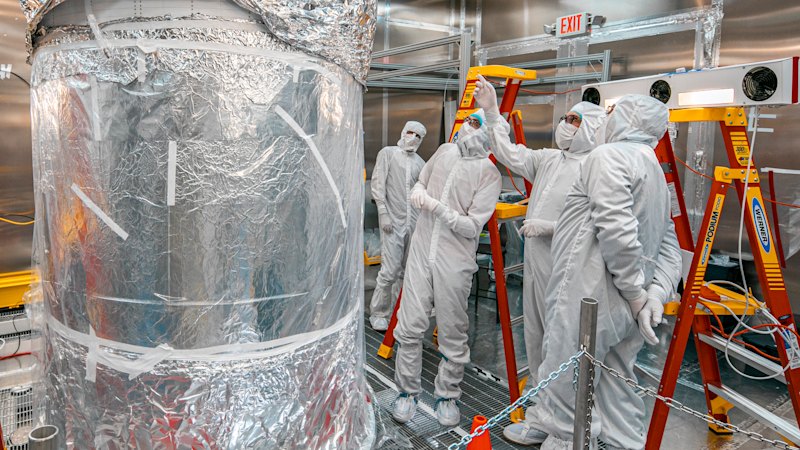
Dr Theresa Fruth, a dark matter hunter from the University of Sydney, helped design and construct one of the best dark matter detectors on Earth, called the LUX-ZEPLIN (LZ) experiment. About 250 scientists and engineers are participating in the project.
“It’s basically a big bucket of liquid xenon,” Fruth says. “Xenon is a trace element in the air around us, and it’s a noble gas. But if you cool it down enough, about minus 100 degrees, it’s a really dense liquid.”
Any skerrick of radiation might mimic dark matter and must be banished.
“Xenon is good because you don’t have any long-lived radioactivity naturally in the xenon. It decays away and you can have this very clean, very quiet liquid.”
The ultrapure liquid xenon is contained in two tanks of medical-grade titanium and teflon, in turn encased by more than 250,000 litres of water for extra shielding.
The entire thing is entombed in an abandoned goldmine in South Dakota, 1.5 kilometres underground, to protect the detector from cosmic radiation lashing Earth from space.
In theory, if a skerrick of dark matter hits this pool of xenon – one of the stillest, quietest, most stable places on Earth – at the right angle, it would spark a tiny flash of light.
On Wednesday, at midnight, scientists reported a flash.
Finding WIMPs
The LZ experiment is designed to detect weakly interacting massive particles, or WIMPs, one of the leading theories for what dark matter could be made of.
WIMPs are thought to be heavy, slow-moving subatomic particles between 10 and 1000 times heavier than a proton.
Scientists think they might be constantly passing through Earth like ghosts.
If one of these WIMPS struck the nucleus of a xenon atom in the LZ detector, theoretically, this would unleash a tiny flash of light. Five hundred photomultiplier tubes in the tank set-up are tuned to pick up any flashes.
Scientists pore over the resulting data to see whether flashes might be explained by stray radiation given off by the material of the detector itself, or some other rogue background ray.
Now they have reported a flash that, as yet, cannot be explained by a background signal: a possible hint of dark matter.
“We don’t really know what to do with that, because we’re so used to not seeing anything,” Fruth says. “We usually make these jokes about how we’re not seeing anything better than anyone else.
“The moment you see something and you don’t quite know yet what it is, it’s very exciting, but also a little bit scary.”
Aussie detector in the hunt
The finding is below “5-sigma” significance, which in physics lingo is the level of statistical confidence needed to report an actual discovery.
The LZ flash sits at 2.6 sigma, which means there’s a 0.5 per cent chance the flash could be due to a known background signal rather than a WIMP.
The scientists are releasing their data so that other dark matter hunters can analyse and try to explain it, so we’ll know more about this detection in coming months.
Meanwhile, the LZ detector team is waiting patiently for another event, which could help refine that sigma number. Should further data push the statistical firepower higher, we could be at the start of a historic moment in science.
Fruth is now working on another dark matter detector running in a gold mine in Stawell, north-west of Melbourne, made of ultrapure crystals rather than xenon.
The type of matter we can see and detect is only a fraction of existence, and yet look at all we’ve made of it.
Once we unlock dark matter’s secrets, Fruth wonders, what else might we learn?
Examine, a free newsletter covering science, is sent every Tuesday. You’re reading an excerpt – sign up to get the whole newsletter in your inbox.


From our partners
Read the full article here


