



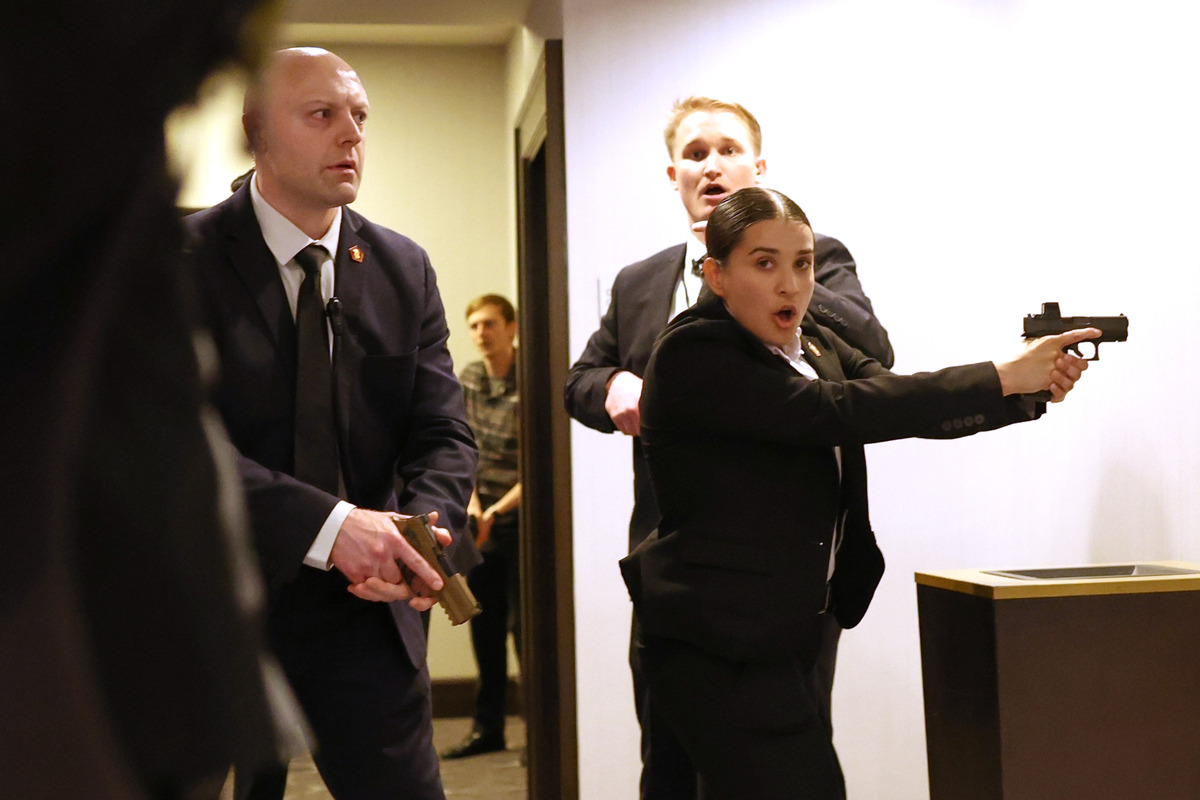
President Donald Trump praised law enforcement and the Secret Service’s response to a shooter charging through a security checkpoint and opening fire at the White House Correspondents’ Dinner in Washington, D.C. on Saturday night.
But the incident, and footage released shortly after the shots rang out and thousands of attendees were rushed from the Washington Hilton ballroom, raise questions about the level of security rolled out at the high-profile event packed with top politicians, celebrities and the president himself.
On the top of this list is why scanners weren’t put up before the entrance to the ballroom itself, whether enough agents were on duty, whether the hotel’s guests were vetted beforehand and whether the incident strengthens the Trump administration’s case for an elaborate new ballroom and bunker at the White House.
Shortly after the assassination of prominent conservative activist Charlie Kirk in September 2025, the White House said politically-motivated violence had “dramatically increased in recent years.”
Trump survived two assassination attempts during his campaign to be reelected as president in 2024, including when he was shot in the ear during a rally in Butler, Pennsylvania, in July that year.
A Senate report from the Committee on Homeland Security and Governmental Affairs looking into this shooting later criticized a “disturbing pattern of communication failures and negligence” in the Secret Service.
The Secret Service is responsible for protecting senior U.S. officials, like the president and vice president, as well as visiting heads of state.
An armed man was shot and killed in February this year after entering the secure perimeter of Trump’s Mar‑a‑Lago estate in Florida. Trump was in Washington, D.C. at the time.
Secret Service Did a ‘Fantastic Job’
Trump said the Secret Service and other members of law enforcement did a “fantastic job” in responding to the incident as it unfolded shortly after 8:30 p.m. ET.
Multiple shots were heard in the ballroom, and footage quickly emerged of Trump being rushed from the vast space by multiple agents. Another clip showed an agent dragging Vice President JD Vance from his seat.
“I was watching to see what was happening, probably should have gotten down even faster,” Trump said. He later remarked he had mistaken the gunshots for a tray clattering in the room.
The agents “acted very quickly,” Trump said, adding the alleged shooter was carrying “multiple weapons.” The Secret Service, in its own statement, said the alleged gunman “underestimated” the service and was “stopped at first contact.”
One Secret Service agent was shot, but was saved by a bulletproof vest and in “high spirits,” the president said. U.S. media reported on Sunday the agent had been released from hospital.
Trump quickly said the alleged gunman had been taken into custody, and posted a photograph of a man in handcuffs face-down on a carpeted floor. Another image verified by the Reuters news agency shows the suspect on the ground, surrounded by black-clad agents.
Multiple media outlets later named the suspect as 31-year-old teacher, Cole Tomas Allen, while the U.S. attorney for Washington, D.C., Jeanine Pirro, said the suspect would be formally charged on Monday on two counts for using a firearm during a crime of violence and assault on federal officers using a dangerous weapon.
Acting Attorney General Todd Blanche said on Sunday that “preliminary” investigations indicated the suspected shooter was “likely” targeting administration officials, including the president.
Authorities have not officially confirmed the alleged gunman’s identity.
Enough Security?
So early on from the incident, it’s hard to be sure whether enough security measures were put in place. The full picture will likely emerge in the coming days.
Opinion is, so far, split. Misha Komadovsky, U.S. correspondent for German outlet DW, said a single pass was the only thing needed to get into the ballroom and there had been no security screening before the lobby.
Newsweek’s White House reporter, Leonardo Feldman, said security teams were only placed on the exterior of the ballroom, rather than around the hotel itself.
There were no security scanners at the entrance to the building, although guards were stationed there, Feldman said. Other reporters present gave similar accounts, and Trump himself called the building “not particularly secure.”
Former U.S. President Ronald Reagan was shot during an assassination attempt at the same hotel in 1981.
The Secret Service said it had a “layered security posture” and a “myriad of countermeasures still ahead.” Blanche said the suspected gunman “barely broke the perimeter.”
Democratic Representative Ritchie Torres of New York said in a post on personal social media that “this failure of even the most basic security protocols—as inexplicable as it is inexcusable—demands an immediate investigation.”
The former British ambassador to the U.S., Kim Darroch, said there was “just one security thing you have to get past.”
Trump shared a 24-second CCTV footage clip showing a person racing through a security checkpoint before agents draw their weapons and aim toward the person.
Barry Donadio, a former Secret Service agent, told the BBC he had worked in the Washington Hilton and it looked like there were likely “more than enough” agents on site.
“But it is a hotel and it’s full of guests who are just there in the hotel,” Darroch also told the BBC.
Police said the alleged shooter was a guest at the hotel. It is not yet clear whether guests booked into the hotel at the time faced any kind of vetting. Newsweek has reached out to the Secret Service and White House for comment.
Is There Now a Greater Need for the Ballroom?
Trump, still dressed in black-tie attire from the dinner, told reporters the shooting strengthened the case for the new ballroom and underground military facility beneath the White House that has been at the center of a legal battle between the courts and the administration.
The U.S. government says the $400-million ballroom, which would replace the now-demolished East Wing of the White House, is vital to national security.
“It’s drone proof. It’s bulletproof glass. We need the ballroom,” Trump said, addressing reporters after being evacuated from the Washington Hilton. In a follow-up post to social media on Sunday, Trump added: “This event would never have happened with the Militarily Top Secret Ballroom currently under construction at the White House.”
The administration has planned a vast military bunker underneath the ballroom, kitted out with missile-resistant steel, ceilings impervious to drone attacks, and blast-proof glass.
But the plans have been mired in legal quagmire. The project was paused in late March, shortly after the National Trust for Historic Preservation sued the White House over the East Wing’s demolition. The Trump administration appealed the decision, insisting it was needed for national security.
A district judge ruled on earlier this month that all above-ground work must stop until approved by Congress, although this excluded work on the underground military complex and “national security facilities.” Trump accused this judge, Richard Leon, of going “out of his way to undermine” national security.
An appeals court then allowed the administration to forge ahead with all construction.
There has been a bunker underneath the East Wing for decades. Trump himself spent time in the Presidential Emergency Operations Center (PEOC), a World War II-era shield for the president and his inner circle, during the 2020 protests over the death of George Floyd.
The PEOC has now been ripped out, The New York Times has reported.
Read the full article here


