



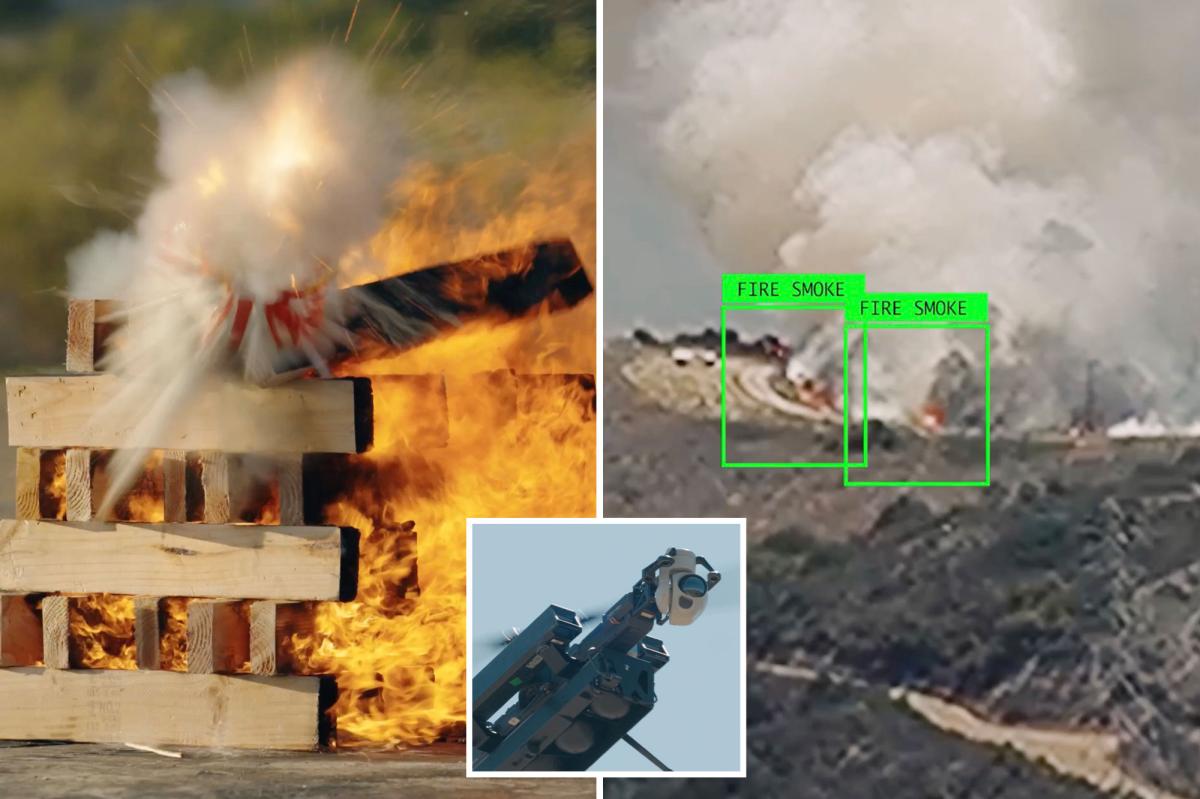
Wildfire detection is getting a high-tech overhaul, with autonomous drones and AI-powered sensors now being trained to spot flames and launch a response before a human firefighting crew can be deployed.
California-based Anduril took first place in the autonomous-response track of the $11 million XPRIZE Wildfire competition, winning $1.2 million after putting its Lattice system through live-fire testing in June.
The defense-tech company also collected a $1 million Lockheed Martin bonus for accurate detection, bringing its total prize haul to $2.2 million.
Lattice is designed to pull cameras, sensors, drones and suppression equipment into one coordinated system, allowing the technology to detect a fire and direct a response without requiring humans to manually connect each stage of the operation.
That speed was the central challenge in the competition.
Teams had to locate a high-risk blaze somewhere inside a 1,000-square-kilometer area of rural Alaska, then completely suppress it within 10 minutes while leaving decoy fires untouched.
“We want to be able to have technologies that can detect a fire before it’s detected by anyone else,” Andrea Santy, program director of XPRIZE Wildfire, told Ars. “A 911 call is still the most typical way that we find out about wildfires, and on average, that’s going to be at least 15 minutes.”
Anduril’s system successfully detected, fought and suppressed live fires during the finals, extending the company’s autonomous technology into wildfire response after it had already been used with its FQ-44 Fury uncrewed fighter and surface vessels.
The competition drew more than 300 teams into the autonomous-response track, with early proposals ranging from robotic dogs and ground systems to lasers and sound-based approaches.
By the final round, the focus had narrowed to technologies capable of handling the brutal combination of speed, distance and precision demanded by the test.
The results also showed how difficult the mission remains.
All three finalists found the high-risk fire within the 10-minute limit, but only two deployed drones attacked it, and none managed to completely extinguish the blaze, leaving the track’s grand prize unclaimed.
Dryad Networks finished second with $800,000, while AURA Foresight took third with $500,000.
The competition now heads into a 12-to-15-month Impact Phase designed to push the technologies closer to real-world deployment.
Video released by Anduril Wednesday shows the tech being put through its paces during a demonstration in California.
Download The California Post App, follow us on social, and subscribe to our newsletters
California Post News: Facebook, Instagram, TikTok, X, YouTube, WhatsApp, LinkedIn
California Post Sports Facebook, Instagram, TikTok, YouTube, X
California Post Opinion
California Post Newsletters: Sign up here!
California Post App: Download here!
Home delivery: Sign up here!
Page Six Hollywood: Sign up here!
Read the full article here


