



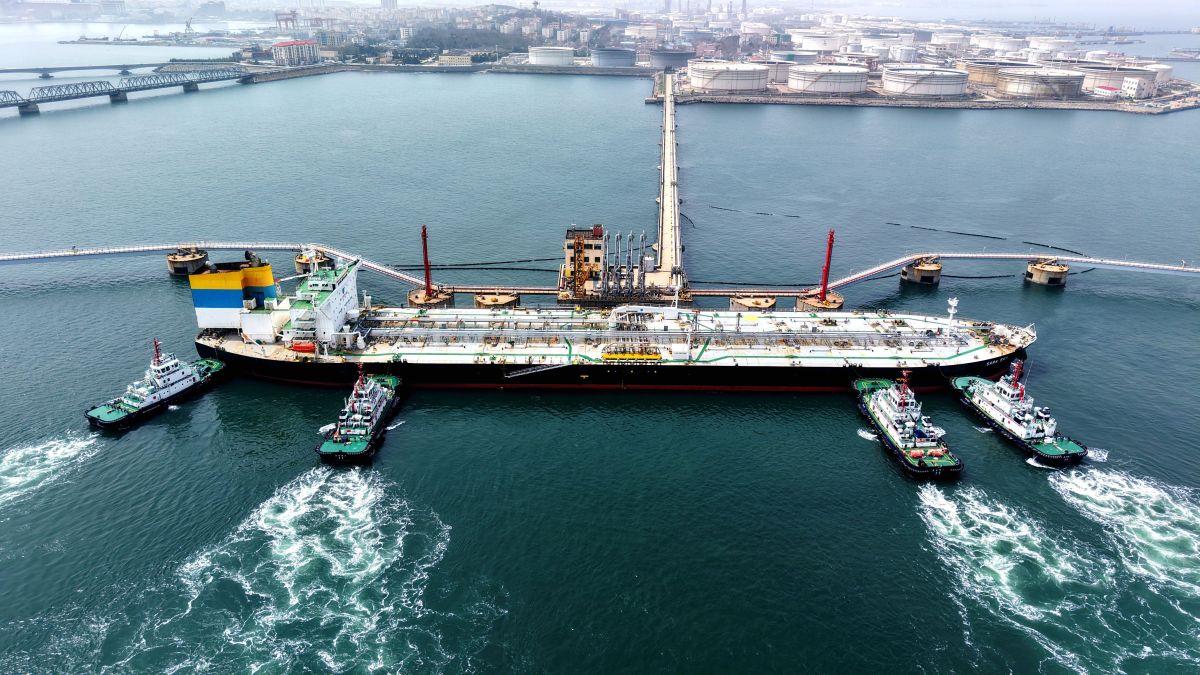
China repeated its push for the Strait of Hormuz to be reopened, issuing the joint message with America after U.S. President Donald Trump paid a visit to Beijing for meetings with Chinese President Xi Jinping.
Trump went in looking for Beijing’s influence on Iran, analysts believe—because China is close to Tehran and the buyer of more than 80 percent of its oil.
But China also has its own reasons for wanting to keep the strait open—for supplies of oil and gas. While it buys most of Iran’s oil, Iran is not its main supplier. China still sources from elsewhere.
Critically it has also built extensive reserves—and its response to the strait crisis these past 11 weeks has shown just how prepared Beijing is for the energy shock—for now.
But despite China’s considerable buffer, officials are getting impatient. The rising cost of crude globally is driving up transportation and logistics costs, and tightening margins for manufacturing firms.
Hormuz Oil Goes To Asia
“We did discuss Iran. We feel very similar about how we want that to end. We don’t want them to have a nuclear weapon. We want the straits open,” Trump told reporters following his meeting with Xi in Zhongnanhai, the leadership compound near Tiananmen Square that serves as headquarters for the Chinese Communist Party.
Xi would also consider resuming imports of U.S. oil, Trump said, because of the strait crisis. Chinese purchases of U.S. oil—which peaked at roughly 4 percent of China’s total imports in 2020—were halted in May 2025 amid flaring trade tensions.
The continent’s top economies are particularly reliant on those sea lanes, with Japan sourcing nearly all of its oil through the Strait of Hormuz, South Korea as much as 70 percent, and China and India roughly half of their oil imports.
China’s Foreign Ministry on Friday urged the U.S. and Iran to hammer out a ceasefire and reopen the Strait of Hormuz, where commercial shipping has remained near a standstill since the Gulf conflict erupted earlier this year.
Ministry spokesperson Guo Jiakun cited the “severe losses” suffered by the Iranian people and countries across the region, as well as “a heavy strain” on global growth, energy security and supply chains.
While China has repeatedly condemned the U.S.-Israeli attacks as illegal, the country has also voiced displeasure with Iran’s reprisals against vessels and oil infrastructure across the Gulf and work with Pakistan to bring Tehran to the negotiating table across from the U.S.
China has so far rebuffed Trump’s appeals for a more direct role, including potentially deploying naval vessels to safeguard shipping through the strait, Michal Meidan, head of China Energy Research at the Oxford Institute for Energy Studies, told Newsweek.
“China has not intervened diplomatically in the Middle East out of concern that it did not have enough leverage on all parties, that it would not be able to broker a deal, or that it could backfire given its extensive ties throughout the region.”
Adding to tensions are Washington’s sanctions against several Chinese teapot refineries and move last month to threaten secondary sanctions on banks doing business with them.
World’s Largest Stockpile
Underpinning China’s resilience is its aggressive stockpiling, with an estimated 1.4 billion barrels of crude in its vast storage network, according to the U.S. Energy Information Administration. That’s enough to cover at least three months of import demand.
Since building its first strategic reserve site in 2006, China has stepped up stockpiling with an eye toward energy security, drawing lessons from the COVID-19 pandemic and geopolitical volatility from crisis such as Russia’s full-scale invasion of Ukraine.
China stepped up its stockpiling in early 2025, even as fuel demand in the country was believed to be peaking, after introducing an energy law requiring both state-owned and private-energy firms to maintain reserves. China’s inventories of crude are fourfold the size of Japan’s and more than three times the size of the United States Strategic Petroleum Reserve.
“The driving force behind this long-term trend is the Chinese government’s strong emphasis on energy security. Ensuring a secure crude oil supply, improving inventory regulation, and expanding inventory capacity remain priorities in China’s next five-year plan,” said Melissa Tan, director of communications in Asia at S&P Global Commodity Insights.
“Even though China’s oil demand is approaching its peak, the country remains highly dependent on imported crude, and total import volumes remain at elevated levels. The rapid increase in crude inventory levels in 2025 was also supported by weaker oil prices and storage capacity expansion,” she told Newsweek.
China accounted for less than one-fifth of the global increase in oil demand in 2024, down from more than 60 percent between 2013 and 2023, according to the International Energy Agency, which attributed the shift to China’s transition from manufacturing-led to service-led growth and the rapid adoption of electric vehicles.
Another factor was the global oil supply glut, driven by sluggish consumption growth in advanced economies and the decision by OPEC+ producers to raise output targets as new production came online. China’s high adoption of green energy, continued heavy coal use and diversified oil supply sources further insulate the country.
How Long Can China Hold Out?
China’s oil imports in April fell by 20 percent to 38.5 million metric tons—or 9.4 million barrels per day—according to the country’s General Administration of Customs—the lowest figure since July 2022.
This contraction was expected, given the lag time for tankers departing the Persian Gulf on their weekslong journey to China. S&P expects China to begin dipping into stockpiles this month.
But the country is far from running dry. “China is not at risk of running out of crude for many months. It’s a question of costs and broader economic impacts,” Meidan said.
“So the supply shortfall is significant, but so is the ability to substitute parts of the loss.” Even if the Strait of Hormuz were completely blocked, China can still source 60 percent of its oil from other suppliers outside the Middle East, including Russia’s sanctioned crude, he said.
“Domestic demand is also relatively weak, so Chinese refiners have been cutting refinery runs.”
China’s supply losses—or the share of its crude imports likely to be cut off in a disruption—from Gulf volumes excluding Iran would amount to less than 20 percent of its total imports based on the 2025 average, Jianan Sun, senior oil analyst at Energy Aspects, told Newsweek.
Oil sourced from the Middle East accounts for close to half of China’s crude imports. While Chinese customs data does not officially record imports of Iranian oil because of U.S. sanctions, Iranian crude makes up about 13 percent of China’s total imports, analytics firm Kpler estimates.
These shipments are largely delivered via the so-called shadow fleet and transferred through ship-to-ship operations before delivery to China’s so-called “teapot refineries.” Largely in the northern province of Shandong, these independent refineries account for an estimated 25 to 30 percent of the country’s total refining capacity, according to estimates by the Economist Intelligence Unit.
Exporting Fuel While Others Tighten Their Belts
While the disruption has forced Japan and South Korea to tap into their strategic reserves—and Southeast Asian countries such as Vietnam and the Philippines to introduce fuel-saving and fiscal measures to mitigate skyrocketing prices—China has faced less pressure to take drastic steps.
This buffer has enabled Beijing to move more selectively to protect domestic fuel security, including ordering refiners to suspend fuel exports on March 12.
While that initial move may have bruised some neighboring economies, China—Asia’s fourth-largest exporter of gasoline, diesel and jet fuel—has since resumed exports of these three so-called clean fuels to countries including Australia, Malaysia and Sri Lanka, signaling that officials assess domestic inventories to be stable.
State energy companies this month are being allowed to export a total of 500,000 metric tons of fuel, or around 16,700 metric tons per day, Reuters reported, citing anonymous sources familiar with the matter. That is more than double the roughly 10,700 tons per day approved for April, though still well below the more than 53,000 tons per day average seen last year, per Kpler.
These efforts align with Chinese Foreign Ministry pledges to provide support amid shortages in the region. In addition to allowing Chinese state-run energy giants such as Sinopec to profit from higher international margins, the move also functions “as a sign of goodwill to support regional economies,” Meidan said.
China has less of a buffer in liquefied natural gas, with about 30 percent of its LNG imports coming from Qatar and the United Arab Emirates, leaving it more exposed to disruptions in Gulf shipping routes.
Read the full article here


