



As the war in the Middle East continues to tighten global oil supplies by 12 million barrels per day, the European Union is scrambling to address soaring energy bills and urging people across the bloc to reduce driving.
The level of alert across the EU27 intensified when Energy Commissioner Dan Jørgensen shifted the focus from a pricing issue to a potential supply disruption following an emergency meeting of energy ministers on March 31.
The Danish Commissioner told EU governments that diesel and jet fuel were at greater risk of shortages due to reliance on the Middle East, warning of a “potential prolonged conflict” and calling for “unity among EU countries”.
The EU consumes about 10.5 million barrels of oil per day, roughly 10% of global demand, led by Germany (2.3 million barrels), France (1.6 million barrels), and Italy (1.3 million barrels).
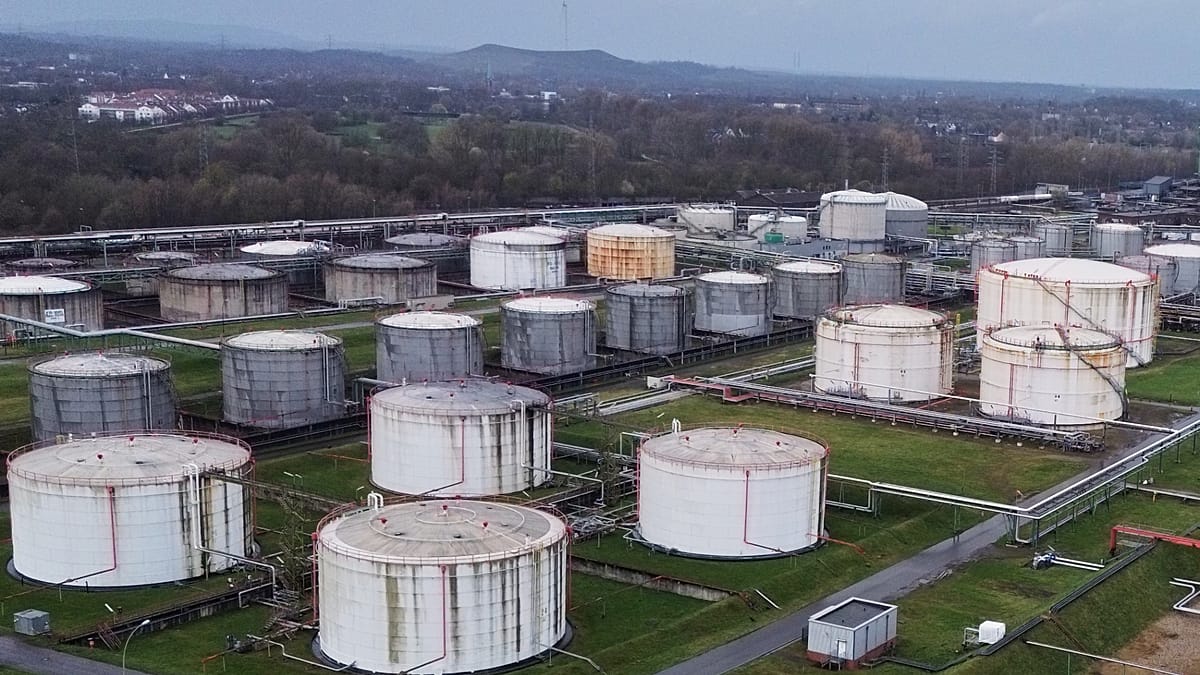
The bloc has emergency oil reserves of around 100 million barrels, typically a blend of crude oil, diesel, and gasoline, of which roughly 92 million were released on March 11 as part of the International Energy Agency’s coordinated release of 400 million barrels.
Oil reserves and storage as buffers
The reserves are held by national governments, while the European Commission coordinates responses during crises to ensure a unified approach. They are estimated to cover around 90 days of net imports, or about 61 days of consumption.
France (120 million barrels), Germany (110 million barrels) and Italy (76 million barrels) are the major EU holders, according to EU data.
Large reserves are also held by Spain, while countries like Belgium, Luxembourg, and Malta hold substantial reserves in other EU countries.
Twenty of the EU27 member states have contributed to the IEA-coordinated emergency release of oil, totalling 91.7 million barrels, or roughly 20% of the 400 million barrels released on 11 March. Germany released 19.5 million barrels, followed by France (14.6), Spain (11.6) and Italy (10).
Energy analysts estimate that the released oil reserves currently in use can last around 5 months.
“The reserves released by the IEA are already being used. So far, they have been used domestically. It depends on the countries, but they are being released at a pace of around 2.5 million barrels per day, so it will take about 160 days,” Homayoun Falakshahi, senior energy analyst at the trade intelligence agency Kpler, told Euronews.
Fatih Birol, head of the IEA, said on April 1 in a podcast with Nicolai Tangen, CEO of Norges Bank Investment Management, that he is considering a further release from strategic oil reserves. A similar sentiment was expressed by Commissioner Jørgensen, who told the Financial Times on April 2 that the bloc “will not rule out another release” if conditions worsen.
Storage and domestic reserves
Additionally, EU storage currently holds 270 million barrels of crude oil, according to Kpler, roughly enough for three weeks of consumption, after being refined into diesel, gasoline or jet fuel.
Strategic reserves and inventory drawdowns are currently doing much of the remaining adjustment, supporting around 6 million barrels per day of demand, the independent economic advisory firm Oxford Economics said.
However, analysts warn that these buffers are finite and become less effective over time, forecasting a shortfall of around 2 million barrels of oil per day.
“In our prolonged Iran war scenario, we estimate the gap widens to around 13 million barrels of oil per day by the sixth month,” said Bridget Payne, head of oil and gas forecasting at Oxford Economics.
While the 2022 energy crisis mostly affected natural gas imports, after the bloc abruptly lost 40% to 45% of its Russian fuel, the situation is becoming increasingly difficult as a major oil shortage now takes hold.
The bloc’s current predicament prompted the oil industry to recall roughly 4 billion barrels of untapped oil resources across Europe, according to the International Association of Oil and Gas Producers (IOGP).
“The question isn’t if we need them or not — we clearly do. The real choice is whether we produce them at home or import more from abroad,” Nareg Terzian, IOGP Europe’s head of strategy and communications, told Euronews.
Terzian suggested these unexplored resources are a “safety net at the EU’s disposal” alongside the bloc’s continued efforts to electrify and improve energy efficiency, through building insulation and technologies that help reduce energy consumption.
“Aside from the historical North Sea and onshore fields, a lot more could be discovered in relatively new exploration areas such as the Eastern Mediterranean and the Black Sea,” Terzian added.
Read the full article here


