



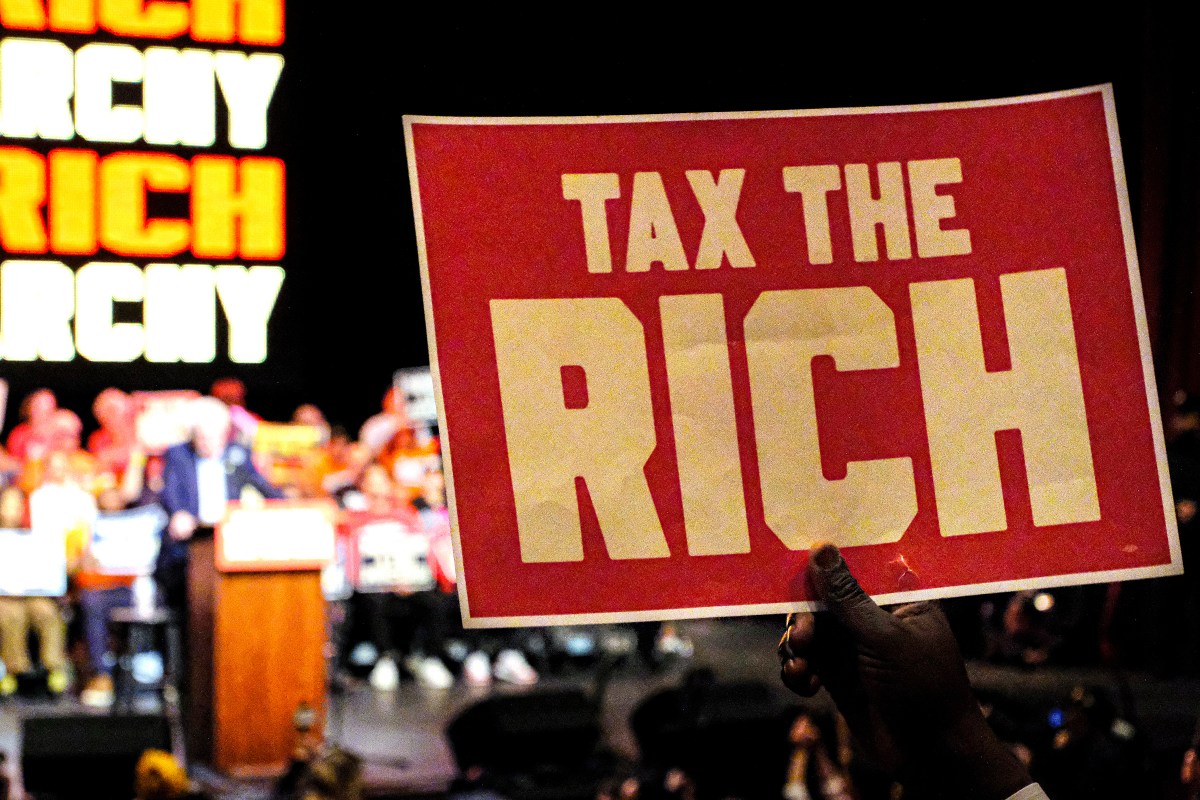
A much-debated proposal to place a new tax on California billionaires has collected enough signatures to reach state voters in November, a labor union backing the measure announced over the weekend.
The so-called “California Billionaire Tax,” spearheaded by the Service Employees International Union-United Healthcare Workers West (SEIU-UHW) union, calls for the introduction of a one-time 5 percent tax on the assets of California residents with at least $1.1 billion.
Despite the strong opposition of Democrat Governor Gavin Newsom and other powerful people in the state, including many Silicon Valley executives, the proposal obtained more than 1.6 million signatures, the union said.
That is double the signatures the proposal needed to go on the November ballot, where it is now headed. This leaves it to California voters to decide whether they support the measure or not.
The significant support the petition has obtained among California voters shows Americans are growing tired of the deepening wealth inequality gap in the country, and, when given the chance, are turning against the richest among them to try to correct the imbalance.
How Rich Are America’s Ultra Rich?
America’s wealth inequality, which has deepened during the COVID-19 pandemic, reached its widest gap last year.
The top 1 percent of households in the U.S. owned 31.9 percent of all the nation’s wealth in the last quarter of 2025, according to data by the Federal Reserve—the highest share on record since the bank began tracking household wealth in 1989 and almost as much as the bottom 90 percent combined. During the same period, the bottom 50 percent held just 2.5 percent.
Collectively, America’s top 1 percent held $25.4 trillion in wealth in the last quarter of 2025, nearly double what they owned in the last quarter of 2019, just before the pandemic, at $13.53 trillion. The bottom 50 percent could count on just $4.31 trillion in wealth.
Not only the richest in the country are getting richer—but they are doing so much faster than regular Americans. According to an Oxfam International report, billionaire wealth increased three times faster than the average annual rate between 2020 and 2025.
Mark Zandi, chief economist at financial research firm Moody’s Analytics, explained to CBS News earlier this year much of this disparity has been exacerbated by the positive performance of the stock market in previous years, which millionaires’ and billionaires’ wealth is tied up to. Most U.S. middle-income households, on the other hand, rely on the equity generated by their homes for their wealth—and home price growth has slowed down significantly over the past couple of years.
On top of that, higher-income Americans have seen their wages increase much faster than those of other income groups. According to Bank of America’s data, higher-income households’ wages grew by 3 percent year-over-year in December 2025, compared to 1.5 percent and 1.1 percent for middle- and low-income households.
Which States Are Considering Taxing the Rich More?
These are the states with ballot initiatives or active proposals to tax the rich.
California
California’s billionaire tax would introduce a one-time 5 percent annual wealth tax on state residents with assets exceeding $1.1 billion.
It is expected to generate roughly $100 billion which should be sufficient, according to the SEIU-UHW who is backing the proposal, to cover for cuts to healthcare implemented by the Trump administration.
The signatures collected need to be verified by county registrars before moving forward to qualify for the November ballot. At least 875,000 signatures must be valid. For the tax to be implemented, voters would then need to approve the proposal.
Connecticut
Connecticut lawmakers are considering several proposals to increase taxes on the state’s richest residents. HB 5133 would increase the state’s highest marginal income tax from 6.99 percent to 7.99 percent. SB 104 would establish a capital gains surcharge on certain taxpayers. And finally, SB 101 would establish a state-wide property tax on residential real property with assessed values of more than $3 million.
This last bill would represent a massive change for Connecticut where property taxes are imposed by local municipalities and not the state.
All proposals had public hearings in late February and are pending further action.
Hawaii
Hawaii lawmakers have proposed a wealth tax on individuals, estates, and trusts in the state with assets over $20 million.
The proposal passed the Senate Judiciary Committee last year but has not proceeded through the state legislature since then. If passed, it would come into force as of January 1, 2030.
Illinois
Lawmakers in Illinois attempted to put on the ballot in November a proposal to introduce a 3 percent “millionaire tax” surcharge on income above $1 million.
The proposal, however, failed to garner enough support from House Democrats and it is extremely unlikely it would reach voters this year, according to ABC7.
“We were very close, very close,” House Speaker Emanuel “Chris” Welch, a Hillside Democrat, said in a statement. “But close is not enough and we’re committed to getting it right. We’re going to continue to work towards it.”
Michigan
A ballot campaign seeking to impose a 5 percent tax surcharge on high earners in Michigan, the so-called Invest in MI Kids, would raise more than $1 billion annually, according to backers, to fund K-12 schools. The measure, if implemented, would only affect less than 1 percent of the top earners in the state, Michigan League for Public Policy found.
The proposal is still gathering signatures to get on the November ballot.
New York
After pressure from New York City Mayor Zohran Mamdani to introduce higher income taxes on the state’s ultrawealthy, Democrat Governor Kathy Hochul—who strongly opposed the proposal—has offered something of a compromise.
The governor has proposed a pied-à-terre tax which she said would be able to close New York City’s budget gap. The measure, which would impose an annual surtax on non-primary residential real estate worth more than $5 million, would be New York’s first pied-à-terre.
Mamdani’s office has estimated it could raise about $500 million a year. Officials have not yet released any details on the new tax, including the rate or timing.
Pennsylvania
By the end of last year, roughly 20 Pennsylvania lawmakers had backed the “Tax Billionaires, Fund PA”, a proposal which backers said would raise $7 billion annually through closing corporate tax loopholes, enacting a digital advertising tax, and taxing billionaire passive income.
The number of legislators backing the proposal has now reached 26, according to the campaign, but it’s unclear what comes next.
Rhode Island
Democrat Governor Dan McKee has endorsed a so-called millionaire’s tax in the state, inserting in the fiscal 2027 budget a 3 percent surtax on income over $1 million. The budget—and the measure—has not yet been approved.
According to McKee, the surtax would generate an estimated $67 million in revenue in fiscal year 2027 and $135 million by fiscal year 2028.
Vermont
Vermont lawmakers have proposed a new 3 percent tax on individuals with an adjusted gross income exceeding $500,000 and an additional 2 percent on income above $1 million.
If passed, the measures—which local news media report would apply to “a very thin slice” of residents—are expected to generate over $110 million annually.
Virginia
Virginia lawmakers have introduced two bills, HB 378 and HB 979, which would increase taxes on certain forms of investment income by 3.8 percentage points and create two new individual income tax rates on high earners at 10 percent and 8 percent, respectively.
The bills have not yet been approved, but would be valid as of fiscal year 2027.
Which States Have Recently Introduced Higher Tax on the Rich?
And these are the states which have recently approved and implemented new or higher taxes on the rich.
Maine
Maine approved a 2 percent income-tax surcharge on income over $1 million for individual filers and $1.5 million for joint filers. The measure was signed into law in April as part of a supplemental budget.
Maryland
Maryland lawmakers approved a package of progressive tax increases, including new higher income-tax brackets for earners above $500,000 and $1 million, as well as a capital‑gains surtax for households earning more than $350,000.
The measure was signed into law last year as part of the state budget.
Washington
Lawmakers in Washington approved a proposed “millionaires tax” calling for the imposition of a 9.9 percent tax on income above $1 million. The success of the proposal marked a significant shift for the state, which did not traditionally have an income tax.
The measure was signed into law in March 2026 and is scheduled to take effect into 2028.
Read the full article here


