



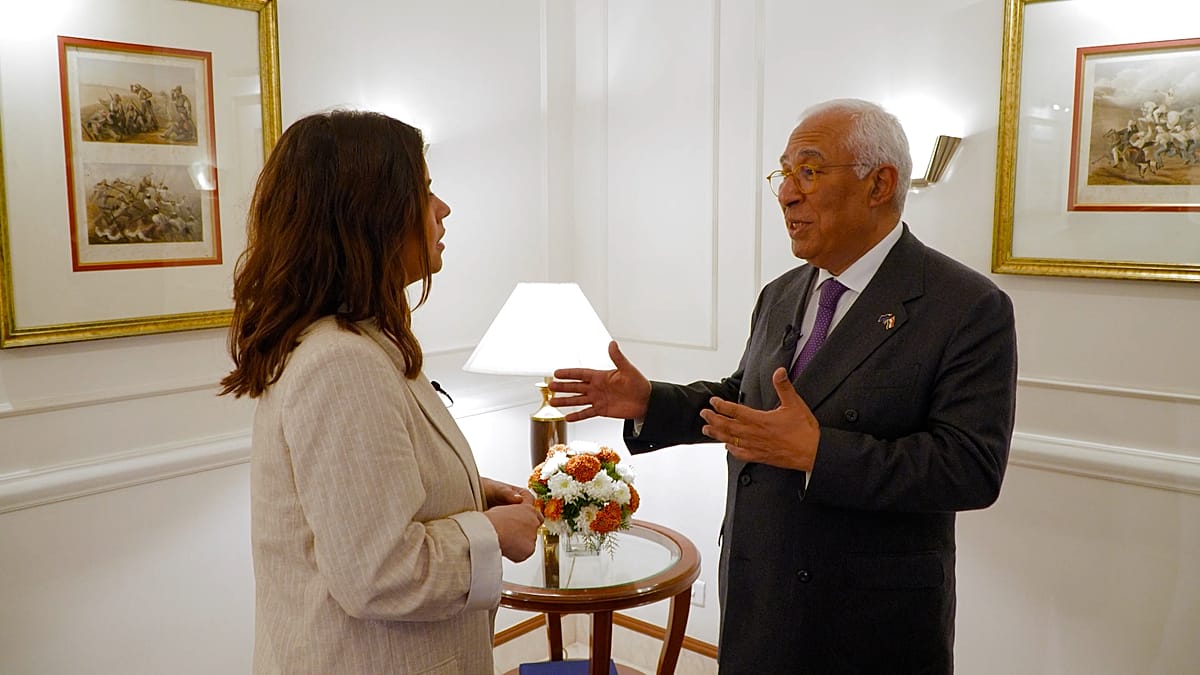
The European Union is reasserting itself in a multipolar world after signing what has been dubbed the “mother of all deals” with India this week, European Council President António Costa told Euronews.
In an interview from Delhi after the agreement was concluded on Tuesday, Costa said the deal provided predictability for businesses and investors but also security in a “very unpredictable world”.
“The deal has great value from an economic view, but perhaps more important is the message that the two largest democracies in the world are sending to the international community,” he said. “It’s important, it’s essential to provide predictability to engage in cooperation instead of confrontation.”
Costa rejected claims that this is the end of the multilateral trade system, stating the opposite is true, that the deal is in fact a “very important way to underpin the multilateral system”.
“We are living in a multipolar world. And in this world, we need to underpin the multilateral system, uphold international law, and engage bilaterally with the different parts of the world,” Costa added, citing a string of trade deals reached by the EU over the past year including with Mercosur.
Alternatives to US market
The deal will see tariffs reduced on more than 90% of European exports, saving approximately €4 billion in duties each year.
It comes as countries around the world seek alternatives to the United States market, following President Donald Trump’s aggressive tariff policy.
Since “Liberation Day” in April 2025, the US has imposed trade tariffs on friends and foes alike.
Last summer, Washington brokered a contentious trade agreement with Brussels at Trump’s Turnberry golf course in Scotland.
While the agreement brought US tariffs on most European goods down from the 30% Trump had threatened as part of his wave of tariffs in April, it effectively tripled the pre-“Liberation Day” tariffs on EU exports. This spurred recriminations from members of the European Parliament and criticism that the EU capitulated to the US.
In response, the European Commission has reinvigorated its trade agenda, looking for new markets from Latin America to Asia.
India, for its part, is currently operating under a 50% tariff regime imposed by Washington in retaliation for Delhi’s continued purchasing of Russian oil.
The Trump administration indicated it could lower the tariffs, which at their current rate effectively shut down Indian exports into the US, only if Indian Prime Minister Narendra Modi halts imports of Russian crude oil.
Asked if he feared retaliation from the US administration because of the EU-India agreement, Costa said no.
“Why (should we)?” he asked. “We fixed the trade agreement with the United States. It’s now in the European Parliament to be approved. And we are diversifying our trade relationships.”
A European official told Euronews that the complex geopolitical scenario, coupled with the introduction of tariffs, gave new momentum to negotiations to seal the deal with India.
Costa added that, when “several economic global agents are disturbing the global trade”, trade agreements are needed to “stabilise the trade relationship”.
India’s trade minister, Piyush Goyal, told Euronews at a press conference that Trump’s policies had not featured in bilateral discussions during the three-day visit, which saw a large European delegation led by Costa and EU Commission President Ursula von der Leyen treated with state honours.
“It didn’t come up,” Goyal said. Costa seconded his comments.
“Don’t you think India and Europe are big enough to focus on ourselves? This summit was about India and the European Union, and nothing else,” Costa said.
Read the full article here


