

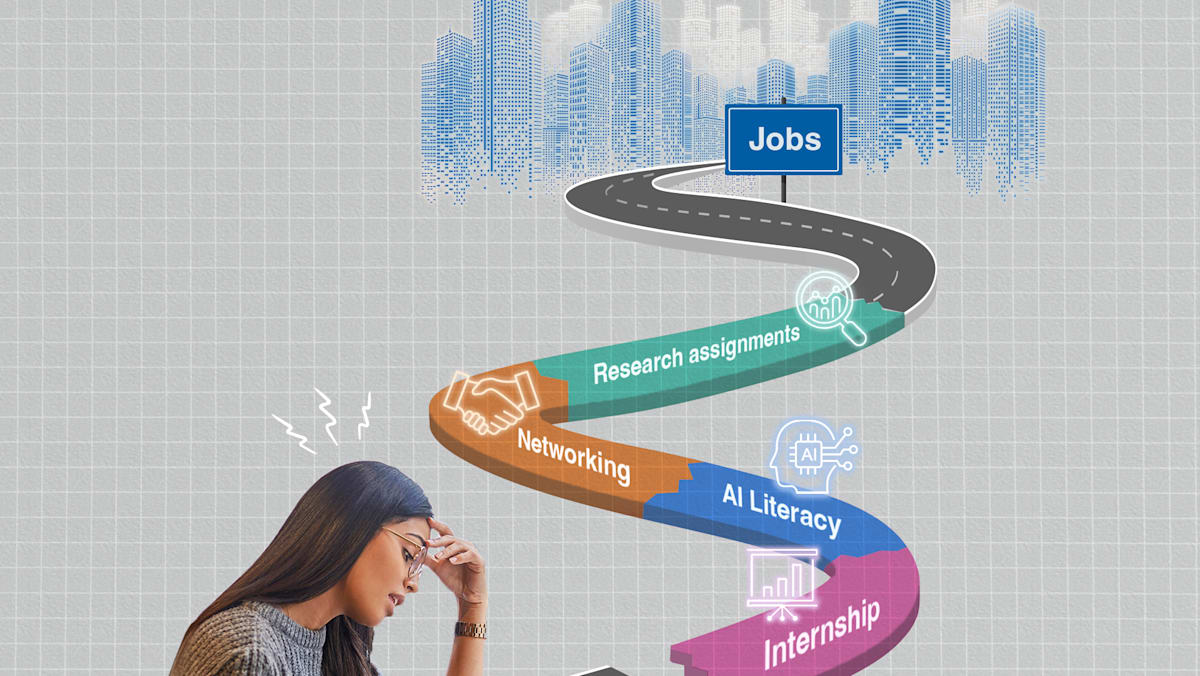
BRIDGING THE GAP BETWEEN CLASSROOMS AND CAREERS
Students’ concerns are not simply about what they are learning, but whether what they are learning today will still matter by the time they graduate.
As AI rapidly changes entry-level jobs and employment opportunities, employers are increasingly seeking practical skills alongside academic qualifications, experts told CNA.
“The expectations have shifted from ‘What does the candidate know?’ to ‘What can the candidate do with what they know?’” said Kishore Selva Babu, Director of the university student council at Bengaluru-based Christ University.
Alongside technical knowledge, recruiters increasingly expect graduates to demonstrate practical application, communication skills, adaptability and familiarity with AI tools, said Babu.
Students who have completed internships, worked on industry projects or can show evidence of applying classroom learning in professional settings are often viewed more favourably than those relying solely on academic performance, he explained.
He added that universities in India are trying to respond through live case studies, debates, industry projects and greater exposure to AI and digital tools, but acknowledged that curriculum reform naturally moves slower than industry itself.
Kamal Karanth, co-founder of recruitment firm Xpheno, said that the problem runs deeper than simply updating the university syllabus.
“The challenge with academic programmes is often the lag between market demand and the academic output window,” he said.
By the time universities introduced specialised programmes and certifications to meet demand, AI and automation had already transformed large parts of the industry, reducing the need for many entry-level human roles, said Karanth.
Read the full article here
