


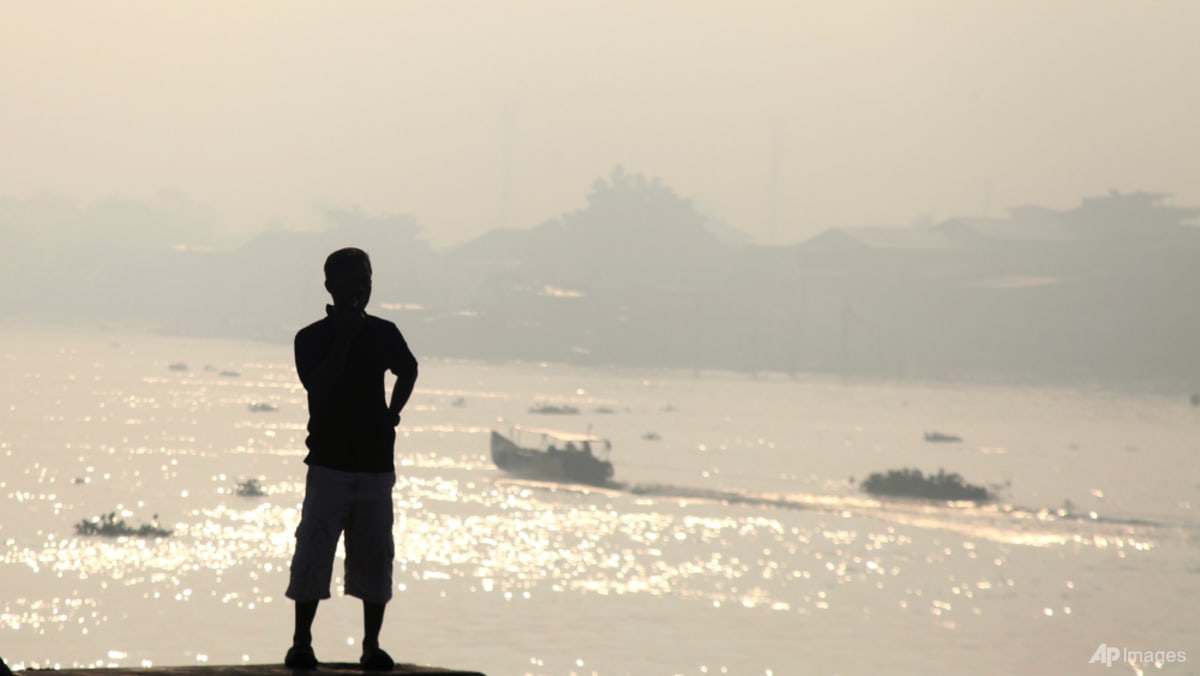
Non-governmental organisations have set up two shelters in Palangkaraya, the capital of Central Kalimantan on Borneo island, for babies and children affected by the haze, with more planned.
The shelters, which can accommodate only five children at a time, were equipped with baby formula and oxygen tanks, medicines, and a playground.
Katharina Abi, 30, brought her two small children, aged one and five, to one of the shelters on Aug 28 as thick smoke blanketed their home.
“There’s a lot of smoke at my house. In the morning it’s not too bad, but in the afternoon and evening there’s so much dust, like there’s a fire nearby. It really bothers my breathing,” she told AFP.
“My children often have coughs and colds, maybe because there is a lot of smoke.”
‘GODZILLA’ EL NINO
Dante said prolonged exposure to toxic air can cause serious longer-term health complications.
He said the ministry has distributed more than five million masks across Indonesia – a country of 289 million people dealing with the effects of a super-charged El Nino weather event dubbed “Godzilla”.
Disaster agency BNPB said on Aug 28 the government has intensified efforts to battle wildfires, with some success.
“Cloud seeding remains one of the measures to support efforts to tackle forest and land fires. Its implementation depends heavily on atmospheric conditions and the presence of rain-bearing clouds in the target areas,” BNPB spokesman Berton Suar Pelita Panjaitan told AFP.
“However, cloud seeding is not the only effort, because the ground and air task forces continue working in the field to carry out extinguishing and cooling operations,” he said.
The agency said it has poured more than four million litres of water on burning areas in the recent weeks, and on Aug 26 alone it scattered more than 8,000kg of salt onto clouds.
Cloud seeding involves sprinkling silver iodide, salts or other particles into clouds to trigger precipitation.
Such operations this week succeeded in prompting light to moderate rains over east and south Sumatra and west Kalimantan, Berton said.
Read the full article here