



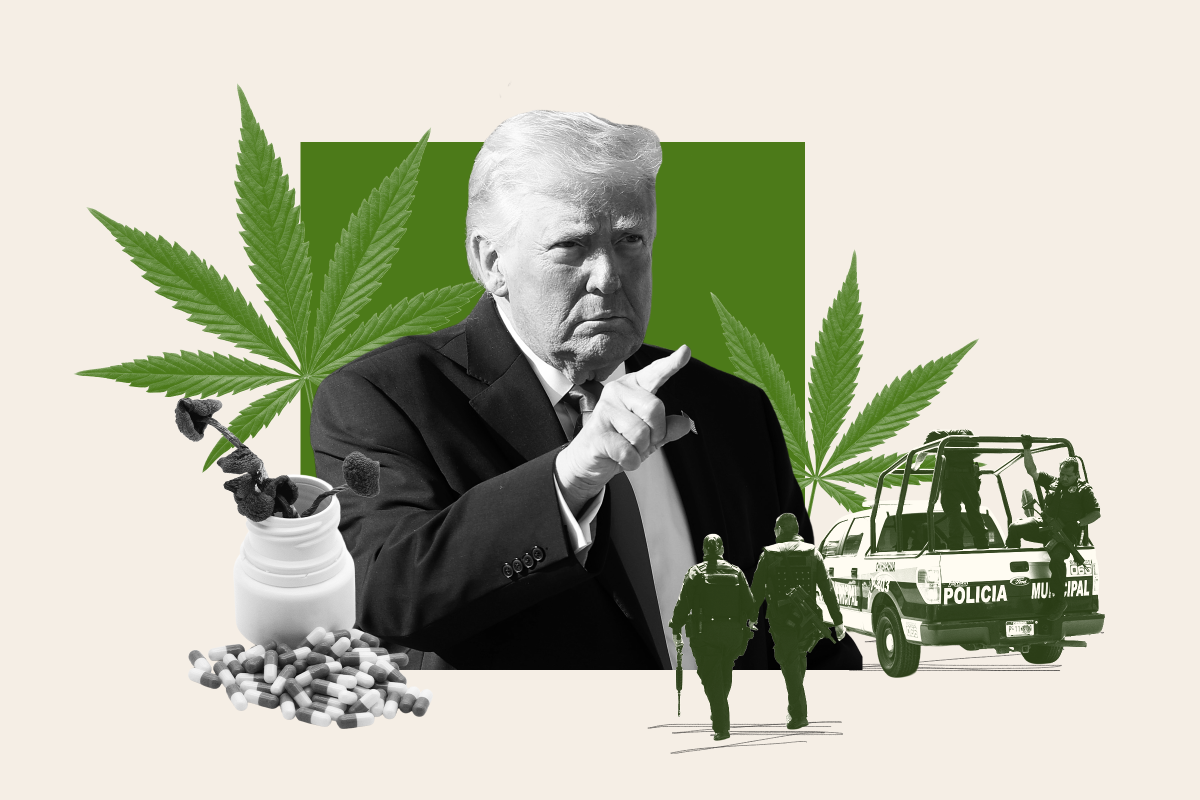
On April 18, flanked by Joe Rogan, a Navy SEAL and Rick Perry’s ibogaine consortium, President Donald Trump signed an executive order to fast-track psychedelic drug approvals. Four months earlier, he directed federal agencies to reschedule marijuana to Schedule III. In both ceremonies, the same frame appeared: Trump positioning himself as the champion of “medicines of healing” against “poison pushed by cartels.”
No president since Richard Nixon launched the war on drugs in 1971 has moved so far, so fast, on making controlled substances more accessible. Yet simultaneously, Trump has weaponized fentanyl enforcement, defunded harm-reduction programs by hundreds of millions and cut nearly $1 trillion from Medicaid—the primary source of addiction treatment in America.
The contradiction sits at the center of a drug policy that is, at once, the most permissive and the most militarized in modern history.
Execution Over Rhetoric
Trump’s December 18 cannabis order directed then-Attorney General Pam Bondi to complete Drug Enforcement Administration (DEA) rulemaking “in the most expeditious manner,” moving medical marijuana from Schedule I to Schedule III. The April 18 psychedelics order moved faster: Food and Drug Administration (FDA) Commissioner Marty Makary announced three Commissioner’s National Priority Vouchers would go to “serotonin 2a agonists”—psilocybin and LSD derivatives—the following week. Stocks in Compass Pathways, which makes synthetic psilocybin, surged 42 percent on the news.
The executive orders represent genuine movement where predecessors stalled or hesitated. Jimmy Carter attempted decriminalization in 1977, and Congress killed it. Barack Obama issued the Ogden and Cole memos, deprioritizing federal cannabis enforcement in state-legal jurisdictions, but kept cannabis Schedule I and denied rescheduling petitions in 2011 and 2016. Joe Biden pardoned roughly 6,500 people for simple marijuana possession and initiated rescheduling in May 2024—but the process stalled in administrative litigation. DEA Administrator Anne Milgram conspicuously refused to sign the Notice of Proposed Rulemaking, breaking decades of precedent. An administrative law judge hearing in January 2025 stayed the entire proceeding one week before Biden left office.
Trump didn’t ask for review. He ordered it done.
Jeffrey Singer, a physician and drug-policy analyst, told Newsweek that Trump has genuinely moved where others hesitated. “No one had moved cannabis off Schedule I before,” Singer said. “Biden talked about it, but Trump actually did it. The same dynamic applies to psychedelics—progress, but still heavily restricted.”
In practical terms, the change reclassifies marijuana from Schedule I—alongside drugs like heroin and LSD, which are considered to have high abuse potential and no accepted medical use—to Schedule III, a less restrictive category that includes ketamine and some anabolic steroids. Schedule III drugs are considered to have moderate to low risk of dependence.
The shift also eases tax burdens on cannabis businesses. Under Schedule III, they can deduct standard operating expenses on their federal taxes—something currently prohibited even though many operate legally at the state level.
Yet Singer noted the rescheduling has limits. “Once rescheduled, cannabis products still need FDA approval, which takes time and clinical trials. If approved, they’ll only be available by prescription,” he said. “Compare that to alcohol—you don’t need a prescription to buy it, and you don’t need a medical condition to justify it. Cannabis should be treated the same way.”
The National Association of Criminal Defense Lawyers called the cannabis order “an incremental, imperfect improvement—a small step off the cliff of cruel prohibition”—but also warned it’s “not the lifeline for justice we desperately need.”
Jeffrey Miron, a Harvard economist and longtime drug-policy researcher, told Newsweek that the gap between policy and rhetoric matters most. “Moving marijuana from Schedule I to Schedule III would allow doctors to legally prescribe it, which isn’t currently allowed,” Miron said. “That would be a net positive, though it wouldn’t fully bring the market above ground under federal law.”
The psychedelics order moved with even greater speed and symbolism. On the same day Trump signed the April executive order, Makary announced that three companies would receive Commissioner’s National Priority Vouchers—an expedited review track that collapses the usual FDA timeline from months to weeks. The vouchers went to two companies studying psilocybin for treatment-resistant depression and one studying methylone, a compound related to MDMA, for post-traumatic stress disorder.
Medicines and Military Strikes
But the same administration that signed these orders has simultaneously dismantled the infrastructure that treats addiction.
In July 2025, Trump signed an executive order barring federal grants for harm-reduction programs—syringe services, naloxone (the overdose reversal drug) and safer smoking kits designed to reduce infection and overdose risk among active users. SAMHSA, the federal substance abuse agency, lost roughly half its staff. The National Survey on Drug Use and Health team was eliminated entirely. In January, the Department of Health and Human Services terminated roughly $2 billion in SAMHSA grants before reversing course after bipartisan outcry.
Simultaneously, Trump designated illicit fentanyl as a Weapon of Mass Destruction—a legal designation that triggers military and intelligence agency involvement in enforcement. He authorized military strikes on suspected drug vessels in the Caribbean and Eastern Pacific, and signed the HALT Fentanyl Act into law, imposing 10-year mandatory minimums for possession of 100 grams or more.
When asked how the administration reconciles calling this the most open drug policy while cutting harm-reduction infrastructure, Singer offered a libertarian viewpoint. “From a libertarian perspective, I don’t think taxpayers should fund these programs. But the government shouldn’t obstruct them either,” he said. “Safe consumption sites have been shown to reduce overdoses and public drug use. The best approach is to remove legal barriers and let private organizations provide harm-reduction services.”

Maritza Perez Medina, policy director at the Drug Policy Alliance, characterized the contradiction as deliberate. “This administration is using fentanyl as a pretext to escalate military conflicts abroad and kill people in foreign waters without any evidence that these unauthorized strikes have anything to do with fentanyl,” she said in a statement to Newsweek.
“If the administration is truly concerned about the harms of fentanyl, they should invest in what works instead of cutting access to lifesaving care.”
The evidence on what actually saves lives tells a different story than the orders suggest. Overdose deaths continued falling: 87,000 in the 12 months ending September 2024, the lowest since June 2020—a trend that predates Trump’s harm-reduction cuts and reflects years of public health investments he is now dismantling.
For Perez Medina, the administration’s framing is unmistakable: medicines of healing for the sick, weapons of war for traffickers. Yet the collateral damage is immediate and measurable.
“The administration’s public health cuts are kicking people off their healthcare plans, gutting overdose prevention services, closing hospitals and community health centers, and making addiction treatment inaccessible and unaffordable for the average American. The contradiction is glaring.”
Kevin Sabet of Smart Approaches to Marijuana was unsparing in his assessment. “This is drug policy at its worst being dictated by podcasters and active addicts who have an important voting base,” he said in a statement after the psychedelics order. “The idea that we’re gonna make pot gummy bears and super silver haze strains and 99% waxes that are causing psychosis and schizophrenia among children schedule three now just makes absolutely no sense. So, we’re going to be fighting this. This is not over.”
Dimitri Mugianis and Ross Ellenhorn, founders of Cardea, a psychedelic-assisted care organization based in New York, warned that Trump has “supported sweeping tax and spending legislation that strips away the very forms of recovery capital the research shows are essential. The Republican tax and budget framework known as the ‘One Big Beautiful Bill’ will cut more than $1 trillion from federal programs including Medicaid and food assistance over the coming decade.”
Selective Permissiveness
The contradiction is foundational to Trump’s drug policy: He is simultaneously the most permissive president on some substances and the most militarized on others.
Singer, the libertarian physician and drug-policy analyst, articulated the tension clearly. “He deserves credit for rescheduling cannabis to Schedule III and advancing psychedelics research,” he told Newsweek. “But he’s also doubling down on the war on drugs—taking aggressive actions like targeting suspected drug traffickers at sea. Traditionally, those cases involve interdiction, arrest, and trial. Even when people are guilty, the penalty is prison, not death.”
The distinction matters historically. Singer noted that Carter’s 1977 decriminalization attempt and Obama’s Ogden memo both represented federal retreats from enforcement. “But those were limited compared to what Trump is doing—formally rescheduling a drug and recognizing the medical potential of psychedelics,” he said. “The question is whether this represents a genuine shift or just a narrower carve-out.”

Trump’s moves are selective by design. Cannabis and psychedelics are framed as medicines for the sick. Fentanyl remains an enemy combatant. Joe Rogan, who stood beside Trump at the April signing, texted the president about ibogaine—a drug he has repeatedly discussed on his show. According to Rogan, Trump’s response was immediate: “Sounds great. Do you want FDA approval? Let’s do it.”
Singer explained the political calculus: “Cannabis and psychedelics are seen as relatively benign now, and psychedelics are associated with treating PTSD. Trump’s approach reflects that—he’s more open to drugs that the public views favorably, and tougher on those it doesn’t.”
The polling data backs this framing. Support for marijuana legalization has risen from 23 percent in 1985 to 64 percent today, according to Gallup—though that represents a slight decline from 70 percent two years earlier, driven primarily by Republicans. For Trump, the political space to move on cannabis and psychedelics exists; it doesn’t on harder drugs.
But Singer pointed to a deeper economic logic that Trump refuses to engage. “Many so-called ‘hard drugs’ are already used medically. Cocaine is Schedule II. Fentanyl and other opioids are prescribed every day,” he said. “The real danger often comes from the black market—unknown purity, contamination, and dosage. The stricter the enforcement, the more potent the drugs become. That’s why fentanyl and even stronger synthetics have emerged. Prohibition doesn’t eliminate demand—it just makes supply more dangerous.”
A Window to Legalization
Miron, when pressed on whether Trump’s moves crack open the door to broader legalization, offered a measured assessment. “None of them engaged in a full-throated defense of drug legalization,” he told Newsweek. “But what matters is execution. Trump didn’t ask for review—he ordered it done. That’s different.”
The question now is whether cannabis and psychedelics become a proof of concept. If rescheduling works, if FDA approvals come through, the political logic shifts. Support for marijuana legalization has risen from 23 percent in 1985 to 64 percent today. That constituency is real. Psychedelics, once approved for PTSD and depression, establish a precedent: Schedule I drugs can be safe, can be effective, can be regulated.
Yet Trump’s fentanyl policy suggests the window has limits. He speaks constantly of fentanyl’s evil, of military strikes, of the border as a drug invasion. The same logic of legalization—that people use safer products when they can obtain them legally from regulated sources—applies here too. As Miron explained, “Neither a priori reasoning nor the evidence supports the view that legalization leads to dramatically increased use. It would be much, much, much safer use because you’ll be buying it at your local drugstore.”

Since legalizing cannabis, several states have reported benefits including reduced arrests, legal relief for thousands of people with outstanding marijuana summonses and millions in tax revenue reinvested into communities. Colorado collected $135 million in marijuana tax revenue in 2015, while New York expected to generate $161.8 million for the fiscal year ending March 2026. In California, 60 percent of marijuana tax revenue funds youth programs, part of a promise that legalization would reinvest funds in education and public health.
But Trump has refused that logic for fentanyl. The window opens selectively.
Singer articulated what advocates see as the real opportunity: “Legalization would likely reduce overdoses because people would have access to regulated, known products. If a product is mislabeled, there’s accountability—something that doesn’t exist in the black market. The question is whether one success—cannabis or psychedelics—creates momentum for the rest.”
The real test comes later this year. If the DEA finalizes the Schedule III cannabis rule and the FDA approves at least one psychedelic by late 2027, Trump will have opened a door that predecessors only talked about. Whether that leads to genuine drug policy reform—or remains a narrow carve-out for politically palatable substances—depends on what comes next.
But in the meantime, many like Perez Medina remain worried about what’s happening now. “If the administration is truly concerned about the harms of fentanyl, they should invest in what works instead of cutting access to lifesaving care.”
Read the full article here


