

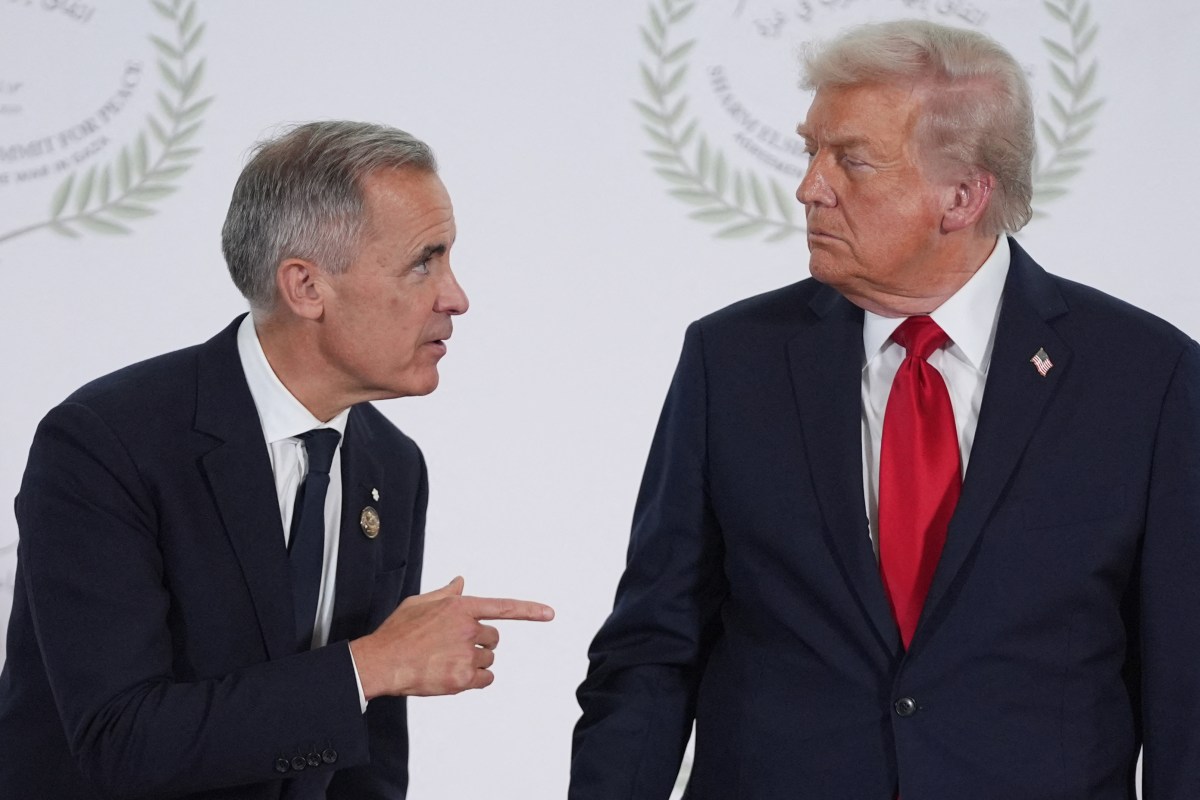
One of the more bizarre features of Donald Trump’s second term in office has been the enormous effort he and his senior officials have put into damaging relations with Canada, our northern neighbor, longtime ally, and key economic partner.
In July, a formal joint review of our trade relationship with Canada (and also Mexico) will take place. This could be an opportunity for a much-needed reset—should the administration choose. But ongoing rhetoric suggests it remains committed to a “tough guy” approach that poorly serves American interests.
In early 2025, Trump imposed a range of tariffs on Canadian exports to the United States, despite the existence of the U.S.-Mexico-Canada Agreement, the renegotiated version of the 1994 North American Free Trade Agreement, which he had signed during his first term. The president asserted in a text message that if they wished to avoid these tariffs, “the only thing that makes sense is for Canada to become our cherished Fifty First State.”
Perhaps this was no more than a typical Trumpian barb aimed at demonstrating the futility of opposing him, but the president has repeated the trope on several occasions, while also referring to Canadian Prime Minister Mark Carney as the “future Governor of Canada,” a line he previously used for Carney’s predecessor Justin Trudeau, who had shrugged it off as a joke.
Trump’s language—not heard since the 19th Century era of “manifest destiny”—provoked a storm of nationalist feeling in Canada as much as the tariffs themselves—which were ultimately reduced in part, though steel, aluminum, and copper remain at high levels.
This nationalist feeling was aggravated when the U.S. ambassador brusquely told Canadians to “get over it” and “move on.” Canadians have become suspicious of American intentions in a way not seen before. They are traveling less to the United States, although concerns about ICE’s intrusive treatment of border crossers and currency weakness are factors here as well.
Meanwhile, Carney has made clear his view that in the light of Trump’s policies, Canada must diversify away from dependence on the United States, stating: “Many of our former strengths, based on our close ties to America, have become weaknesses. Weaknesses which we must correct.”
He has said that Canada, which is beginning a long-overdue defense build-up, will look beyond the United States for supply, and is even revisiting a planned purchase of U.S.-made F-35 fighter aircraft. Carney has sought to deepen economic ties with Europe and is allowing China to export electric vehicles to Canada. While they cannot be re-exported to the United States, Secretary of Transportation Sean Duffy has ominously said that Canada would “regret” this decision.
The Trump administration’s abusive language and unilateral acts will complicate July’s trade agreement. Canada has reportedly been in no hurry to respond to a range of U.S. demands, leading Commerce Secretary Howard Lutnick, who seemingly relishes his attack dog role in the administration, to say “they suck” as negotiators. This comes on top of an earlier Lutnick statement that Canada must accept “second place” in auto trade with the United States.
Nonetheless, it seems unlikely that the United States will simply walk away from the trade agreement, something which it can do with six months’ notice, as the result would be chaotic for a U.S. economy already battered by the effects of global tariffs and the Iran war oil shock. That said, simple renewal seems unlikely, although, given the fraught situation in the world today, many would breathe a sigh of relief at resolving at least one area of concern.
More likely, negotiations will drag on—perhaps the current agreement will remain in force while a second review takes place in a year, an option which is allowed under its terms. Of course, that would lead to more uncertainty and act as a drag on investment on both sides of the border. And, in the meantime, Trump is always capable of further surprises—like his steel, aluminum and copper tariffs—and could even revive his fantasy of annexation.
The United States has some genuine trade issues with Canada, such as its highly protected dairy sector (although its American counterpart receives its own share of government support) and provincial-level bans on the sale of U.S. wine and liquor, which were imposed as retaliation for Trump’s rhetoric and tariffs. And there may even be ways to look anew at auto trade without, as Secretary Lutnick evidently prefers, decimating Canada’s own industry.
But the administration seems locked into a policy of taking shots at Canada. On May 18, it announced the suspension of meetings of the Permanent Joint Board of Defense, a low-profile coordinating mechanism on security issues dating to the Second World War.
The nominal reason is that Canada “has failed to make credible progress on its defense commitments,” despite the fact that it is in the middle of a major increase in defense spending. Is this an effort to put pressure on Canada in trade negotiations, a response to its looking at non-U.S. defense suppliers, or a pique at its outreach to China? It is impossible to know in the murky world of Trump administration policymaking.
But what seems clear is that diplomacy by insult and provocation, which has characterized the administration’s approach, has only led to suspicion and hostility, and will make it that much harder to reach an agreement with a country that should be our best friend and closest partner.
Richard M. Sanders is Senior Fellow, Western Hemisphere at the Center for the National Interest in Washington. He served as Chargé d’Affaires and Deputy Chief of Mission at the U.S. embassy in Ottawa, 2013-16.
The views expressed in this article are the writer’s own.
Read the full article here
