



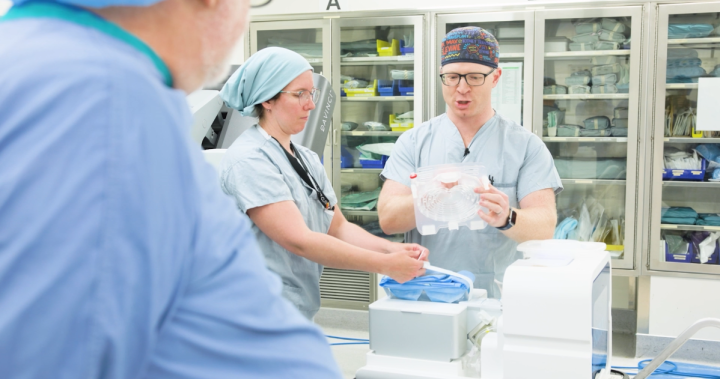
A state-of-the-art piece of technology is changing the way kidneys make their way between donors and recipients.
The XVIVO Kidney Assist Transport was approved for use by Health Canada at the end of 2025 and University of Alberta Hospital in Edmonton was the first centre to utilize the equipment.
“What’s unique about this new technology for us is it introduces oxygen into the circulation, which improves the outcomes of our patient’s kidneys after transplant,” said Dr. Max Levine, the surgical director of the U of A Hospital’s kidney transplant program.
“This is an evolution in the transplant technology that we’ve been using previously.”
Give Life Alberta says more than 300 people are waiting for a kidney transplant in Alberta. For Levine, he says it was important to capitalize on the evolving technology.
“With growing evidence behind it, we wanted to implement this for our patients so we jumped in head first.” he said.


Get weekly health news
Receive the latest medical news and health information delivered to you every Sunday.
The XVIVO transports kidneys from deceased donors and Levine says those organs have a higher risk of injury, and therefore a higher risk of failure in recipients.
“This technology helps reduce the amount of injury and actually helps them recover faster,” said Levine.
That looks to be the case for David Cliplef, a veterinarian who was diagnosed with kidney failure four years ago.
“I was diagnosed at about 14, 15 per cent kidney function, kind of went up and down a little bit,” Cliplef said. “Eventually it progressed to somewhere around seven per cent kidney function.”
Cliplef was on dialysis while waiting for a kidney transplant, before a kidney was found from an older, deceased donor. It was transported with the XVIVO and a minimally invasive was done using robots.
“Because of the technology and the advancements we’ve had in our program here, we were able to marry those two emerging technologies in transplant and he was able to benefit from those,” said Levine.
It has helped with a speedy recovery post-surgery. “I was up and walking within a few days and out of hospital at about seven, eight days,” Cliplef said.
“I got all the way up at one point to 60 per cent kidney function, which is technically normal. It’s fallen back a little bit, but I still have a lot more energy than I had when I was on dialysis.”
Only three months since his new kidney was transplanted, he’s returned to the vet’s office, working three days a week.
“It’s nice to feel better, to have more energy and be more optimistic about things going forward,” he said.
Read the full article here


