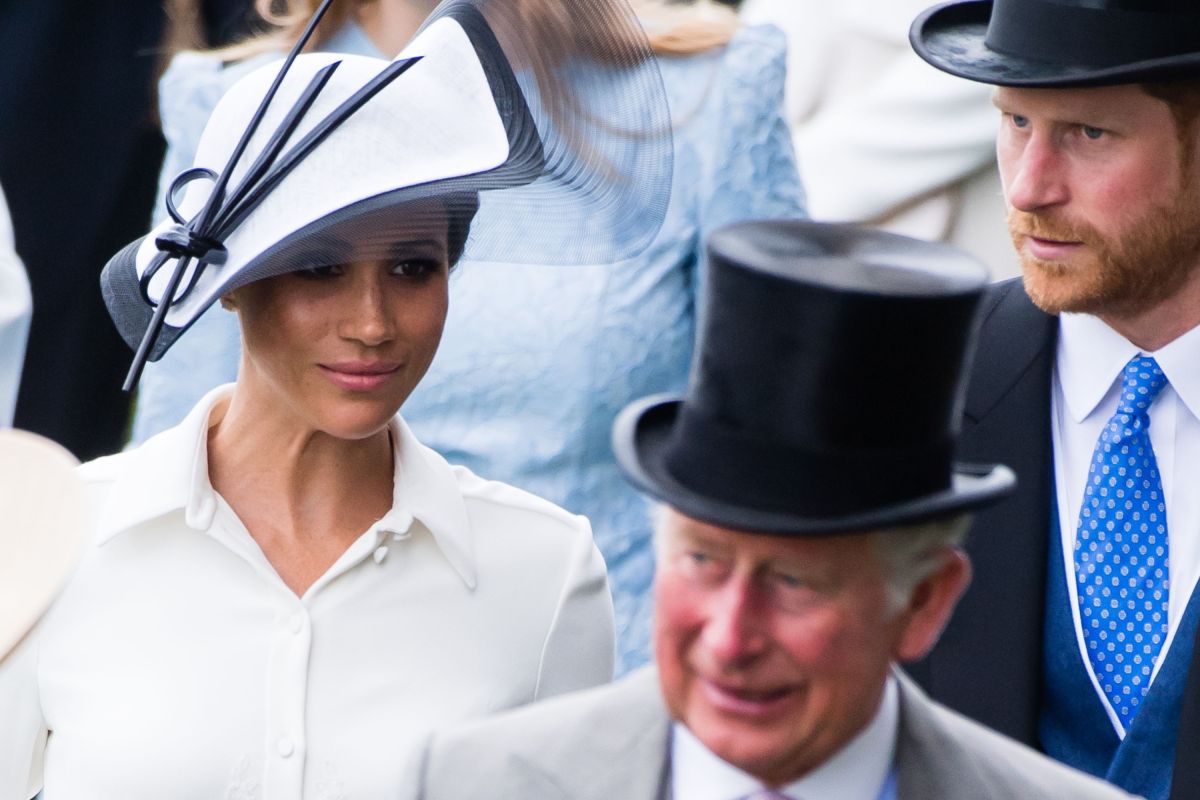
King Charles III has for his entire reign had a bigger U.K. fan base than Meghan Markle even at her peak—while Queen Camilla currently outstrips Prince Harry, despite the legacy of his mother Princess Diana.
New YouGov polling this month shows Charles was liked by 60 percent and disliked by 31 percent of U.K. adults, giving him a net approval rating of plus 29. The figures are broadly indicative of his standing over the last few years, though he has scored higher at times, with a peak fan base at 70 percent of the country.
It may come as no surprise that Meghan was some way behind, having sunk in British public opinion the moment she quit the palace in 2020. Indeed, she was liked by 19 percent and disliked by 66 percent, giving her a net rating of minus 47 in the representative sample of 2,103 U.K. adults polled across January 8 and 9.
What may come as a greater surprise is the fact Meghan has in fact never hit 60 percent in the her U.K. fan base as measured by YouGov. Newsweek has also found only one instance when her popularity among Americans surpassed that figure, at the time of her Oprah Winfrey interview. And even that high, which saw her liked by 67 percent, was behind Charles’ recent U.K. peak of 70 percent, in 2022.
It should be noted, of course, that America has a far larger population, meaning those percentage will add up to a greater lump sum of people.
Why It Matters
Harry and Meghan’s public criticisms of the British monarchy have been one of the defining royal stories of the current generation but also one that constantly confounds public expectations.
The Duke and Duchess of Sussex have always generated more headlines and public discussion than any other royal, both positive and negative—landing them major platforms, such as their Oprah Winfrey interview and the Netflix deal.
Harry also accused the royals of being jealous, telling Oprah in 2021 that negative stories about Meghan started to appear after “the first time that the family got to see how incredible she is at the job.”
At times, that capacity to shine brightly has been conflated with popularity, while Charles and Camilla’s struggle for column inches has been read as a sign they were less relevant or less liked.
Indeed, Harry told the couple’s Netflix show that the “penny dropped” for Meghan about his family’s jealousy after she stole the front page of the Sunday Telegraph in November 2019, following an event where they were all present.
“The issue is when someone who is marrying in, who should be a supporting act, is then stealing the limelight, or doing the job better than the person who was born to do this, that upsets people,” said Harry, “It shifts the balance.
“Because you’ve been led to believe that the only way your charities can succeed, and the only way that your reputation can be grown or improved, is if you are on the front pages of those newspapers. But the media are the ones who choose who to put on the front page.”
What the Numbers Say
Meghan’s fan base made up 55 percent of U.K. adults at its height, recorded by YouGov in October 2019. Her highest net approval rating was in November 2017, when she was liked by 49 percent and disliked by 14 percent, giving a net rating of plus 35.
There are different ways to measure popularity and no one system is definitively better than the others. Meghan’s net approval in November 2017 was higher than Charles’ now but that’s because the king was also disliked by 31 percent in January, more than Meghan in 2017.
What is striking is that even during the heady days of what the British press called “Meghan Mania,” when thousands lined the streets to catch a glimpse of the duchess during her first ever royal engagements in 2017 and 2018, she still did not actually have a bigger fan base than Charles does now.
They may well have been a more vocal and energized fan base, and that visibility may have been bolstered by American fans on social media, but her British supporters were smaller in number.

In fact, the king has consistently outperformed Meghan’s high of 55 percent for the entire duration of his three-year reign, during which his lowest score among supporters was 59 percent in April 2023.
Public sympathy over the death of his mother, Queen Elizabeth II, caused his popularity to surge to its highest in the post-Diana era in September 2022, when he was liked by 70 percent and disliked by 22 percent, a net rating of plus 48.
In Britain, some might argue Charles has a home field advantage but interestingly even in America Newsweek has found only one occasion when Meghan’s fandom swelled past 60 percent.
That was in March 2021 when Morning Consult recorded 67 percent who liked Meghan compared to 18 percent who did not, a net approval rating of plus 49.
YouGov research in the U.S. in November 2020 found 57 percent liked Meghan compared to 30 percent who disliked her, giving her a net approval rating of plus 27.
Meghan more frequently scores below 50 percent, as she did in polling by Redfield & Wilton for Newsweek, in December 2022, right before her first Netflix docuseries, Harry & Meghan.
At the time, 43 percent of Americans liked Meghan and 20 percent disliked her, giving her a net approval rating of plus 23. Following the release of Spare, Harry’s memoir, the couple’s U.S. popularity took a major hit, though it did later rebound.
Her latest YouGov numbers saw her liked by 31 percent and disliked by 26 percent, with a net rating of plus 15, as measured through the pollster’s quarterly ratings system.
And at the time of her May 2018 wedding to Harry, Ipsos recorded Meghan as being liked by 43 percent of Americans and published a net approval rating of plus 39, suggesting she was disliked by just 4 percent of U.S. adults.
Analysis
Meghan was never as popular in Britain as the most popular royals, including Queen Elizabeth, Prince William and Princess Kate, as well as Harry at his height, however she was popular and had scores politicians would die for.
The key lesson from the comparison with King Charles is not so much that Meghan was unpopular as a working royal, but rather that it is difficult to properly gauge public opinion without polling data because media hype tends to skew perception even—or perhaps especially—among journalists themselves.
It is of course possible that the royals did feel jealous of Meghan’s media attention because they wanted publicity for their own causes. But that should not be conflated with popularity.
Do you have a question about King Charles III and Queen Camilla, Prince William and Princess Kate, Meghan Markle and Prince Harry, or their family that you would like our experienced royal correspondents to answer? Email royals@newsweek.com. We’d love to hear from you.
Read the full article here