



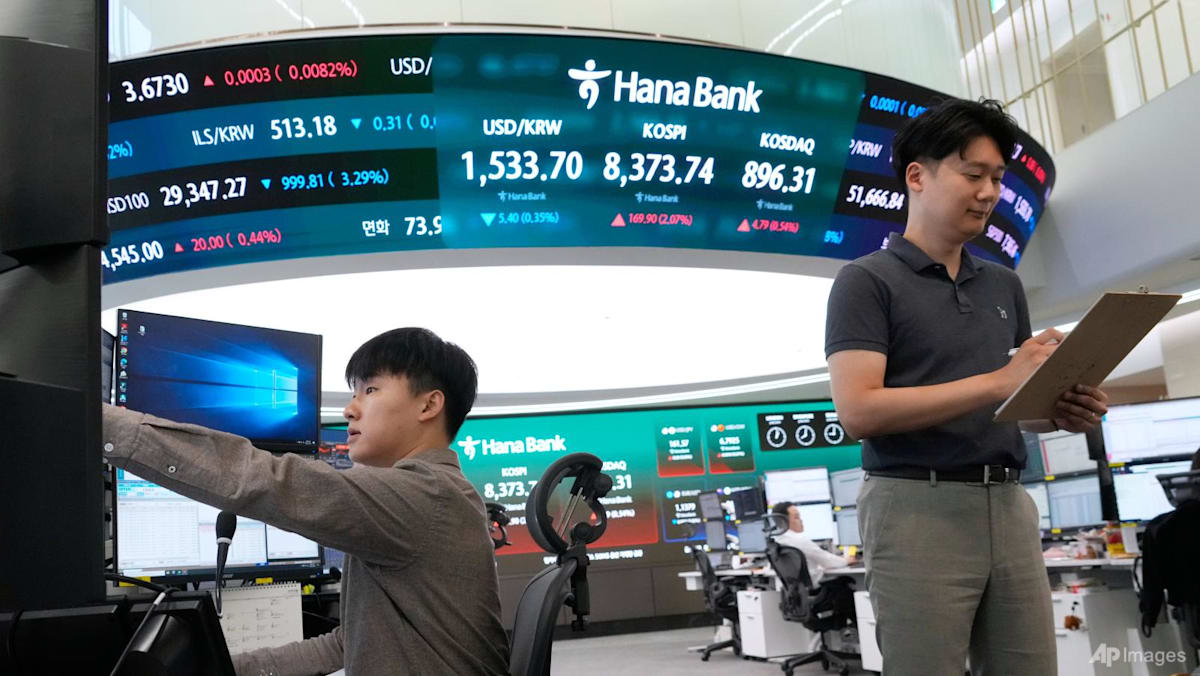
HONG KONG: South Korean stocks bounced back on Wednesday (Jun 24) from the previous day’s rout, while the rest of Asia battled to recover from a region-wide sell-off amid lingering concern about the AI spending boom.
Oil prices extended losses to sit around their lowest levels since the early days of the Middle East crisis, even as some strains emerged in talks to bring an end to the conflict.
Investors tentatively got back on the horse in Seoul as they picked up the pieces following a 10 per cent collapse in the KOSPI on Tuesday, which was led by 12 per cent losses in chip giants and market heavyweights SK Hynix and Samsung.
While no specific catalyst was blamed for the selling, analysts said it illustrated the growing concern on trading floors about the extended valuations of tech firms, which have been the key driver of a rally to record highs in several markets globally.
Questions over when firms will see a return on the trillions that have been invested in all things artificial intelligence have also been cited, as has the prospect of a US interest rate hike following last week’s hawkish pivot by the Federal Reserve.
Seoul, Tokyo and Taipei – where many of the world’s hardware makers are listed – have been at the forefront of the rally this year, taking over from Wall Street, where many of the big-name performers are downstream software firms.
“The next-stage debate on AI investing is not whether the theme is real, but whether the scale of investment will ultimately generate the returns that investors expect,” said Christoffer Enemaerke, at RBC BlueBay Asset Management.
After a second day of selling on Wall Street – where the Nasdaq lost a further 2 per cent – benchmark KOSPI closed up 267.18 points, or 3.26 per cent, at 8,471.02, after rising as much as 4.55 per cent during the session.
Leading the index higher, Samsung Electronics rose 9.84 per cent, following a media rout that the chipmaker plans a share buyback programme worth about 90 trillion won (US$58.4 billion). Peer SK Hynix gained 0.98 per cent.
“Tuesday was not simply a bad day for Korean equities,” wrote Stephen Innes at SPI Asset Management. “It was a reminder that one of the world’s most successful AI markets had also become one of its most crowded expressions of over-leverage.”
But he added: “The fundamental case remains intact, at least for now. Memory remains one of the critical bottlenecks in the global AI buildout, and neither SK hynix nor Samsung suddenly lost their strategic importance because the market had one violent session.”
There were also gains in Hong Kong, Shanghai, Sydney, Singapore, Mumbai and Bangkok, though Tokyo, Taipei, Manila, Jakarta and Wellington fell again.
Jakarta shed two percent as stock compiler MSCI delayed a decision on whether to downgrade the Indonesia market amid concerns about “opacity in shareholding structures”.
London and Frankfurt opened slightly lower, while Paris rose.
Eyes turn later in the day on the release of earnings from US chipmaker Micron Technology, which will provide a fresh idea about the state of demand in the sector and whether the AI rally still has legs.
Oil prices continued to fall on optimism for an eventual deal to end the war in Iran, as two maritime tracking platforms said traffic through the Strait of Hormuz on Monday reached its highest level since the war began.
However, disputes over the vital waterway, nuclear inspections and missiles exposed early strains in negotiations.
US Secretary of State Marco Rubio said Tuesday that Washington would not accept Iranian tolls or fees on the strait – through which a fifth of oil usually passes.
Iran and Oman said in a joint statement that they would study the administration of the trade route and the costs to be charged for services, while insisting on their sovereignty over it.
But Rubio, opening a regional tour in the United Arab Emirates, said: “It’s an international waterway. No country is allowed to charge tolls or fees on an international waterway.”
Tehran’s top negotiator, Mohammad Bagher Ghalibaf, had earlier said Hormuz “will never return” to the pre-war status quo, despite both sides agreeing to set up communication lines to keep it open.
Read the full article here


