



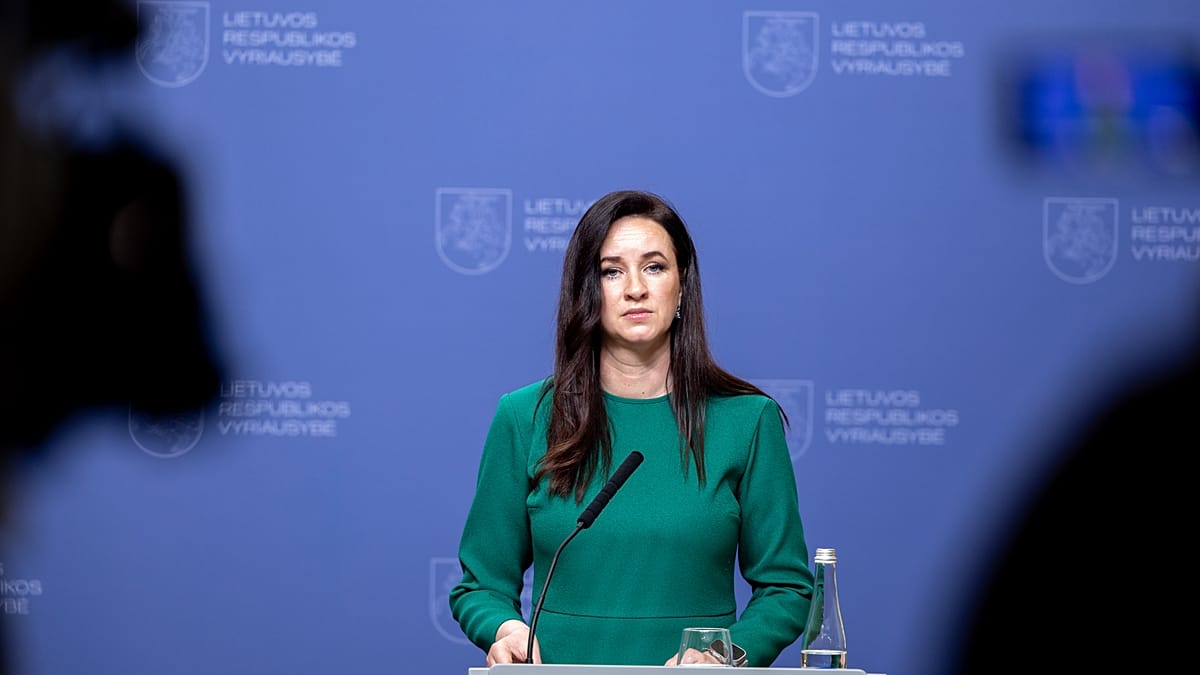
“Nothing in politics is permanent, and we as politicians must understand that our positions and offices are not eternal,” Ruginienė told journalists after the final cabinet meeting. “We are given a certain period of time to do good work, and I believe that this government has made proper use of that time.”
Her brief premiership was marked by a series of crises, including balloon-smuggling incidents, drone incursions, a record-high defence budget set at 5,38 GDP, and the dismissal of both the culture and defence ministers.
Breaking the law by taking family members with her on official trips to Italy and the Vatican and poorly handled information about leaked data from the Centre of Registers might seem like the last drops in her tenure as Prime Minister.
However, Ruginienė dismissed the resignation as part of “a normal political process,” saying that Sinkevičius had been expected to take over last year; however, “this step was simply postponed,” she said, without giving more details. Ruginienė took office in August last year, after the resignation of Gintautas Paluckas following allegations of unethical financial dealings involving loans, EU funds, and business ties concerning him and his relatives.
Ruginienė is expected to return to where her “heart truly lies” — the social security minister’s chair — once a new cabinet, set to be led by Sinkevičius, is formed and approved.
President Gitanas Nausėda is expected to submit Social Democrat leader Mindaugas Sinkevičius’ nomination to Lithuania’s parliament Seimas on Thursday, according to LRT. Once the Seimas approves the President’s nominee, the President appoints the Prime Minister and mandates them to form a government.
Ruginienė’s outgoing cabinet will continue in office until the new government is formed.
The balancing act of foreign minister
While Sinkevičius said last week that changes to the cabinet would not be “major,” speculation continues over the future of Foreign Minister Kęstutis Budrys, widely viewed as closer to the president than to the Social Democrats.
Now Budrys faces a delicate balancing act.
He has been tasked to normalize relations with China — one of the key foreign affairs commitments in the new coalition agreement. “If not, we will look differently into the question [about the future of Budrys],” the president said, LRT reports.
However, at the EU level, Lithuania is aligned with France, Italy, Spain and the Netherlands — countries that during last week’s European Council called for broader use of tariffs and other defensive trade instruments to counter China’s unfair trade practices.
The government’s reshuffle happens as Social Democrats kicked out the populist Dawn of Nemunas from the ruling coalition, with the Democrats “For Lithuania” agreeing to return to the ruling coalition.
Under the new coalition deal, Social Democrats — the largest party in Seimas — will keep nine ministries: environment, finance, defense, culture, social security, transport, education and sport, foreign affairs and interior. Democrats “For Lithuania” will lead three: health, agriculture and energy. The Farmers and Greens, along with their allies, will keep the economy and justice.
Read the full article here


