



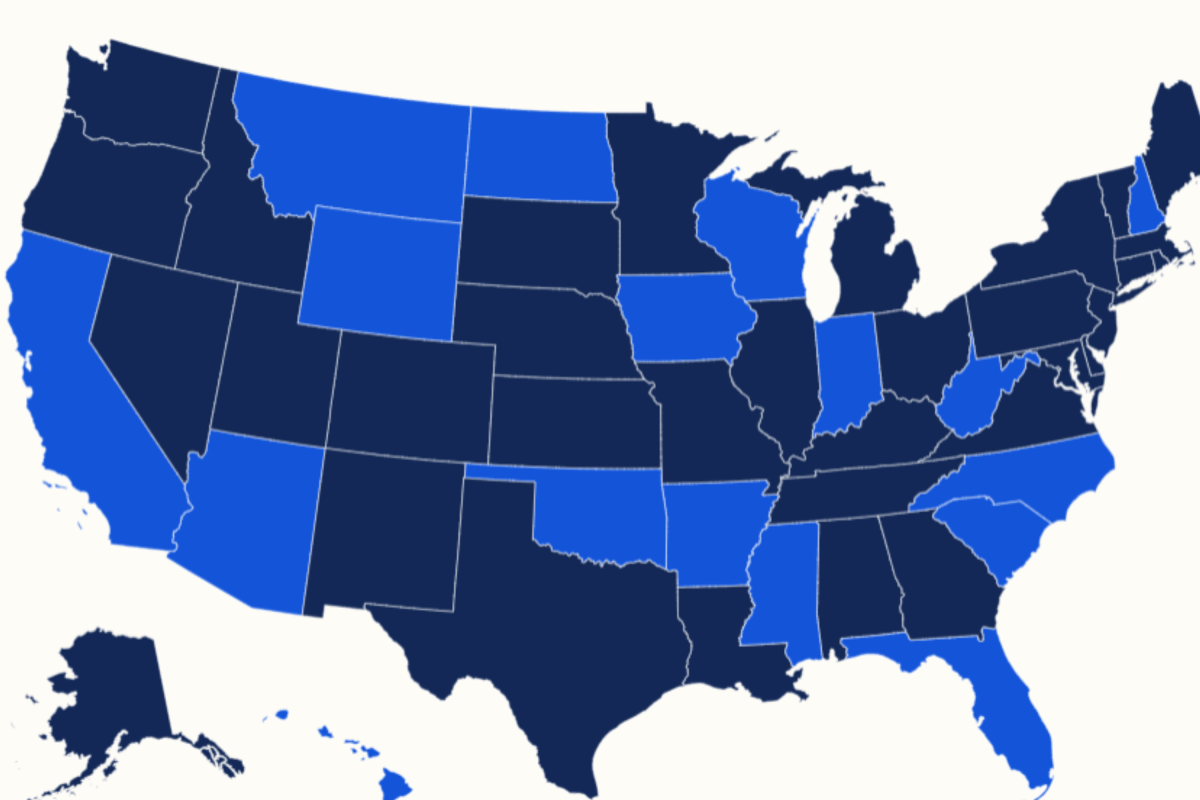
More than half of U.S. states will recognize Juneteenth as a legal holiday in 2026, new research shows, as the holiday remains in the political spotlight amid criticism from President Donald Trump and the administration’s decision to remove it from the National Park Service’s calendar of fee-free days.
Juneteenth, which commemorates the emancipation of enslaved African Americans, was officially designated a federal holiday in 2021 when then-President Joe Biden signed bipartisan legislation into law.
This means federal government offices now close of June 19, but it’s still up to individual states whether to make a federal holiday a state legal holiday, creating a patchwork of state-level legal recognition across the country. Newsweek has mapped this divide: In 33 states and the District of Columbia, most state workers receive a paid day off, according to the Pew Research Center. In the remaining 17 states, they do not.
Trump did not issue a proclamation marking Juneteenth last year, instead writing on social media that the United States observed “too many” nonworking holidays that are “costing our country.”
In December, the Department of the Interior removed Juneteenth and Martin Luther King Jr. Day from its annual list of fee-free days, a move facing legal challenges from several Democrats who want the days codified as permanent free-admission days.
Where Juneteenth Is a Permanent Holiday
Thirty states and the District of Columbia have made Juneteenth a permanent legal holiday, meaning most state government employees automatically receive a paid day off each year without needing annual action by governors or state agencies. Additionally, in New Mexico, Kansas and Kentucky, while Juneteenth is not a permanent holiday, most state workers receive a paid day off.
States Where Juneteenth Is Paid Day Off
- Alabama
- Alaska
- Colorado
- Connecticut
- Delaware
- Georgia
- Idaho
- Illinois
- Kansas
- Kentucky
- Louisiana
- Maine
- Maryland
- Massachusetts
- Michigan
- Minnesota
- Missouri
- Nebraska
- Nevada
- New Jersey
- New Mexico
- New York
- Ohio
- Oregon
- Pennsylvania
- Rhode Island
- South Dakota
- Tennessee
- Texas
- Utah
- Vermont
- Virginia
- Washington
States Where Juneteenth Is Not Paid Day Off
- Arizona
- Arkansas
- California
- Florida
- Hawaii
- Indiana
- Iowa
- Mississippi
- Montana
- New Hampshire
- North Carolina
- North Dakota
- Oklahoma
- South Carolina
- West Virginia
- Wisconsin
- Wyoming
While Juneteenth is not an official holiday in these states, some give the day off in a different way. In California, for instance, employees can choose to take Juneteenth off in lieu of a personal holiday. In North Carolina, some workers can apply paid personal leave to a day of “cultural or religious importance,” which includes Juneteenth.
State workers in West Virginia will technically get June 19 off, but not for Juneteenth. Instead, the state is set to observe West Virginia Day, which commemorates its admission to the union. West Virginia Day is celebrated on June 20, but as that falls on a Saturday this year, it is observed on the preceding Friday.
Former West Virginia Governor Jim Justice greenlit Juneteenth as a state holiday between 2021 and 2024, but incumbent Governor Patrick Morrisey has chosen not to.
The History of Juneteenth
Juneteenth commemorates the end of slavery in the United States, tracing its origins to June 19, 1865, when Union Major General Gordon Granger arrived in Galveston, Texas, and announced that enslaved people in the state were free, more than two years after President Abraham Lincoln issued the Emancipation Proclamation.
For decades, Juneteenth was primarily celebrated in Black communities, particularly in Texas and across the South, before gaining wider national recognition.
Texas was the first state to formally recognize Juneteenth, establishing it as a permanent state holiday in 1980, and prior to 2020, it was the only state to do so.
Following the widespread protests sparked after a white police officer killed George Floyd in Minneapolis on May 25, 2020, efforts to make Juneteenth a national holiday gained traction. Individual states—such as Virginia, Louisiana, New York and New Jersey—began to mark June 19 as a paid holiday.
In June 2021, Biden made Juneteenth National Independence Day a federal holiday—the first new federal holiday created since Martin Luther King Jr. Day in 1983.
Conservative Criticism of Juneteenth
Critics of the holiday argue that it has become entangled in identity politics and cultural divisions, while some support commemorating the day but oppose its designation as a federal holiday.
Former Representative Matt Rosendale of Montana, who voted against the 2021 bill making Juneteenth a federal holiday, said the left was trying to “create a day out of whole cloth to celebrate identity politics.”
“Let’s call an ace an ace,” Rosendale said at the time. “The Left has made up what was primarily a Texas holiday, which they are now acting like they recently discovered, in order to continually make Americans feel bad and convince them that our country is evil.”
Other Republicans against the bill, including Representatives Chip Roy of Texas and Representative Thomas Massie of Kentucky, said they took issue with the official name—Juneteenth National Independence Day—which Roy said created a “separate Independence Day based on the color of one’s skin.”
Similarly, Massie said it would create “confusion and push Americans to pick one of those two days as their independence day based on their racial identity.”
What Has Trump Said About Juneteenth?
Trump has not explicitly spoken out against Juneteenth, and he marked the holiday in 2020 during his first term.
However, in his social media post last year, he wrote on June 19: “Too many non-working holidays in America. It is costing our Country $BILLIONS OF DOLLARS to keep all of these businesses closed. The workers don’t want it either! Soon we’ll end up having a holiday for every once working day of the year. It must change if we are going to, MAKE AMERICA GREAT AGAIN!”
When the Trump administration removed Juneteenth and MLK Day from the 2026 calendar of fee-free days at national parks, it also added others, including Flag Day—which falls on Trump’s birthday. Democratic-backed legislation introduced in December to codify the two days and four others as permanent fee-free days appears to have stalled in Congress.
Earlier this month, Democratic Representative Sydney Kamlager-Dove of California introduced similar legislation in the House. She said in news release: “Not only do these fee-free days recognize important days in American history, they are also used to promote public service within our public lands. The Encouraging Public Service in Our National Parks and Public Lands Act takes an important step to restoring the celebration these days deserve.”
In 2025, the National Park Service offered these fee-free days:
- MLK Day, January 20
- The first day of National Park Week, April 19
- Juneteenth, June 19
- The anniversary of the Great American Outdoors Act, August 4
- National Public Lands Day, September 27
- Veterans Day, November 11
In 2026, the National Park Service offers these fee-free days:
- Presidents’ Day, February 16
- Memorial Day, May 25
- Flag Day, June 14—which is also Trump’s birthday
- Independence Day weekend, July 3-5
- The 110th birthday of the National Park Service, August 25
- Constitution Day, September 17
- Theodore Roosevelt’s birthday, October 27
- Veterans Day, November 11
Read the full article here


