



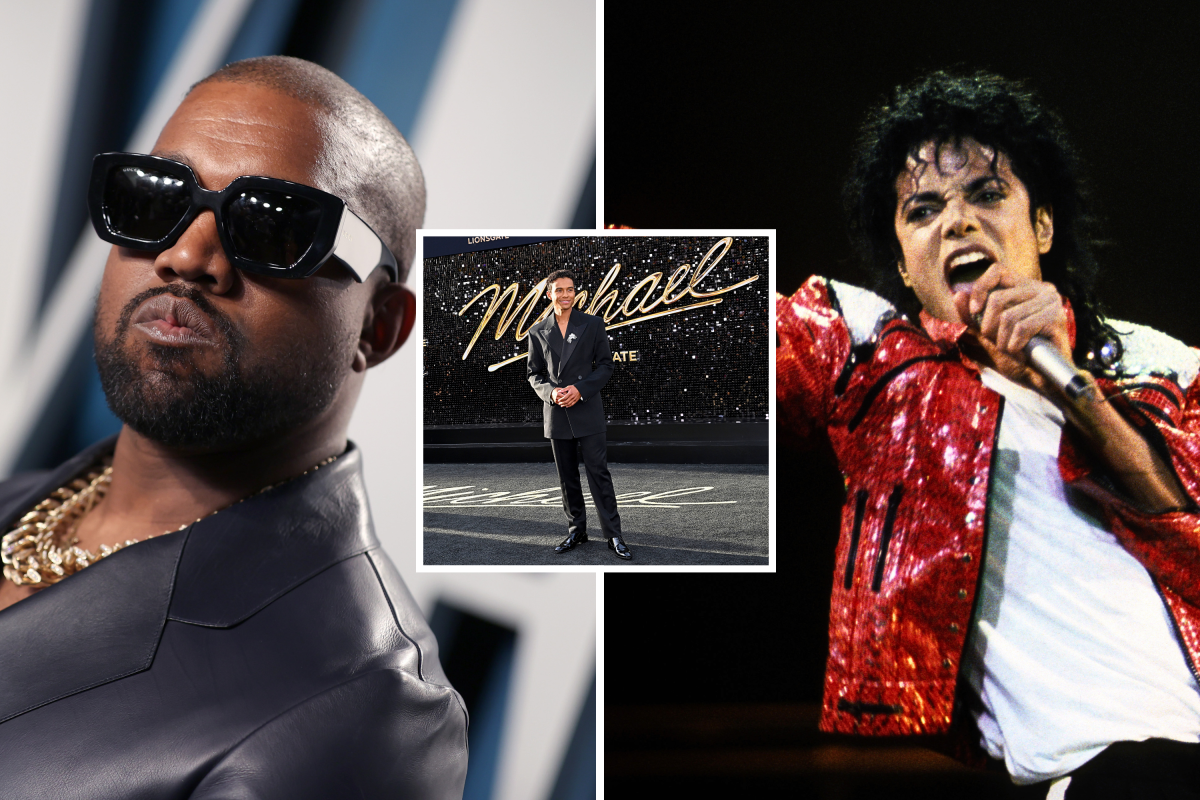
Despite one person being long deceased and another largely canceled, Michael Jackson and Kanye West are both having a bit of a resurgence, and their overlapping return to the spotlight has exposed something uncomfortable about our collective memory.
Antoine Fuqua’s Michael—a sweeping, estate-approved biopic featuring the King of Pop’s own nephew, 29-year-old Jaafar Jackson, in the lead role—has just opened to record-tracking box office figures despite what can only be described as miserable reviews.
Audiences showed up in enormous numbers, apparently unbothered by either the critical consensus or the long shadow of child sex abuse allegations that engulfed Jackson’s legacy—allegations that were thrust back into the public consciousness by Leaving Neverland.
Meanwhile, across the Atlantic, Kanye West, now going by Ye, has been blocked from entering the U.K.
London’s Wireless Festival, where he , was canceled following furious public pressure and the withdrawal of major sponsors, all of whom cited his well-documented history of antisemitic remarks.
West subsequently apologized in The Wall Street Journal, but the damage was done. Further dates in France, Switzerland, and Poland have also been pulled, and yet, paradoxically, West still has an upcoming international tour, with a headline slot at an Italian music festival slated for July.
One artist’s comeback was partially blocked, while another’s legacy has scored a massive commercial boost, albeit posthumously. Although Jackson’s abuse allegations and West’s antisemitism are both profoundly different accounts of wrongdoing, when placed side by side, they illuminate a striking inconsistency in the way the public applies their moral frameworks—and who, ultimately, bears the consequences.
Newsweek reached out to West, Lionsgate and Fuqua for comment via email.
Has Michael Jackson Been Forgiven?
The Jackson situation has a particular wrinkle; it is not even the man himself on screen, but a carefully curated version of his story, produced with the blessing of his estate, and starring a young and charismatic family member. The contrast with West is stark. The rapper is a living artist, unpredictable, uncontrollable, capable of generating fresh hurt and controversy at any moment.
This divergence is also present elsewhere in entertainment. When Usher and Chris Brown announced an upcoming joint tour, the backlash was swift. Brown’s long history of assault charges, and Usher’s own associations in the wake of the Sean “Diddy” Combs scandal, made the collaboration itself a scandal.
The public appetite for moral accountability, it turns out, is highly situational.
Laura Bull, bestselling author and global brand strategist, told Newsweek the divide is less about ethics than audience segmentation.
“The difference is between who is reacting to the art,” Bull said. “These two artists developed strong fanbases who will be very forgiving to their legacies and still enjoy their work.
“However, the establishment will not.”
According to Bull, fan loyalty often persists beneath institutional shutdown.
“If you look at social media posts regarding Kanye, you will find that there is still a lot of fans support,” she said. “If you look at Ye’s personal brand, one of his core pillars is controversy, like when he made Taylor Swift cry.
“The shock is why his core audience loves him and will continue to. You can say they are putting on blinders to serious offenses, but at the end of the day, his core audience will still buy tickets and show up.”
And that is something that Jackson’s relatives have also picked up on and publicly celebrated.
Tito Jackson’s son TJ, Jackson’s nephew, has been an advocate of the film since its time in pre-production. As negative critic reviews began to flood the internet, TJ took to X to share his delight at the positive audience response resurfacing in contrast on Rotten Tomatoes.
Michael has already had the best opening for a musical biopic, smashing between $12.5 and $13.5 million for the combined previews from yesterday’s IMAX/PLF fan 6 p.m. showtimes and showtimes since noon on April 23.
Why We Separate Art From Its Creator
James Pearson, a public relations expert at Converge who has met Jackson and worked on one of his Indiana shows, frames the divergence as temporal distance and risk management rather than genuine moral reckoning.
“This is not just an example of separating art and artist according to some high moral standard,” he told Newsweek via email, “but rather unacceptable human acts treated selectively, depending on when they occurred, the level of cultural offense, repentance, and perceived distance.
“In the case of Ye, the situation is currently happening and there is an immediate call for institutions to take a stand.”
Time, Pearson added, functions as a moral anesthetic.
“Michael Jackson cannot change anything at this point, and the controversy dates back quite a few years,” he added. “That time allows consumers to accept the idea of separating art from artist because of the legacy he already has.
“Even bad reviews will not make a difference, because people will often consume a person’s product anyway as part of something bigger than just the music.”
Hana Ben-Shabat, founder of Gen Z Planet and author of Gen Z 360, cuts to the chase.
“I don’t believe that we separate art from the artist,” she told Newsweek. “We separate convenience from inconvenience.
“Ye is an ongoing risk. That’s why institutions—the U.K. government, the sponsors—reacted the way they did. It’s Risk Management 101.”
Jackson’s death, she said, is the decisive variable.
“He is no longer here to create new risks, which makes it easier to curate his legacy—especially by focusing on the precontroversial years,” she said. “Gen Z is now the largest segment of moviegoers and will ultimately dictate how this plays out.
“I believe their attendance is not a proof of forgiveness—just an indication that death, time, and selective curation make it convenient to ignore a reality that occurred.”
Read the full article here


