



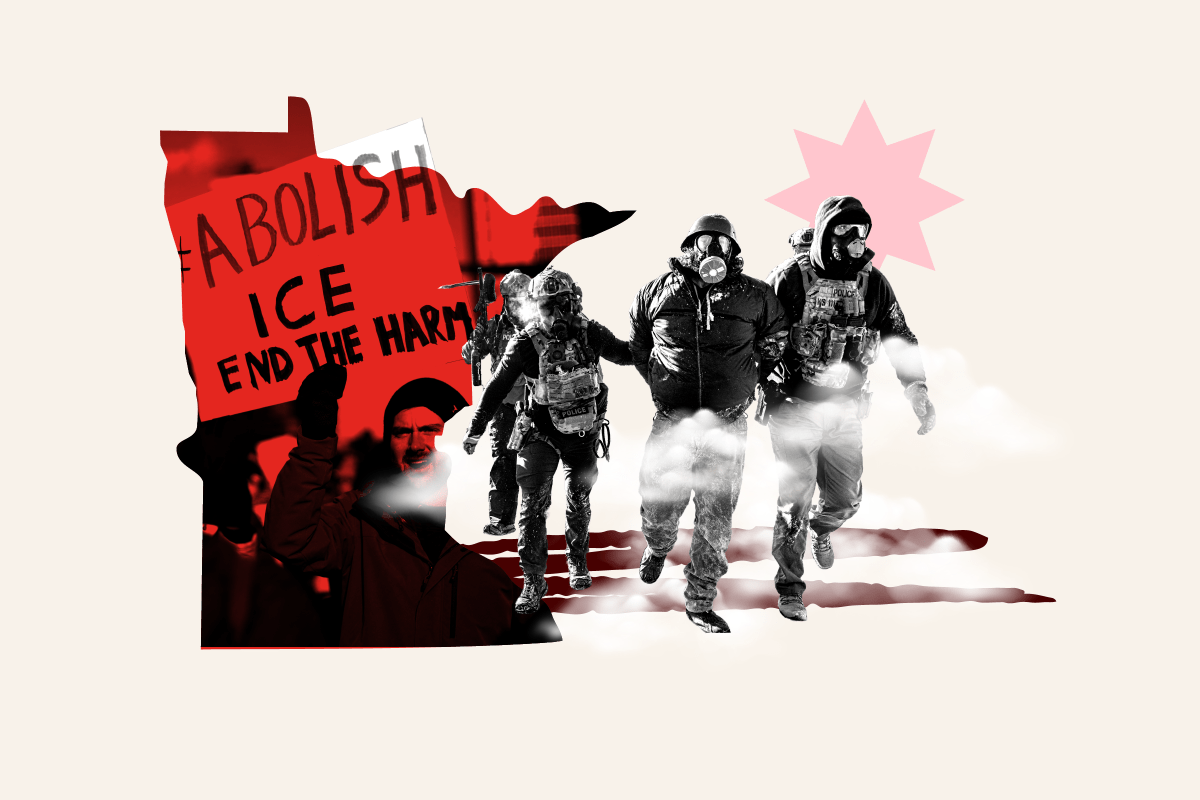
What began as a high-profile federal enforcement operation has become one of the most damaging episodes for the Trump administration’s immigration crackdown and broader domestic agenda.
Renee Nicole Good and Alex Pretti, two 37-year-old U.S. citizens, were shot dead in the streets of Minneapolis by federal agents this month, leaving a city and a nation in shock.
In the aftermath of the killings, the government is facing public backlash, protests, and plummeting approval for its immigration policy. This, in turn, has forced the White House to make a rare public climbdown, reassessing its massive deployment of Immigration and Customs Enforcement (ICE) and Border Patrol agents in Minnesota.
Earlier federal operations focused on cities such as Los Angeles and Chicago, with sweeping arrests and deportations. Last summer, in Los Angeles and across Southern California, raids sparked protests, and in some cases, violent confrontations with federal agents as communities pushed back against the presence of agents and the tactics used in enforcement actions. In July 2025, a Mexican farmworker identified as Jaime Alanis died from a fall while trying to escape ICE agents conducting a workplace raid in Camarillo, California.
The following month, Roberto Carlos Montoya Valdez, a 52‑year‑old Guatemalan day laborer, was struck and killed by a vehicle on the 210 Freeway near Monrovia, California, after fleeing a federal immigration raid at a Home Depot parking lot. In October, 24‑year‑old Honduran national Josué Castro Rivera was killed on Interstate 264 in Norfolk, Virginia, when he was hit by a pickup truck while attempting to flee a targeted immigration enforcement stop by federal agents.
In Chicago, Operation Midway Blitz resulted in thousands of arrests as well as allegations of excessive force and unlawful detentions, with civil rights groups filing court challenges arguing ICE agents made warrantless arrests and used heavy‑handed tactics in predominantly immigrant neighborhoods. U.S citizens were dragged from their cars, children were zip-tied, and federal agents conducted a high-profile Black Hawk helicopter sweep in predominantly immigrant neighborhoods.
On September 12, 38‑year‑old Silverio Villegas González was shot and killed by an unnamed ICE officer during a traffic stop in the Chicago suburb of Franklin Park. Villegas González, a long‑time Chicago resident who worked as a cook and had no criminal record beyond minor traffic violations. He was attempting to flee the stop when the agents fired.
Despite these earlier operations in major cities, the national narrative shifted dramatically after two U.S. citizens were shot and killed by federal agents in Minneapolis, in scenes captured on video from multiple angles.
Under Operation Metro Surge, which launched in December 2025, more than 3,000 federal immigration agents were deployed to Minneapolis and St. Paul.
The Minneapolis operation was initially triggered by an investigation into alleged welfare fraud in the city’s Somali community, despite most of those immigrants having legal status. The investigation was quickly overshadowed by the deaths of Good and Pretti, turning what was supposed to be a focused enforcement action into a national crisis.
Gregory Bovino Gets Swapped for Tom Homan
Faced with widespread outrage that boiled over after Pretti was killed despite having already been disarmed by federal agents, the administration has begun scaling back its presence in the Twin Cities. Some federal agents are departing, Border Patrol commander-at-large Greg Bovino is being removed from his role in Minneapolis, and President Donald Trump has ordered border czar Tom Homan to take charge on the ground amid the political fallout. Homan will report directly to Trump, sidelining Homeland Security Secretary Kristi Noem.
One current ICE official, who requested anonymity to speak freely, told Newsweek. “I’ve met Homan. I know he is bombastic. He will do a good job representing President Trump’s intentions.”
“It’s a large operation, and a strong leader needs to be there to run it,” the official added.
Retired U.S. Border Patrol agent and Texas sheriff Thaddeus Cleveland told Newsweek that he supports sending Homan to Minnesota as a positive step, given his experience working under both Trump and former President Barack Obama and his understanding of frontline operations.
“I think that’s a good thing because you’re getting someone who’s a career law enforcement,” Cleveland told Newsweek.
“Not to take away from Greg Bovino. He’s doing a tremendous job. Greg and I worked at headquarters together, but I think some of the guidance coming out of DHS, I think we need Tom Homan involved,” he said.
“You have those that are running DHS at the top level. They’re not career law enforcement,” he added.
The Trump administration’s internal divisions over immigration enforcement became increasingly visible as the Minneapolis crisis unfolded, with Noem, a career politician, and border czar Tom Homan at odds over strategy and messaging, Axios reported.
Homan, a long‑time career immigration enforcer who has emphasized prioritizing arrests of people with criminal histories, has clashed with Noem’s more aggressive tactics that aimed to maximize overall removal numbers, a strategy backed by senior Border Patrol leadership.
The Department of Homeland Security referred Newsweek to Noem’s statement about Homan heading to Minnesota on X: “I have worked closely with Tom over the last year and he has been a major asset to our team—his experience and insight will help us in our wide-scale fraud investigations, which have robbed Americans, and will help us to remove even more public safety threats and violent criminal illegal aliens off the of streets of Minneapolis. We continue to call on the leadership in Minnesota to allow for state and local partnership in our public safety mission.”
Bovino and his team of Border Patrol agents, often trailed by a camera crew, had made headlines in cities like Los Angeles, using aggressive tactics including teargassing public spaces and detaining residents in large sweeps. But in Minnesota, the dynamic changed.
Bovino has since been reassigned to his former El Centro sector along the California border, effectively sidelining one of the most visible figures associated with the Minneapolis operation.
CNN reported that DHS took away Bovino’s access to his official social media accounts. The reassignment signaled an effort by the administration to de-escalate the situation in Minnesota while distancing senior leadership from an operation that had become untenable.
DHS said Bovino has not been relieved of his duties, despite reports he may leave Minneapolis and was removed as the U.S. Border Patrol’s “commander-at-large,” according to The Atlantic.
DHS Assistant Secretary Tricia McLaughlin responded to reports of Bovino’s demotion, saying: “Chief Gregory Bovino has NOT been relieved of his duties. As Press Secretary Karoline Leavitt stated from the White House podium, Greg Bovino is a key part of the President’s team and a great American.”
The job saw Bovino overseeing operations across multiple cities, advising senior leadership, and coordinating across regions rather than managing a single sector. In that role, Bovino reported directly to Homeland Security Secretary Kristi Noem, bypassing the agency’s normal chain of command.
In the immediate aftermath of Pretti’s killing, Noem, Bovino, and White House chief of staff Stephen Miller publicly described the ICU nurse as a “domestic terrorist” and “would-be assassin” intent on “massacring” federal law enforcement. That language drew immediate backlash as video evidence of Pretti’s killing directly undercut statements from top administration officials.
By Monday, the White House distanced itself from some of the most inflammatory statements made by its own administration.
“Does the president agree with them?” ABC News Chief White House Correspondent Mary Bruce asked White House press secretary Karoline Leavitt.
“Look, as I’ve said, I have not heard the president characterize Mr. Pretti in that way,” Leavitt said. “However, I have heard the president say he wants to let the facts in the investigation lead itself.”
Trump declined to say whether he thought the agents involved in the Pretti shooting acted appropriately, in an interview with The Wall Street Journal on Sunday, and said his administration was “reviewing everything and will come out with a determination.”
“There is only one page: the President’s page. Everyone’s on the same page,” a senior DHS official told Newsweek. “We have seen a highly coordinated campaign of violence against our law enforcement. This individual committed a federal crime while armed as he obstructed an active law enforcement operation. As with any situation that is evolving, we work to give swift, accurate information to the American people as more information becomes available.
“Secretary Noem is focused on restoring law and order and executing on the President’s agenda for mass deportations—not publicity. The media is chasing gossip-style stories instead of writing about the 1,300% increase in assaults, 3,200% increase in vehicular attacks, and 8,000% increase in deaths threats against our brave men and women of law enforcement.”
Public Opinion Turning Against ICE
The protests in Minneapolis and other cities have been widely described as successful in drawing attention to federal enforcement overreach. Critics say the events have eroded public trust in law enforcement and energized communities nationwide to resist aggressive ICE operations.
Polling shows the Minneapolis operation is not just a local flashpoint, but has translated into a nationwide collapse in public support for federal immigration enforcement and Trump’s handling of the issue.
A poll by Reuters and Ipsos conducted from January 24 to January 26, 2026, found that 39 percent of Americans approve of the job President Trump is doing on immigration, while 53 percent disapprove. Fifty-eight percent of respondents said that ICE agents have gone too far in their enforcement actions. The poll surveyed 1,139 U.S. adults and has a margin of error of plus or minus 3 percentage points. The fieldwork took place immediately before and after the second Minneapolis shooting, capturing the public’s immediate reactions.
An Ipsos KnowledgePanel survey conducted from January 16 to January 18, 2026, using a sample of 1,229 adults, found that 59 percent of respondents said ICE’s efforts go too far. A majority of respondents, 52 percent to 25 percent, viewed the fatal shooting of Good as an excessive use of force. The margin of error for this poll is plus or minus 3.2 percentage points. This survey took place after the first Minneapolis shooting but before the second.
A poll by The Economist and YouGov, conducted on January 25, 2026, surveyed 3,359 U.S. adults and found that 46 percent of respondents strongly or somewhat strongly support abolishing ICE, with 34 percent strongly supporting it and 12 percent somewhat supporting it. Twelve percent of respondents were unsure, and 41 percent opposed the idea, including 10 percent who somewhat opposed it and 31 percent who strongly opposed it.
This erosion in support is not confined to one side of the political spectrum. Even within Republican circles, backing for ICE has weakened:
Support among Republicans who backed abolishing ICE increased to 19 percent, up from 15 percent in early January, while Democrats remained the most supportive, with more than three out of four backing abolishing the agency, per The Economist/YouGov survey.
Several Republican senators, including Bill Cassidy of Louisiana, Susan Collins of Maine, Mike Crapo of Idaho, John Curtis of Utah, Jerry Moran of Kansas, Lisa Murkowski of Alaska, and Thom Tillis of North Carolina, have all called for a thorough investigation into Pretti’s death.
Texas’ Republican Governor Greg Abbott, a key Trump ally, said the White House needs to “recalibrate” its immigration enforcement strategy in the wake of the fatal shooting.
At the same time, Republican Senator Rand Paul and Chairman of the GOP-controlled House Homeland Committee, Andrew Garbarino, are calling for top immigration officials to testify before Congress. Republican Senator Chuck Grassley scheduled a hearing for Noem to appear.
Will Noem Remain DHS Secretary?
Noem has come under scrutiny following the Minneapolis shootings and the national backlash against ICE operations. Her public characterization of Alex Pretti as a “domestic terrorist” drew widespread criticism, prompting the White House to distance itself from her comments.
One former ICE official, who spoke on the condition of anonymity to speak freely, told Newsweek he backs replacing Noem.
“I think that if they got rid of Kristi Noem, things would change,” the former ICE official said.
Meanwhile, House Democrats are plotting to impeach Noem, citing her role in overseeing aggressive immigration operations. Nearly two‑thirds of the party’s caucus back the measures.
The effort, first introduced by Representative Robin Kelly of Illinois after the fatal shooting of Good by an ICE agent in Minneapolis, has quickly gained traction, with more than 140 Democratic cosponsors supporting articles of impeachment that charge Noem with obstruction of Congress, violation of public trust, and self‑dealing.
The killings of Good and Pretti, coupled with the public protests and legal scrutiny, escalated the crisis and shifted the enforcement dynamic nationally.
What had been a relatively contained operation in other cities became a symbol of federal overreach and has brought political consequences to the White House.
The DHS appropriation bill is at risk of collapsing and causing a government shutdown as lawmakers debate federal enforcement priorities. The prospect of a government shutdown looms amid growing opposition to ICE tactics in Congress. These political pressures, combined with ongoing protests and public outcry, have made Minnesota a critical test case for the administration’s enforcement policies.
The city has become a focal point of national resistance, public opinion has turned sharply against the agency, and federal leadership has been reshuffled. Amid the political fallout, the administration faces an unusually difficult enforcement environment, one that could have lasting implications for national immigration policy.
For the first time, ICE’s authority is being openly questioned on a national scale by Democrats and Republicans.
The fate of the DHS funding bill has become closely tied to the backlash following the Minnesota killings.
Senate Democrats, led by Minority Leader Chuck Schumer, have said they will not provide the votes needed to advance a $64.4 billion DHS appropriations bill in its current form because it includes roughly $10 billion for ICE without meaningful reforms.
Several Democratic senators have pledged to oppose the measure unless changes are made to rein in what they describe as unchecked ICE authority, leaving Republicans’ 53‑seat majority short of the 60 votes required to break a filibuster and pass the legislation. The standoff has brought the appropriations process to the brink, with a partial government shutdown looming if lawmakers cannot reach an agreement before the funding deadline.
This is the point where the Minneapolis saga hits its sticking point. The killings of Good and Pretti have shifted the dynamic nationally, turning routine immigration enforcement into a matter of widespread outrage and bipartisan criticism.
The backlash has forced the Trump administration to revisit its strategy ahead of the 2026 midterms, and ICE’s authority is now being questioned across the political spectrum. With congressional fights over DHS funding and impeachment efforts against Noem, no one yet knows where this crisis will lead.
Read the full article here


