





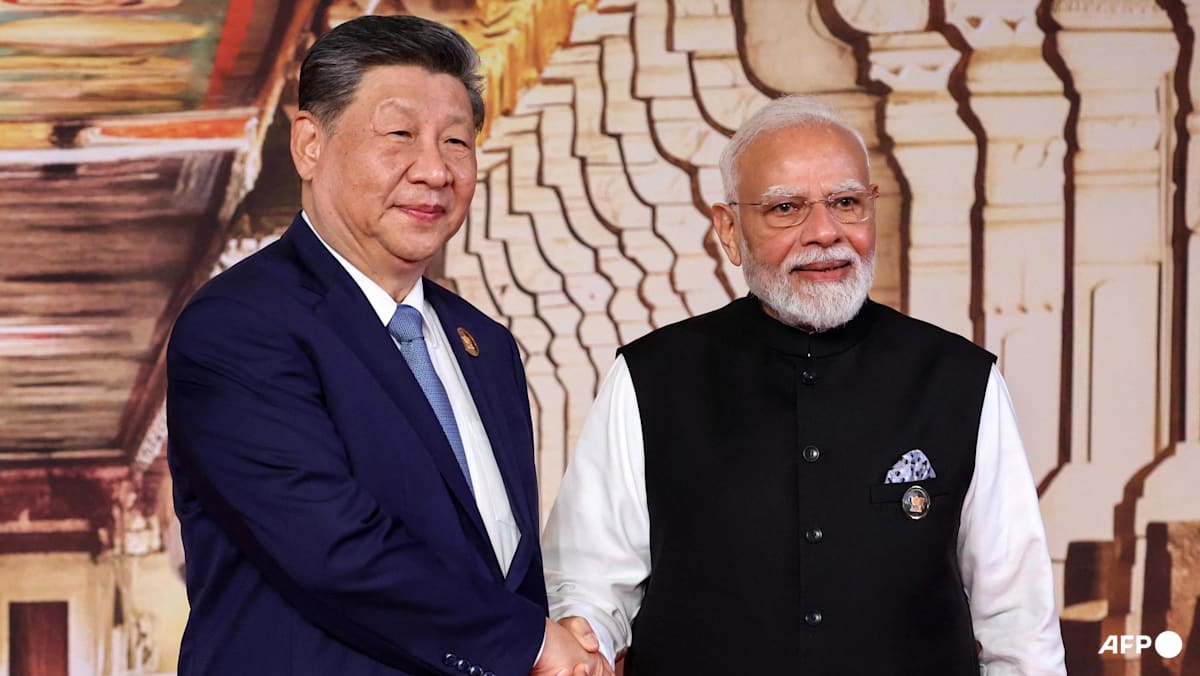
NEW DELHI: Indian Prime Minister Narendra Modi and Chinese President Xi Jinping agreed to work together towards resolving their countries’ contested border, New Delhi’s foreign ministry said on Saturday (Sep 12) after the leaders met.
Xi’s visit to New Delhi, to attend the 11-nation member BRICS summit, is being closely watched because it is his first to neighbouring India since 2019, and the biggest step yet in a cautious thaw between the nuclear-armed rivals.
BRICS stands for Brazil, Russia, India, China, the group’s founding countries, along with South Africa.
“Although our two countries are different in many respects, they are fully capable of complementing each other’s strengths, supporting one another, achieving mutual success and advancing together,” Xi said as he met Modi, in a video released from New Delhi.
India’s foreign ministry said in a statement after the meeting that “the two leaders expressed commitment to a fair, reasonable, and mutually acceptable resolution of the boundary question”.
Modi “underlined the need for both sides to observe existing agreements and understandings on border related issues”, it added.
In a separate statement, China’s Ministry of Foreign Affairs on Saturday said both sides should “stay committed to advancing bilateral relations and resolving the boundary question, seek parallel, mutually reinforcing progress, and maintain peace and tranquility in the border areas”.
The ministry said both Xi and Modi had a “sincere and in-depth exchange of views and reached the important consensus that China and India should be partners”.
Xi pointed out that China approaches its relations with India from a “strategic and long-term perspective”.
“Over the past two years, I have met with Prime Minister Modi twice, guiding the bilateral relations from starting afresh to making further improvements,” Xi said.
The Chinese leader is visiting six years after a deadly military clash along the disputed border.
Ties have since gradually improved through restored flights, visas and high-level contacts.
The underlying territorial dispute remains unresolved, and both sides retain heavy military deployments along their roughly 3,500 km high-altitude border along Tibet.
In its statement, the Chinese foreign ministry said both countries have different national realities, and that they should draw on each other’s strengths, support each other and help each other succeed.
It added that both countries shoulder “important responsibilities” in the light of the “changing and turbulent international landscape”.
“Differences should not become disputes,” New Delhi’s foreign ministry said, in a statement.
Read the full article here


