



Published on
Trees age very slowly. The reason is that they constantly renew their tissues: needles or leaves, bark, twigs, trunk and roots are continuously regenerated while older parts gradually die off.
A remarkable fact: while trunk and crown are exposed to wind, weather, animals and loggers, a tree’s vast underground root system can continue to live on, hidden from view, for much longer.
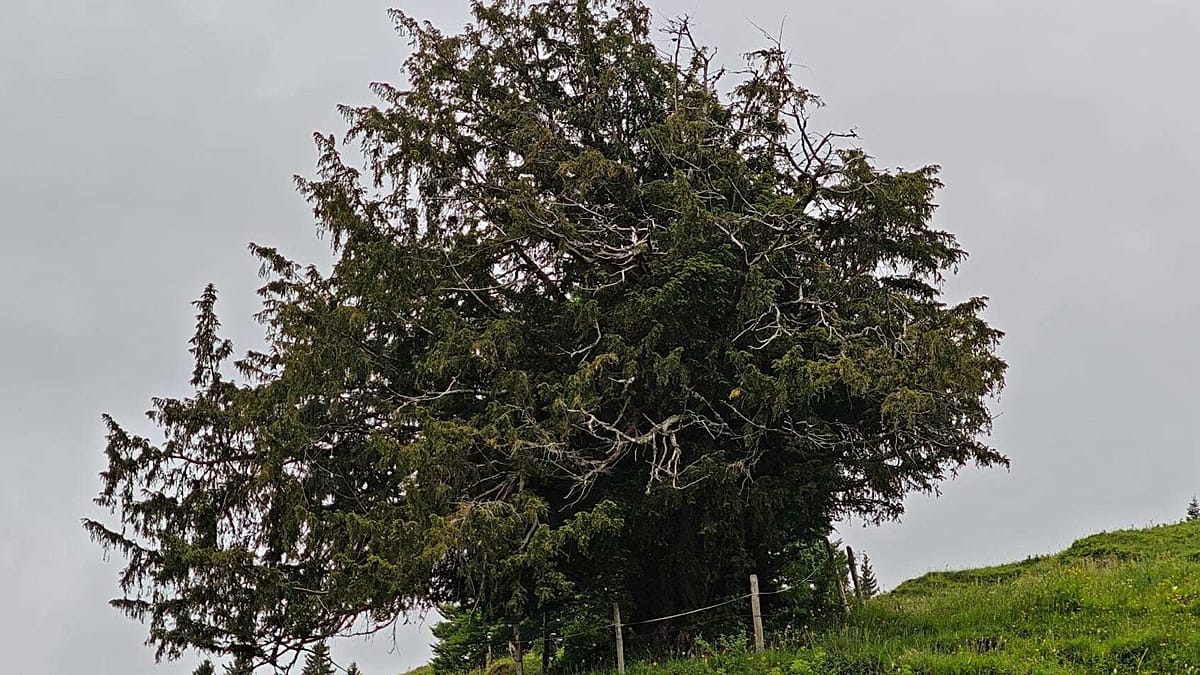
Germany’s probably oldest tree stands in complete seclusion on a grazed alpine meadow between Steibis and Balderschwang in the Upper Allgäu, at an altitude of 1,100 metres.
The German Dendrological Society, an association of experts in tree science, estimates that the yew is around 1,100 years old. Its trunk circumference is 5.1 metres.
Located on a north-west facing slope, the tree is close to the upper limit of the yew’s altitudinal range, which in the Alps is around 1,300 metres: “During the winter half of the year it hardly gets any sun there, and it is noticeably colder than on south-facing slopes at this altitude,” say the tree experts. “That is why it is a miracle that it has survived all these centuries and is obviously thriving – it may even be ‘pleased’ about the current warming.”
Andreas Roloff, senior professor of tree biology at Dresden University of Technology, enthuses: “Its trunk is a dreamlike monument with fissures, bulges, bumps, ribs, cracks and holes, made up of several very different sections.”
Ötzi’s hunting bow was made of yew wood
How the yew came to the remote alpine pasture remains unknown to this day. One thing is certain: it was probably not planted. A bird most likely brought the seed to this spot. As long as 5,000 years ago, in the Neolithic period, yew trees had a special significance for people in the South Tyrolean Alps. Ötzi, the “man from the ice” who was discovered in a crevasse in the glacier in the region at more than 3,000 metres above sea level, carried a hunting bow made of yew wood.
The Allgäu yew now displaces the village lime tree of Upstedt in Lower Saxony: until now the summer lime tree, estimated to be around 1,000 years old, was regarded as Germany’s oldest tree.
Close behind comes the Erle Feme oak in Raesfeld in the western Münsterland, whose age is estimated at around 900 years. The oak has a trunk circumference of more than twelve metres and is probably Germany’s thickest tree of this species. From 1363 until the end of the 16th century, secret tribunals known as ‘Femegerichte’ sat beneath its crown – making it Europe’s oldest known court tree. The “Feme” was feared in the Middle Ages because proceedings were partly held in secret and verdicts – including death sentences – could be carried out.
The European yew, meaning trees such as the 1,100-year-old specimen, was already present around 150 million years ago. That makes the yew Europe’s oldest native tree species.
The world’s oldest tree stands in California
The oldest tree in the world, measured by the age of its above-ground parts, is a pine in the White Mountains of California (USA). It is more than 5,000 years old. In Sweden’s Fulufjället National Park grows “Old Tjikko”, a Norway spruce whose root system is estimated to be around 9,550 years old.
Even older is the clonal colony “Pando” in Fishlake National Forest (USA): its rhizome system, an underground network of quaking aspen roots, is dated to around 80,000 years. A clonal colony is a group of plants that are genetically identical because they originally arose from a single ancestor.
Read the full article here


