

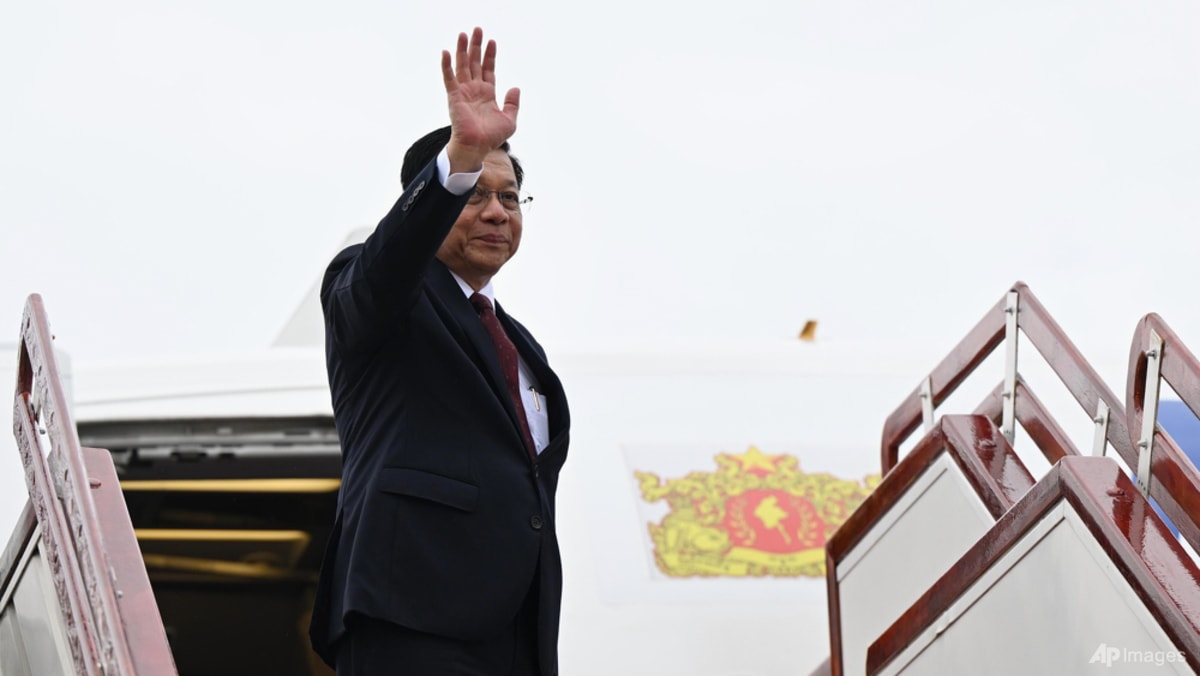
In Min Aung Hlaing’s recent charm offensive abroad, he has emphasised that Myanmar is open for business and portrayed the country as being on a path towards progress, stability and democracy.
He has also pledged to restore ties with the Association of Southeast Asian Nations (ASEAN), although he has pushed back on the regional bloc’s Five-Point Consensus peace plan, saying it discriminates against Myanmar.
Analysts say his diplomatic push has several objectives, including securing economic deals and gaining greater international recognition for an administration that remains isolated, particularly in much of the West.
But his choice of destinations is shaped by another consideration: the risks of arrest over allegations of international crimes.
LEGAL RISKS ABROAD
In November 2024, the International Criminal Court (ICC) prosecutor sought an arrest warrant for Min Aung Hlaing over alleged crimes against humanity involving the Rohingya ethnic minority.
International human rights lawyer Chris Sidoti said travelling overseas therefore carries some degree of risk for the Myanmar leader.
“(Min Aung Hlaing) is taking a risk when he travels,” he said. “But he certainly can be confident when he travels to his close friends (such as) China, a country that has a very close association historically to the Myanmar military.”
Russia is also considered a relatively safe destination for Min Aung Hlaing, Sidoti added. Putin himself is subject to an ICC arrest warrant over the alleged war crime of deporting Ukrainian children to Russia.
But it remains unclear if the court has since issued an arrest warrant for Min Aung Hlaing, as the ICC does not always immediately make such warrants public.
If one has been issued, the court can rely on its member states to carry out an arrest. Within ASEAN, only Cambodia and Timor-Leste are parties to the Rome Statute, the treaty that established the ICC.
But Sidoti said this does not necessarily mean Min Aung Hlaing can travel freely elsewhere in the region.
“Universal jurisdiction still applies for all states,” he said. “There are expectations that they would take seriously various responsibilities under international law to prosecute persons suspected of those most serious international crimes.”
Universal jurisdiction is a fundamental principle of international accountability. It allows nations’ courts to investigate and prosecute serious international crimes such as war crimes, crimes against humanity and genocide.
Under this principle, a state may exercise jurisdiction through its national courts over these crimes even when they were committed abroad.
“In some instances, some countries consider that they have an obligation to prosecute a person who falls into these categories,” said Sidoti.
“If Min Aung Hlaing (travels) to some countries, he would be almost certain to be arrested and investigated. In other countries, it’s a discretionary jurisdiction.”
Read the full article here
