



Good morning from Brussels. I’m Mared Gwyn, taking you once again to our EU editor Maria Tadeo in New Delhi to start this morning’s newsletter.
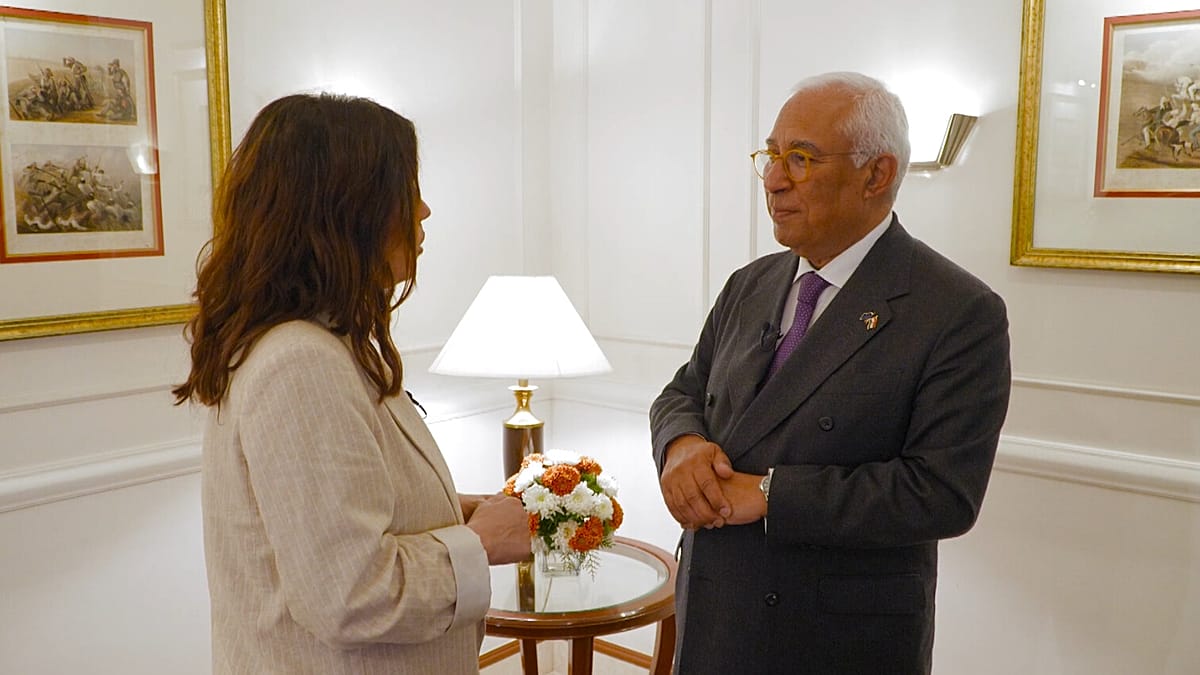
Speaking to Maria last night after the signing of a landmark free trade deal between the EU and India, European Council President António Costa hailed the agreement as a major economic opportunity and strategic victory in an “uncertain world.”
“The deal shows that it’s possible – in this very uncertain world – to provide predictability, when reliable partners agree on trade, on security, on defence, on people-to-people contact,” Costa told Maria.
“It has great value from an economic point of view,” Costa added. “But perhaps more important is the message that the two largest democracies in the world are sending to the international community.”
“It’s important, it’s essential to provide predictability to engage in cooperation instead of confrontation, and that reliable partners can work for good in the world.”
The deal is set to slash tariffs on EU goods from wines to cars and hedge against escalating global trading tensions. Asked whether Trump’s recent threats of an all-out trade war over Greenland had been the ultimate catalyst to seal the deal, Costa said: “We started these negotiations a lot of years ago, but of course when you are living in an unpredictable world, you need to provide predictability to the business (…) and to give hope and security for the citizens.”
The European Council President also confirmed that Mario Draghi and Enrico Letta – both former Italian Prime Ministers who have recently counseled the EU on its lagging competitiveness – willjoin an informal summitof EU leaders next month.
The gathering is due to take place at Belgium’s Alden Biesen castle on 12 February, with talks centered on how to restore the bloc’s competitive edge and economic resilience amid deepening global volatility.
President Donald Trump’s protectionist trade policy and unpredictable foreign policy have reinforced some of the major calls of both Letta and Draghi’s 2024 reports (the latter’s called on the EU to get down to work on boosting its competitiveness or face “slow agony”).
Costa said the retreat will serve to kickstart a cross-institutional debate on how to strengthen the European economy, and reinstate momentum around the recommendations made by Draghi and Letta in the blueprints they published in 2024.
In other news this morning, our correspondent Sasha Vakulina spoke to Josef Aschbacher, the Director General of the European Space Agency, about how the US still invests six times more in public space funding than Europe as a whole, and China spends about 50% more than Europe, leading to a decline in the bloc’s global share.
“It is very alarming because on one side Europe has excellent capabilities, our industries are among the best in the world,” Aschbacher said. But the US “is spending so much more” and “this is where we see a real risk that European companies may be pushed out of the market.” Watch.
Meanwhile, the Danish and Greenlandic Prime Ministers are on a tour of European capitals to shore up support ahead of pending negotiations with the Trump administration on Greenland’s future.
Mette Frederiksen and Jens-Frederik Nielsen met Chancellor Friedrich Merz in Berlin last night and will move on to Paris for talks with President Emmanuel Macron later today as the nature of the deal sought by Trump remains unclear.
Also in this newsletter: how Paris is resisting increasing calls for the EU to designate Iran’s Revolutionary Guards as a terrorist organisation, and how Mark Rutte has come under fire for his most recent smooth-talking comments on Trump.
France emerges as key holdout in EU talks on blacklisting Iran’s Revolutionary Guard
Momentum is building within the EU to designate Iran’s Islamic Revolutionary Guard Corps (IRGC) as a terrorist organisation, after Italy shifted its stance on Monday and announced it would push for the move, our EU correspondent Maïa de la Baume reports.
According to diplomats, Rome had previously been reluctant to back the designation, but reversed course after new data highlighted the scale of Iran’s recent violent crackdown on protesters. Some reports claim the death toll from the crackdown tops 30,000.
Foreign Minister Antonio Tajani said on X on Monday that he would propose adding the IRGC to the EU’s terrorist list “in coordination with other partners” because “the sudden losses among the civilian population during the protests demand a clear response.” Iran has summoned its Italian ambassador in response.
While a large majority of the EU’s 27 foreign ministers are expected to back the designation when they gather in Brussels on Thursday, diplomats say France remains the main obstacle. The decision requires the unanimous backing of all EU member states. French officials argue that fully cutting diplomatic ties with the Iranian regime carries significant risks and that listing the IRGC would be largely symbolic, as many of its members are already subject to EU sanctions under three categories: human rights abuses, nuclear proliferation, and military support for Russia’s war against Ukraine.
Maïa has the full story.
Volodymyr Zelenskyy sets 2027 as target for Ukraine’s EU accession date
Ukrainian President Volodymyr Zelenskyy has announced that his country is aiming to join the European Union in 2027. Posting on X after a phone conversation with the Austrian Chancellor Christian Stocker, Zelenskyy described EU membership as one of his country’s security guarantees in a prospective agreement to end Russia’s war.
EU officials have long insisted that the bloc’s enlargement policy is “merit-based” and that candidate countries must hit a range of reform targets before they can become fully-fledged members.
But the possible inclusion of a target date for Ukraine’s accession in a future peace deal is torpedoing that policy, and forcing officials to contemplate overhauling how it integrates new members.
An EU official tells our EU correspondent Sandor Zsiros reports that the model of “gradual membership”, where Kyiv would initially join without the full benefits of EU membership, is being contemplated as part of that overhaul.
Sandor has the details.
Rutte faces backlash for telling Europeans to ‘keep on dreaming’ about independence from US security
NATO Secretary General Mark Rutte has come under fire for saying that the EU should “keep on dreaming” about becoming independent from the US on security and defence, my colleague Jorge Liboreiro reports.
Rutte – who famously called Trump “daddy” and who was instrumental in convincing Trump to climb down on his recent threats over Greenland – told the European Parliament on Monday: “If anyone thinks here, again, that the European Union, or Europe as a whole, can defend itself without the US, keep on dreaming.”
“You can’t. We can’t. We need each other.”
Paris has struck back, with Foreign Minister Jean-Noël Barrot saying on X: “No, dear Mark Rutte. Europeans can and must take charge of their own security. Even the United States agrees. It is the European pillar of NATO.”
Asked by Jorge about Rutte’s intervention, the European Commission’s chief spokesperson Paula Pinho said the political focus should remain on making the EU “increasingly resilient” and “increasingly independent” on “various fronts”, including security and defence.
“We have a positive story to tell in terms of how we’ve been able to reduce our dependence on imports of fossil fuels from Russia,” Pinho said on Tuesday afternoon. “Such dependencies are seen also in other areas: on defence, on critical raw materials.,”
“We are engaged in doing all that needs to be done to reduce that dependence, to reduce that exposure.”
Jorge has the full story.
More from our newsrooms
EU now has own ‘secure and encrypted’ satellite communication system, Kubilius says. The EU’s defence chief said Tuesday that countries now have access to European-made “secure and encrypted” satellite communication, part of plans to reduce dependence on foreign space services, such as Musk’s Starlink. Alice Tidey hasthe story.
ICE agents’ role in Milan-Cortina Olympics sparks criticism in Italy. US Immigration and Customs Enforcement (ICE) agents will play a security role during the upcoming Milan-Cortina Winter Olympics, drawing the ire among some Italian officials on Tuesday, Gavin Blackburn reports.
Iran protests death toll could surpass 30,000, reports claim. Casualty estimates from Iran’s ongoing protest crackdown range from approximately 3,100 according to state media to more than 30,000 cited by independent sources and medical professionals. Massoud Salari has more.
Ex-FIFA president Sepp Blatter backs calls to boycott World Cup in the US. Blatter has backed a proposed fan boycott of World Cup matches in the United States because of the conduct of President Donald Trump and his administration at home and abroad. Gavin Blackburnhas the story.
We’re also keeping an eye on
- The European Defence Agency’s annual conference takes place in Brussels. The European Space Agency conference also continues.
- US Ambassador to the EU Andrew Puzder speaks to Members of the European Parliament (MEPs)
- The European Parliament’s employment committee to quiz Amazon representatives over employment conditions in their warehouses
That’s it for today. Maria Tadeo, Jorge Liboreiro, Maïa de la Baume and Sandor Zsiros contributed to this newsletter. Remember to sign up to receive Europe Today in your inbox every weekday morning at 08.30.
Read the full article here


