



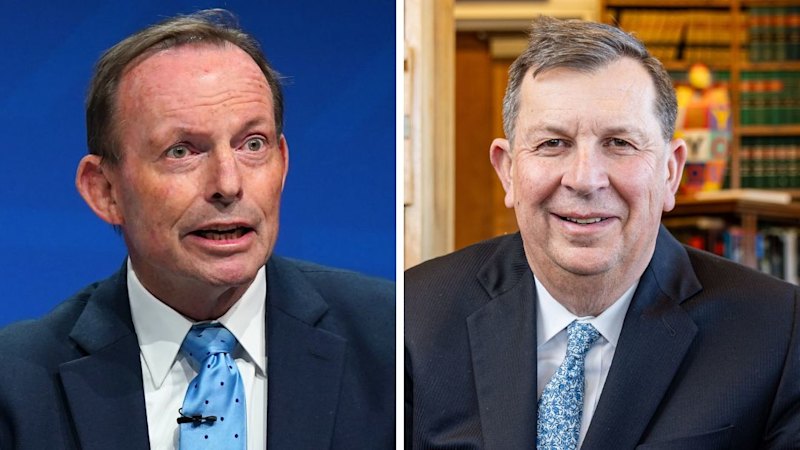
The state’s top judge has taken aim at former prime minister Tony Abbott over a social media post as he issued a stern rebuke about the dangers of misinformed criticism of court decisions.
NSW Chief Justice Andrew Bell used his speech at a dinner on Thursday to mark the new law term to express concern about the corrosive effect of public attacks on judges that were made “in terms that betray an ignorance” of the law.
Two Supreme Court judges “who have been the subject of highly personalised and misconceived criticism in some sections of the media for particular decisions have received death threats in the last 18 months”, Bell said.
The chief justice expressed alarm last year about the “simplistic but frequently highly personal criticism in some sections of the press and social media of some judges who had granted bail where the prisoner had subsequently reoffended”.
He said in a statement at the time that the “decision to grant bail to any person charged with a serious offence is not risk-free” and “there is a risk of doing irreparable harm to individuals ultimately found to be not guilty of any crime by imprisoning them for long periods”.
Separately, Abbott posted on X in August last year in response to a decision by Supreme Court Justice Belinda Rigg to reject an application by police for a prohibition order over a pro-Palestine march across the Sydney Harbour Bridge.
The former prime minister said it “should not be for judges to decide when a political protest is justified”.
“The decision to close the Sydney Harbour Bridge to facilitate this protest is a political decision and should be made by elected and accountable ministers – who as it happens, think the march should not go ahead,” Abbott said.
“We are on a slippery slope when unelected judges start making political judgments.”
Bell did not suggest Abbott’s commentary triggered threats but said it was, “with respect, misconceived”.
“First, the judge’s decision was not one concerning whether ‘a political protest was justified’ as any understanding of the statutory framework and case law set out in the judge’s reasons would have made plain to anyone who took the time to read it,” he said.
“Second, the judge did not make ‘the decision to close the Sydney Harbour Bridge’. The authorities had already taken the decision to close the Harbour Bridge in any event, that is to say, irrespective of the judge’s decision, a fact twice recorded in the judgment and one which was influential in the ultimate decision.”
Third, Bell said that “responsibility for the decision … was one expressly given to the court” in legislation, and “it was not an unauthorised assumption of jurisdiction by ‘an unelected judge’, as the post might have suggested”.
“Fourth, her Honour’s decision was not a ‘political’ judgment but involved the careful weighing of the common law and constitutionally protected right to free speech and public assembly with considerations such as public safety and disruption in circumstances where, as I have said, the evidence was that the bridge was going to be closed by the authorities in any event.”
Months later, three judges of the NSW Court of Appeal, including Bell, issued a prohibition order to halt a pro-Palestine march that was expected to result in tens of thousands of protesters descending on the Opera House. The court said the “public safety risk … is extreme”.
Bell said in his speech on Thursday that “[just] as her Honour’s decision was not a ‘political’ decision, so too, the decision by the Court of Appeal … was not a ‘political decision’ but involved a similar weighing exercise and risk assessment”.
He said that “while judicial decisions on subjects such as bail and public assemblies should not be free from scrutiny or criticism where justified, social cohesion … is not enhanced when judicial decisions are attacked on bases and in terms that betray an ignorance of the statutory framework”, the judge’s reasoning process, and the evidence before the court.
“Such attacks, often dashed ‘off the cuff’, are a form of misinformation that undermines trust in and respect for the judiciary and the rule of law,” he said.
“They corrosively suggest or imply that the community cannot have confidence [in the judiciary] … That is regrettable to say the least. Some might call it irresponsible.”
As Bell delivered his criticism of Abbott’s tweet, a screenshot of the post was featured on eight screens across the room.
The Supreme Court has also been the subject of more measured commentary.
From our partners
Read the full article here


