



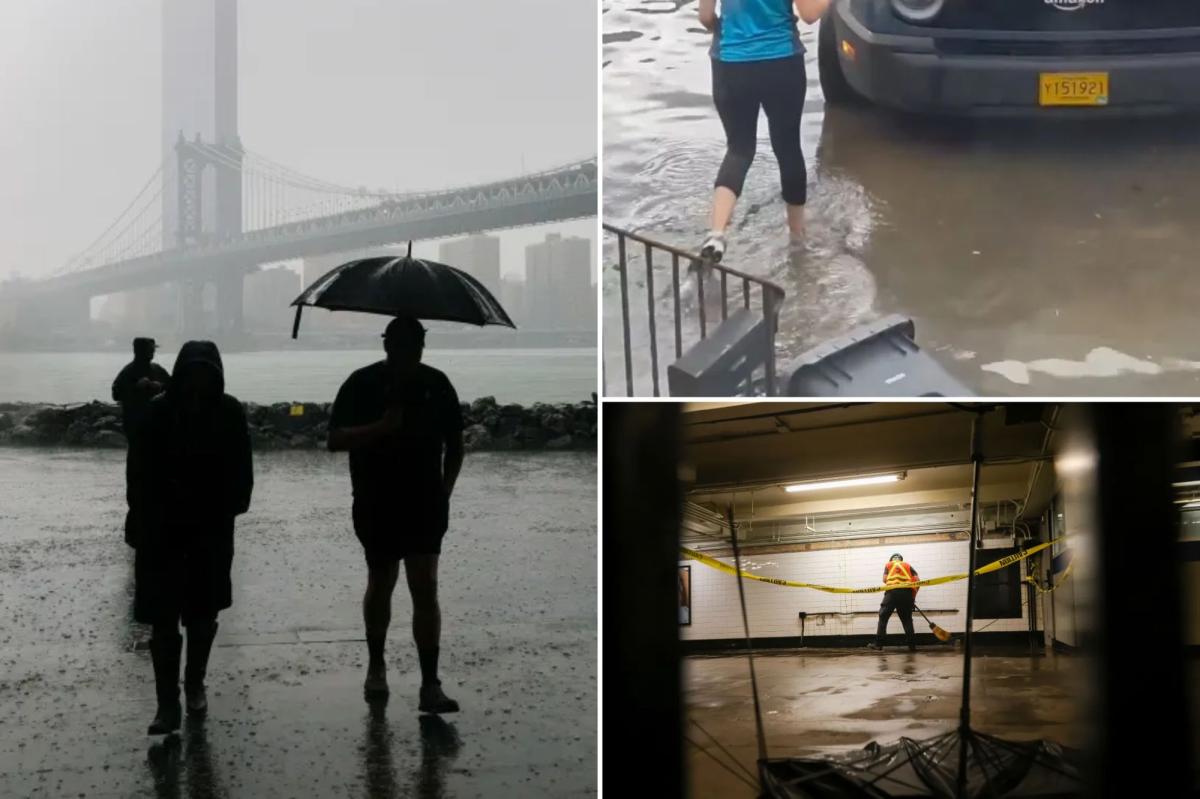
The soggy Apple.
The five boroughs were yet again swimming in floodwaters Thursday evening after being walloped by heavy rain that clinched the city’s wettest summer in five years.
Staten Island beared the brunt with wild video showing drivers trapped in their cars when torrential rains — which brought 3.72 inches of precipitation — turned the borough’s streets into rivers.
The heavy rains were just one of several dozen flood events that soaked the Big Apple this summer, which Comptroller Mark Levine warned will only get worse if the city’s infrastructure isn’t significantly upgraded.
“I don’t know how anyone who lives through this summer could still tell themselves we’ve had no change in weather patterns. It’s really quite obvious we’re not investing enough to protect the city in the face of this rising threat from extreme weather,” Levine told The Post.
“This is real. And it’s a trend that should worry us all.”
Flooding of more than a foot was recorded in New York City nine times this summer, according to the comptroller.
Neighborhoods were drenched with at least four inches of rain as many as 36 times — and residents have been inundated with what feels like constant flash flood alerts on their phones.
More than 16.7 inches has fallen in Central Park since June 1, according to AccuWeather.
That’s easily bests the average of 13.7 inches — and marks the wettest summer on record since 2021 when Tropical Storm Henri brought an incredible 24 inches.
There’s been a considerable increase this summer in the atmosphere’s moisture being blown in from the Gulf of the Caribbean, explained senior meterologist Matt Benz.
While the extra downpours were beneficial in offsetting drought conditions experienced at the beginning of the summer, Benz said the “unusual” amount of rain resulted in unwanted flooding.
The Big Apple’s 100-year-old infrastructure is simply not equipped to deal with the “new era of extreme weather,” Levine warned.
“Heavy rain events that might’ve been considered once every five years are now happening multiple times in one summer.”
The city needs to invest billions, Levine said, across numerous agencies to mitigate flooding — otherwise low-lying neighborhoods could soon become inhabitable.
“Most people feel this in the subways, a system that even on a dry day has to pump out a significant amount of water, but in a heavy rainstorm just gets totally overwhelmed,” Levine explained.
Expanding the capacity of pumping stations and hardening subway entrances to mitigate runoff is necessary, as well as greatly diverting water from the city’s century-old sewage overflow system — which can only handle up to 1.75 inches of rain per hour.
Levine has also been pushing for expanding the number of trees, bio-swales and rooftop vegetation across the five boroughs to absorb the water before it even seeps into the industrial systems.
“We need them now because the rain is here and it’s coming more intensely,” said Levine. “We’ve got to up our game.”
Read the full article here


