



Susan Horsburgh
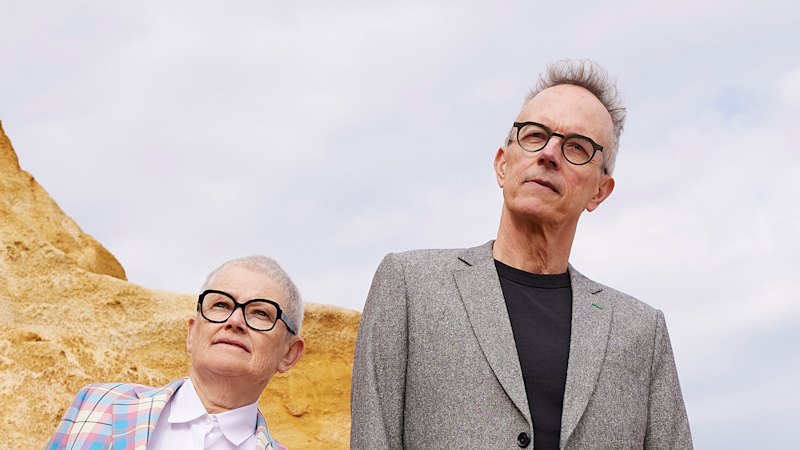
Writers and colleagues Peta Murray, 67, and David Carlin, 62, grew close when their parents became residents of the same aged-care home. Now they’re teaching each other how to grow old in style.
wasn’t here,” David Carlin says of Peta Murray. “We compare
notes and show our scars.”Mia Mala McDonald
PETA: We were both in alternative theatre in the 1980s, so I feel as if I’ve always known David, but our first formal encounter was in the early ’90s when he was artistic director of a theatre company and commissioned me to write a play. I basically tied myself in knots and never delivered it, so when we met again years later, I was mortified. That night, at a writers’ function, he suggested I do my PhD at RMIT.
In 2013, he became one of my supervisors, so I read his memoir, Our Father Who Wasn’t There. It was breathtaking in its vulnerability and poignancy [David’s father died by suicide when he was a baby]. I felt at ease with him, which can be unusual for me with men. My mum died not long before I started my PhD – which was about ageing as an artist – and he nursed me into it.
In 2017, as my father, Frank, was going into aged care, David invited me to share his office; whenever we wanted to speak to each other we’d ring a reception-counter bell. There’s a goofy, slapstick thing between us; through my PhD, I wore a stick-on moustache, the academic to his professor. Ridiculous, really, because we’re both clowns.
David sees his mum, Joan, regularly; I have enormous respect for men who step up. When she first went into care in 2018, she was playing bridge and walking; David wanted to make sure that her “Joan-ness” would flourish. With my parents, it had been this diminishment, this shrinking away to nothing. Dad was just a very misanthropic man. He was very hard to engage and, eventually, I just stopped trying. I became his PA. I’d been a good girl – the “eldest unmarried” as he called me – and I did that dutifully until his death in December 2019, but jeez, I was shitty. In every way, David’s relationship with Joan is so different: there’s warmth, fondness and mutual interest.
Get the best of Good Weekend delivered to your inbox every Saturday morning. Sign up for our newsletter.
David likes a suit. On work trips to Vietnam, he’d have bespoke ones made and I was filled with envy. He’s got one he calls his “bag of fruit” – a checked, car-salesman suit – and he’s mad for a hectic floral shirt. He’s my influencer. And an endless self-improver. I remember his swimming phase – up every morning with the larks, glowing with self-righteousness. I’m now in psychoanalysis, following his lead.
David and I have both suffered anxiety and depression. One of the perils of ageing is the obsession with “the organ recital” – where people complain at length about their health problems – but we have a longstanding interest in each other’s ailments. Our Signal chat is like a secret back-channel where we confide our fears and paranoias and offer each other reassurance.
When I’m tired and testy, I find David’s overthinking wearying – I could do my washing while I wait for him to finish a sentence – but I admire his intellectual rigour.
David pays attention to me in a kind way. I don’t have many men who look at me – I don’t want many men looking at me – but he does. He makes me laugh a lot as well. I’m just grateful I’ve got him in my life.
DAVID: Peta’s like the close sibling I never had. When we had an office together, it felt like sharing a childhood bedroom with the line down the middle. She’s the sort of person you can be in meetings with, texting under the table about how absurd it is.
Being a lapsed Catholic is a strong element in her life; it comes through in her love of pageantry and rituals. That’s something I love about her because I come from a culture that’s very held-in and a bit dour. For her PhD presentation, where most people just show some PowerPoint slides, Peta did a performance with funny little props and egg-timers going off; she gave the examiners roles and costumes. It was all related to her research on “elder-flowering”, a word she’d made up. She used the opportunity to showcase her queerness, eccentricity and capacity to blossom in new ways without denying the reality of getting older.
‘Her love of pageantry and rituals … [is] something I love about her because I come from a culture that’s very held-in and a bit dour.’
David Carlin
Peta’s mother had dementia and she’s paranoid about getting it herself, so she has all these life hacks – like learning Scottish Gaelic (she’s obsessed with her ancestry). She also does Scottish highland dancing and takes piano lessons. She wants to do everything and sometimes crashes from exhaustion. Then she loses her confidence and can’t leave the house.
When Mum moved into Frank’s aged-care place, we hoped they’d become friends, but Frank retreated into himself; he thought everybody was an idiot. Peta had to do a lot of the caring. I saw the frustration and anger – that feeling of giving so much and not getting anything back. It caused her a lot of grief, how little she felt he knew her. She’s been really gutsy addressing that in our book [How to Dress for Old Age, out February 3]; often people don’t talk about the hard stuff.
We’re both determined to not fade away. At RMIT, she started an a cappella choir called Hot Holler, after [her project for academics] Hot Scholar. She also has her drag alter-egos, Wanda Lusst and Buster Loose. I came back from Vietnam with an electric-blue suit and she was so jealous, she decided to get her own made up in baby pink-and-blue tartan – something expressive of her gender identity.
The only disagreement we’ve had was about AI. I’ve only used it a bit, but it peeves me that it’s both so sucky and so sure of itself. We were working on a podcast idea and she brought in a plan that AI had helped her write. I started picking holes in it. We were just a bit cold, but it was quite scary to have that tension. Later, I sent a message to apologise. She wrote back, saying, “Thanks for sharing your feelings. You’re a most atypical fellow.”
I find it hard when she puts herself down. Sometimes I just want to shake her and go, “You’re brilliant!” She also suffers from dyscalculia, where she freaks out with numbers and forms, and sometimes I get frustrated. That’s the only area where our twin DNA has mutated wildly because I do love an Excel spreadsheet.
There would be something terribly missing if she wasn’t here. We compare notes and show our scars. I just love hearing her stories and being able to tell her mine.
twoofus@goodweekend.com.au
To read more from Good Weekend magazine, visit our page at The Sydney Morning Herald, The Age and Brisbane Times.
From our partners
Read the full article here


