



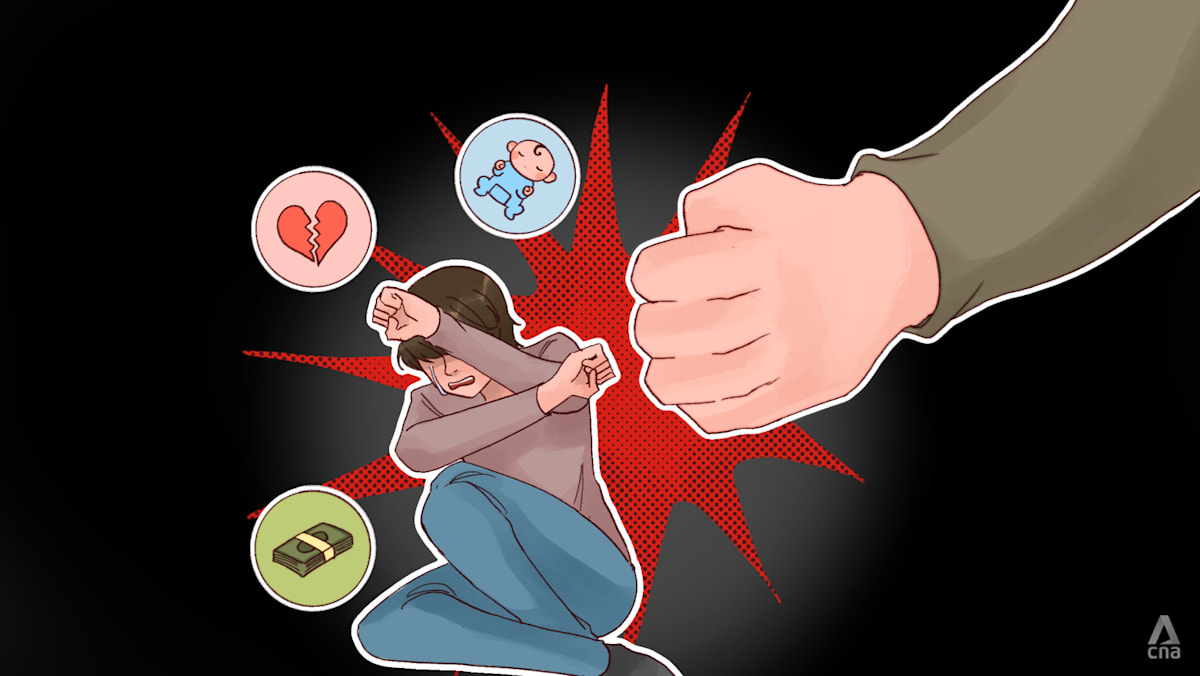
Siti Aminah Tardi, executive director of the Indonesian Legal Resource Center (ILRC), told CNA that domestic violence was still a pervasive issue in the archipelago, noting that according to the 2024 UN Population Fund Indonesian Women’s Life Experience Survey, one in five Indonesian women had experienced domestic violence within the past year.
She posited that the society largely adhered to a patriarchal culture, exacerbated through the interpretation of religion, customs, and laws that state the husband as the head of the family and the wife as the manager of the household.
“This social construction triggers the perception and belief that husbands have the right to control, dominate, punish and exploit weaker family members, especially wives and daughters,” she said.
“This unequal relationship will be expressed or worsened when there is poverty, unemployment, financial difficulties, debt bondage, or where women are considered disobedient to patriarchal norms.”
In other countries, societal stigmas keep domestic abuse shielded inside the home, said experts.
“Culturally, it’s considered to be a private family matter and should stay there,” said Am Sam Ath, operations director of the Cambodian human rights group Licadho.
According to Cambodia’s 2021 to 2022 Demographic and Health Survey, 53 per cent of women who have experienced physical or sexual violence have never sought help or told anyone about the violence.
According to the survey, 21 per cent of women who have ever had an intimate relationship have experienced emotional, physical, or sexual violence by their current or most recent partner, with 13 per cent having faced such abuse in the 12 months leading up to the study.
Sam Ath said that women were considered to be subservient partners who had to be obedient and tolerate abuse.
“There is still a lot of shame against divorce and separations,” he added.
The struggle is mirrored in the Philippines, where political and environmental factors have been observed to contribute to cases of reported domestic violence.
Jean Enriquez, who chairs the Civil Society Advisory Group for Protection from Sexual Exploitation and Abuse in the country, told CNA that the political climate under the presidency of Rodrigo Duterte from 2016 to 2022 significantly normalised violence against women.
Enriquez said that Duterte was openly sexist towards women, including those who were in positions of influence and also spoke about how his own abusive acts went unpunished.
In a 2018 speech, Duterte had recounted confessing to a priest how he had sexually assaulted his maid when she was sleeping.
Duterte’s spokesperson, cited in media reports, has since said the former president “made up” and “added and spliced” the speech referencing the confession.
During a 2016 campaign rally, he sparked outrage by joking about the 1989 sexual assault and murder of an Australian missionary in Davao.
Recalling the incident from his time as mayor, he stated he was angry about the crime but added that the victim was so beautiful that, as mayor, he “should have been first”. He has since apologised.
“All these emboldened abusers,” said Enriquez.
During the COVID-19 pandemic, lockdowns denied women access to resources and kept them trapped inside homes with their abusers, leading to unabated violence, she said, adding that seasonal typhoons and other disasters caused similar stresses.
According to Enriquez, the barriers to safety are even higher for some communities, especially in geographically isolated and disadvantaged areas where essential services are nearly inaccessible.
“In these regions, the prevalence of child, early, and forced marriages further complicate the legal and social landscape, leaving young women particularly vulnerable to a cycle of abuse that the state is often too far away to break,” she said.
Survivors can face a “trap” where leaving requires access to financial resources, legal protection, and social support, said experts.
According to Nazreen of WAO, fear heavily prevents survivors in Malaysia from leaving. This includes the fear of bodily harm, the fear that their children will be taken away, the fear of not being believed, and the dread of what comes next.
She said that financial dependence is a huge barrier, especially when the survivor has no income, no savings, or nowhere safe to go.
SIS echoed this and said that women also faced uncertainty around legal processes, concerns about child custody, and social pressures that discourage leaving.
“In many cases, remaining in the relationship is a response to limited options rather than acceptance of abuse,” said the SIS spokesperson.
Another domestic violence survivor from Malaysia, who wanted to be identified only as Siti, 52, told CNA that the physical violence in her marriage began when she sought a divorce from her husband of nine years, following his repeated infidelity.
He subjected her to slapping, choking, pulling her hair, and on one occasion, threw her against a cupboard.
Despite the danger, Siti found herself trapped in the home by her financial constraints and her concern for her son’s schooling.
“It was my house and I was paying for it, but there was no way I could afford to leave because I couldn’t pay rent for another place,” she said, adding that her ex-husband refused to leave the house.
“People ask me why I didn’t leave, but it is not as easy as that. There are so many factors that one has to consider. I had to bear this for nine months.”
Her husband eventually moved out once their divorce was finalised.
Read the full article here


