



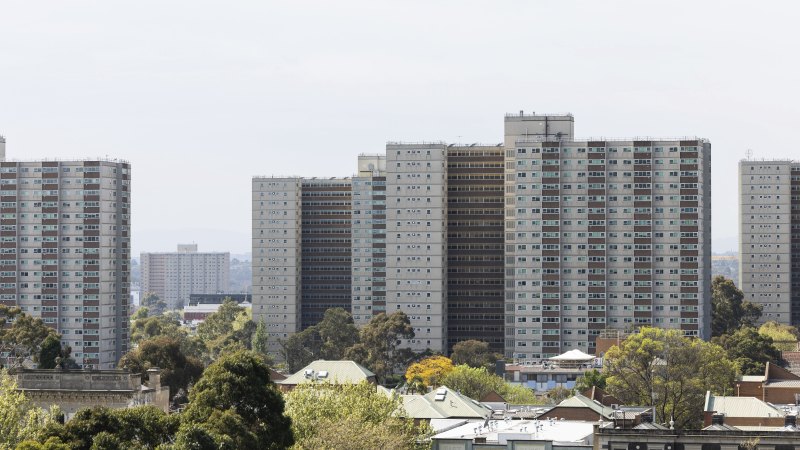
Secret state government research warned that replacing Melbourne’s 44 public housing towers with developments that mixed subsidised and private market housing would fuel social division and lead to owners “looking down” on low-income residents.
The findings showed public housing tenants overwhelmingly opposed the overhaul – but Homes Victoria is nevertheless moving ahead with the government’s plan to demolish the ageing towers.
The research, conducted by Redbridge using focus groups of public housing tenants, nearby residents, and members of the public, was completed in the months leading up to the government’s September 2023 announcement that all 44 high-rise towers would be torn down.
Under the redevelopment plan, announced in the dying days of Daniel Andrews’ tenure as premier, the government pledged at least a 10 per cent increase in community housing. But the developments will no longer include traditional public housing owned and managed by the state. About two-thirds of the new apartments are expected to be private housing.
The research – released to the opposition through freedom of information laws after the government fought for two years to keep it secret – found that tenants strongly and almost unanimously rejected the government’s so-called mixed-tenure model, fearing it would create social friction, reinforce stigma and lead to private owners “looking down” on them.
In focus groups with members of the public, participants were critical of Melbourne’s high-rise public housing, seeing it as “dog boxes” that were “not fit for human beings”.
Some participants raised concerns about large numbers of disadvantaged people “sandwiched together”, with universal agreement that high-rise housing was undesirable and that something needed to be done to improve conditions for residents.
But responses critical of the proposed mix of social and private housing said private owners would be hesitant to live next door to public housing.
“If you’re a business owner… you’re thinking, ‘Will my customers come there?’… I’d be scared my customers wouldn’t want to come there,” one participant said.
“Somebody will say, ‘I’ve spent $700,000 buying my house, and I’m living next door to you in public housing where you’ve spent nothing.’ People will say, ‘You’re leaving yours like a tip or not maintaining it, I’m cleaning it and looking after mine’,” another read.
The focus group notes showed public housing tenants in the towers spoke warmly and with great gratitude about their homes. They especially loved the locations of the towers; close to shops, public transport, hospitals and services.
However, residents in Flemington, Richmond and Fitzroy described serious issues regarding the lack of maintenance and upkeep. When issues were raised, such as damage to facilities or the hot water not working, residents reported that repairs could take months.
“A number of participants described a water leak which had not been fixed for weeks and there are now flooding toilets with sewage spilling out,” the research read.
In advising the government on a communications strategy based on its findings, Redbridge said opinions and commentary from residents would be vital to the social licence of the towers project, noting there was great public sympathy for public housing tenants.
“This research would suggest that the public will want to know the human stories of what these works mean for residents … and personalisation (if possible) could be powerful,” the report read.
In a submission to a parliamentary inquiry into the redevelopment of the towers, the Department of Families, Fairness and Housing defended its social mix approach.
It said it would reduce “place-based disadvantage” and socially integrate public housing tenants with private residents.
However, some academics last year argued at the inquiry that the social mix approach failed to improve outcomes for residents.
David Kelly, a housing and homelessness researcher at Royal Melbourne Institute of Technology, said such approaches tended to benefit higher-income residents, while producing significant negative effects for those on the lowest incomes.
In a majority report backed by Liberal and Greens MPs, the inquiry recommended pausing the tower redevelopment project due to concerns about transparency and evidence.
Deputy opposition leader and opposition housing spokesman David Southwick said the research showed the government was out of touch and did not listen to Victorians.
“It’s clear why Labor fought so hard to keep this report secret,” he said.
“Under Labor, social housing waitlists are soaring, wait times for our most vulnerable are unacceptably high and there is a complete lack of transparency over the rebuild of these housing towers.
“Instead of riding roughshod over local communities, Victoria needs a new approach to social housing that works with residents to deliver better outcomes for tenants and taxpayers.”
The opposition first applied for the research under FOI laws in April 2024. The government refused to release any documents, claiming they were cabinet-in-confidence and internal working documents.
In October last year, Victoria’s information commissioner ordered the department to release the documents; however, the government took its fight to keep them secret to VCAT. In April this year, it withdrew its application and released the documents.
A spokesperson for Housing Minister Nick Staikos said the government had listened to a range of stakeholders who said for social housing to work, it needed to be part of integrated, mixed developments to establish a strong sense of community.
“People deserve homes that are safe, modern and affordable – and that’s exactly what we’re delivering,” the spokesperson said. “Melbourne’s ageing high-rise towers have reached the end of their useful lives, and we’re replacing them with thousands of new ones.”
Start the day with a summary of the day’s most important and interesting stories, analysis and insights. Sign up for our Morning Edition newsletter.


From our partners
Read the full article here


