



Published on
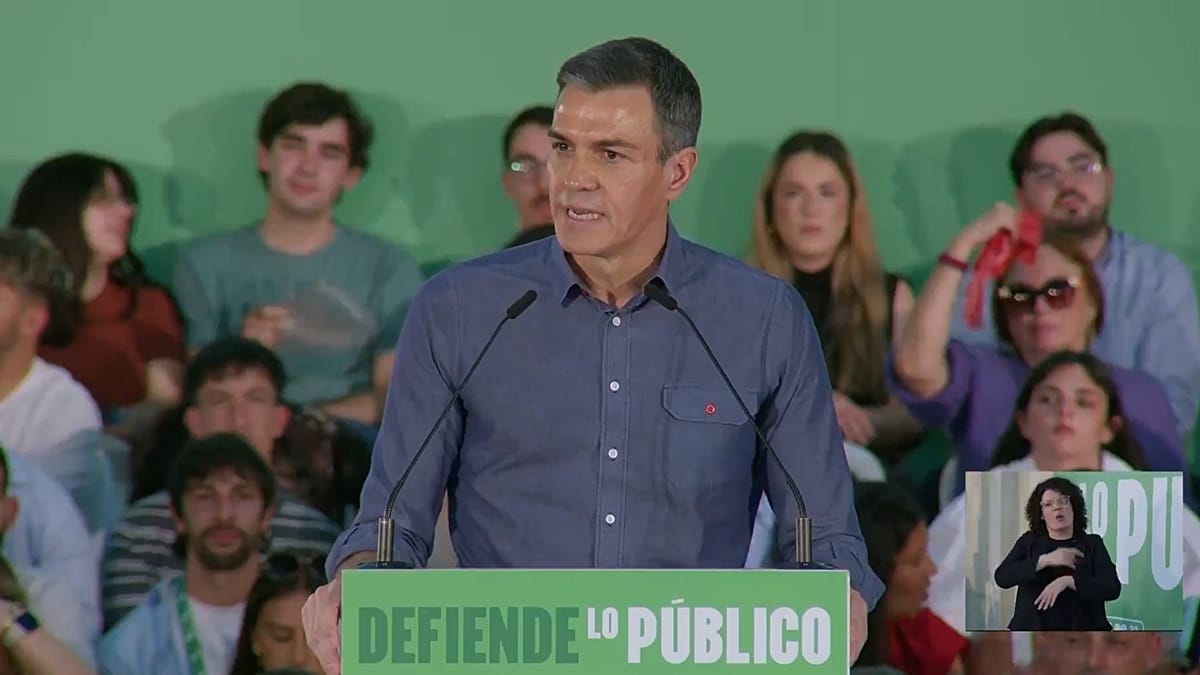
Pedro Sánchez used an election rally in the province of Huelva to deliver one of the most far-reaching foreign policy messages of recent weeks. “This Tuesday, the Government of Spain will take to Europe the proposal that the EU sever its association with Israel,” he told supporters.
The prime minister added that Spain is “a friend of Israel”, but that it does not share the actions of its government, and urged other European countries to join the initiative.
The announcement did not come out of the blue. Days earlier, Sánchez had called on the EU to suspend its Association Agreement with Israel after what he described as the heaviest Israeli attack on Lebanon since the start of the offensive. On Sunday, that appeal hardened into a firm pledge, with a date set for action.
A long-running diplomatic showdown
Spain’s stance on this conflict has been hardening for months. Sánchez and Ireland had already called for an urgent review of the EU–Israel agreement, arguing that respect for human rights and democratic principles is an “essential element” of the relationship.
At the European Pulse Forum 2026, held in Barcelona, Sánchez argued that Israel is “trampling on and violating” several articles of the Association Agreement, and said that Spain is “ready to take that step together with many other European countries”. Netanyahu responded by accusing Spain of waging a “diplomatic war” against Israel, to which Sánchez replied by taking the debate to the European institutions.
European backing: a majority, but not unanimity
The Spanish proposal does not start from a position of isolation. Countries including Belgium, Slovenia, Finland, France, Ireland, Luxembourg, Portugal and Sweden had previously backed similar initiatives, while Bulgaria, Croatia, Cyprus, Germany, Greece, Hungary, Italy and Lithuania have opposed them.
The EU is Israel’s largest trading partner, with a relationship worth more than €45 billion a year. Any suspension or rupture of the agreement would therefore carry major economic and political consequences.
A review of the agreement found “indications” that Israel has failed to comply with its human rights obligations, although several diplomats believe those findings will not necessarily prevent the treaty from remaining in force.
War as a backdrop
At the rally, Sánchez also addressed those “who started this war” and urged them to stop it and to “rein in” Netanyahu. The choice of a campaign event to deliver this message is no accident: the prime minister is seeking to set Spain apart on the European stage while at the same time reinforcing his progressive profile among Andalusian voters.
A citizens’ initiative, Justice for Palestine, has already collected more than one million signatures calling on the member states to break off the agreement between the EU and Israel, surpassing the minimum threshold that obliges the European Commission to examine the issue. The Spanish proposal therefore has the wind behind it on the streets, even if the path in Brussels remains tortuous.
Read the full article here


