



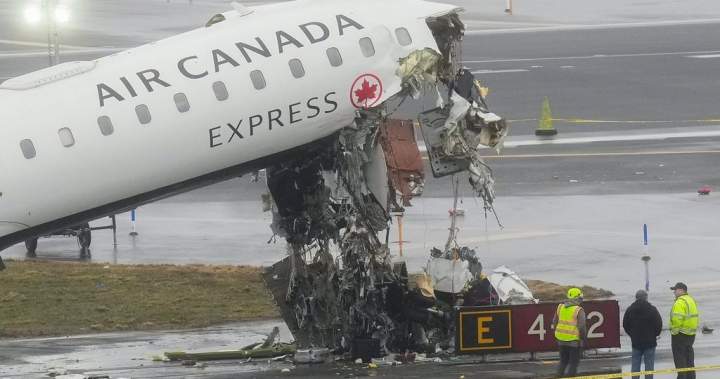
A crew member aboard the fire truck that crashed into an Air Canada Jazz aircraft landing at New York’s LaGuardia Airport in March told investigators he did not realize a radio transmission of “stop stop stop” was meant for them until they had entered the runway, investigators said Thursday.
The U.S. National Transportation Safety Board’s preliminary report said the driver of another truck had relayed the command to “Truck 1” after seeing the approaching aircraft shortly before the deadly collision, which killed the two Air Canada pilots and injured 39 other people.
“The turret operator in Truck 1 recalled hearing the words ‘stop stop stop’ … but he did not know who that transmission was intended for,” it continues.
“He subsequently heard “Truck 1 stop stop stop” and realized it was for them and subsequently noticed that they had entered the runway. He further recalled that as they turned left, he saw the airplane’s lights on the runway.”
A total of seven airport and police vehicles, including the fire truck, were responding to an unspecified emergency at one of the airport terminals prior to the accident. The vehicles were proceeding from the nearby fire station to the terminal as the Air Canada flight was approaching the runway.


Get daily National news
Get daily Canada news delivered to your inbox so you’ll never miss the day’s top stories.
A timeline of the incident says the fire truck had requested to cross the runway with the other trucks and was cleared to proceed by air traffic control, but was then twice told to stop seconds before the collision.
The report says the aircraft’s last recorded ground speed before the collision was 167 kilometres per hour (107 miles per hour, or 90 knots).
Investigators did not draw any conclusions or assign blame in the report, but rather lay out the evidence collected so far through interviews, reviews of the cockpit voice recorder and flight data recorder and surveys of the crash scene.
The report does not raise any issues with air traffic controller staffing or the conduct of the pilots or flight crew onboard the plane.
It said a crash prevention system didn’t generate an audio or visual alert in the control tower, and that runway entrance lights that act as stop lights for crossing traffic were on until about three seconds before the March 22 collision. The system is designed to turn the lights off two or three seconds before a plane reaches an intersection, the report said.
The system, known as ASDE-X, didn’t work as intended at the time because none of the ground vehicles were outfitted with a transponder, investigators said. The proximity of the vehicles merging kept the system from triggering an alarm, investigators said.
“At the time of the accident, ASDE-X displayed only two radar targets (at the intersection), rather than all seven of the response vehicles as distinct targets at their respective locations,” the report said.
The plane, a CRJ900 regional jet from Montreal, had more than 70 people on board. Pilots Antoine Forest, 24, and Mackenzie Gunther, 30, were killed. About 40 people, including the two people in the fire truck, were taken to hospitals.
—With files from The Associated Press
Read the full article here


