



The beep test line starts to grow ragged somewhere around level 5.
The boys lope through the first levels, running ahead of the beats, trying to find rhythm, looking like bored teenagers denied screen time.
As the intervals tighten, the group becomes focused. Heads go forward and down with concentration, and then back with exhaustion. Shoes squeak. A boy, hair shaved on the sides, misses one count and must now sprint to make the next – the beep test’s punishment. The reward for the successful is also, unfortunately, the need to run faster.
The first young Olympic hopeful drops out at level 6. By level 13, there are just two boys in it, matching each other step for step, each stealing glances at the other in the hope he will drop out first. At 13.8, one runner gives up, hurling his bib in frustration. The other boy barely makes it any further.
These children – and you have to remind yourself they are children, as many sport adult physiques – are here to follow their dreams. They are not sure what path those dreams will take them on, but for all the destination is the same: Brisbane 2032.
About 600 children are here, in the chilly and increasingly smelling-of-sweat gymnasium at the State Sports Centre at Parkville, to participate in a national talent search for potential Olympic talent.
Many top athletes come up through the ranks of youth sport and development pathways. This is different. Scientists from the Australian Institute of Sport are here looking for hidden gems: people aged 13 to 23 who have the unusual metrics that might make them stars in pole-vaulting or discus.
It’s less a talent competition and more a spot-the-hidden talent competition.
Take Georgia Robertson, who turned 15 last week. At home in Shepparton, she takes part in athletics and plays netball and cricket with her younger brother. Could she be good at something else, she wonders? “I want to try water polo or triathlon. I don’t know,” she says with a laugh. “I love a good run.
“I’m from a small area. You don’t have many options. To come down here, it’s really nice to be able to see everything I could be good at.”
Her proud parents, Rachel and Matt, sit high above the court, watching their daughter through glass. Her mother spotted this event on Facebook. “There’s no coaching at home; she’s all just natural ability,” says Rachel “It’s very exciting – and just to see where she’s at, compared to other kids.”
And the parents are being judged too. Staff ask for mum and dad’s height, as especially tall parents can indicate a child who might be about to undergo a big growth spurt.
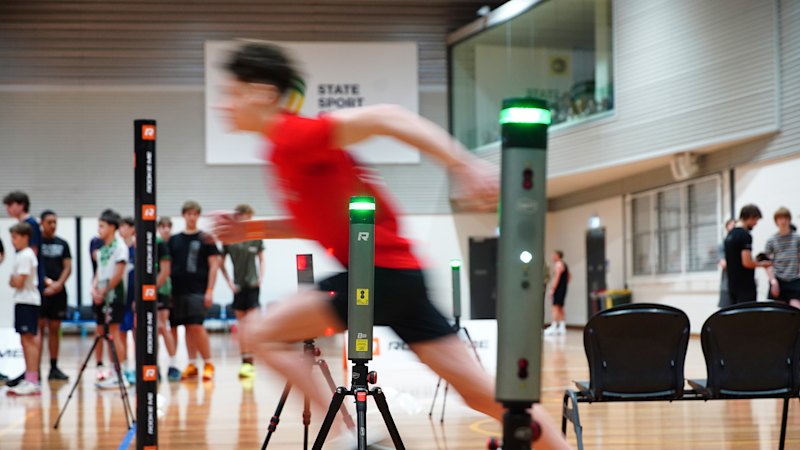
Next to the beep test, Australian Institute of Sport staff have set up a field of tripods to track sprint times. Kids line up to have their jumping power measured by a mat set on the floor, and then crane their arms upwards for the standing reach. The room is bordered in discarded jumpers and colourful water bottles. On the far wall, Simon Rogers, one of the institute’s performance pathways scientists, measures kids’ wingspans.
“We’re looking for people that have that X-factor,” he says. “There’s often a metric, a particular physiological trait a sport is really reliant on. It’s a matching of where their traits might be best applied.”
Rowing needs long arms and long torsos to drive the boat, as do the kayak sports. “Discus is another one, where the long arms really benefit the length of the throw,” says Rogers. “We’re looking to give everyone that opportunity to find an Olympic pathway. The road to 2032 can start now.”
While Rogers hunts for unusual metrics, Regan Molyneaux is hunting for gymnasts to take to the slopes. Elite gymnasts master the art of flipping and flying through the air – if Molyneaux, the Australian Institute of Sport’s talent transfer co-ordinator, can teach them to ski, they could become the next generation of elite aerial skiers.
She pulls out her phone to show a video of an elite gymnast turned novice skier gingerly making their way down a ski run. “They have generally never been to the snow,” she says. “They have been a gymnastics athlete from five years of age, and not necessarily had access to high-performance programs, or had an injury, and that prevented them from reaching their goal.”
Often, the children are surprised when Molyneaux tells them they could make it on the snowfields. “They have only known themselves as a gymnast. They don’t consider they were probably really good at school athletics or riding a bike as a kid.”
Back at the beep test, the robotic, merciless voice is commanding the next batch of kids to push through the pain. They do, for a time, before falling away, leaving Anthony Audino to win at 12.6.
“Which is not too bad,” he says afterwards, still catching his breath. “I haven’t done the beep test since I was in year 5.”
Audino has an AFL background but no notions of what Olympic sport he might be best suited for. “I think representing the country at a national level in any sport would be pretty cool,” he says.
Start the day with a summary of the day’s most important and interesting stories, analysis and insights. Sign up for our Morning Edition newsletter.


Contact him via email or Signal (encrypted) liammannix.18
Connect via X, Facebook or email.From our partners
Read the full article here


