



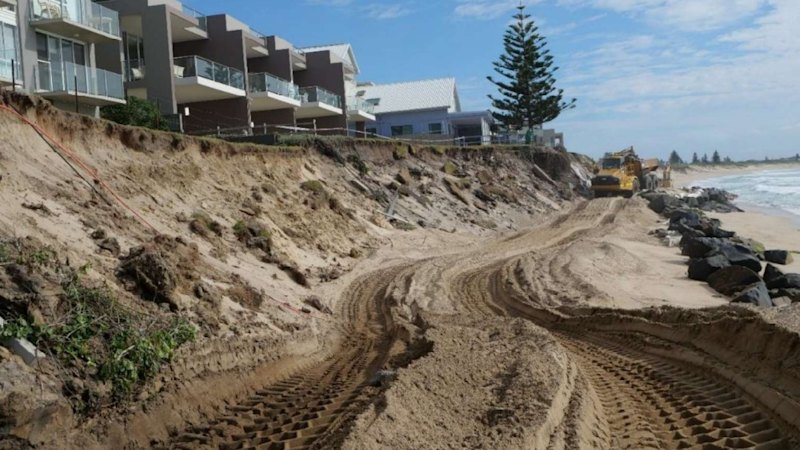
The battle over a controversial seawall on the Central Coast has become the latest flashpoint in a growing conflict along the NSW coastline as communities grapple with the escalating cost of protecting beachfront homes from severe erosion, intensifying storms and rising sea levels.
The NSW Land and Environment Court has approved a permanent 90-metre seawall designed to protect three beachfront apartment blocks at The Entrance North, overturning the Central Coast Council’s refusal of the project and delivering a decision likely to reverberate well beyond the disputed stretch of coastline.
Standing up to 1.5 metres high, the reinforced concrete structure will protect dozens of strata units on Hutton Road that have become increasingly exposed after decades of erosion and major storms, including in 2020 and 2025, which destroyed protective dunes, eroded backyards, and contributed to the beach losing 35 metres of width since 2020.
The decision comes as councils across NSW face mounting pressure to respond to increasingly destructive storms and coastal erosion while balancing demands from beachfront home owners against concerns over environmental impacts and public beach access.
The Hunter and Central Coast Regional Planning Panel last month rejected a proposed $17 million seawall at nearby Wamberal Beach after receiving 637 public submissions, citing unresolved environmental concerns.
Land and Environment Court Commissioner Joanne Gray found The Entrance North seawall was an appropriate response to the site’s “persistent” coastal hazards and would protect both private property and public safety.
The decision follows emergency intervention by the NSW government in the wake of the 2025 storms, when emergency coastal protection works were authorised to place 15,000 cubic metres of sand and 6000 tonnes of rock along the shoreline while authorities considered a permanent solution.
However, the proposed seawall exposed deep divisions within the community, attracting more than 100 submissions from residents, surfers and environmental groups.
Central Coast Council opposed the development, arguing it would create a “hard, regular, man-made and visually dominating structure” that would detract from the natural landscape.
Opponents warned the wall would impede beach access, damage shorebird habitat, accelerate erosion on adjoining beaches and create an unsightly barrier, with one submission describing it as “worse than the Berlin Wall”.
The project also split apartment owners, with some claiming they had never endorsed the proposal and warned construction costs could exceed estimates, leaving residents facing levies of up to $294,000 to fund the works.
Supporters argued worsening climate change impacts had left residents with little alternative.
Peter Horton, director of Horton Coastal Engineering, which represented the owners in the court appeal, said the seawall would provide 60 years of protection and end uncertainty.
“It’s been enormously stressful to be exposed to this risk over many years – a constant fear that the next storm will be the one that washes away their homes, an asset that is completely uninsurable,” he said.
Horton said NSW’s planning laws made it “almost impossible” for howeowners to secure approval for permanent seawalls and argued future coastal protection works should follow a funding model used to protect beachfront homes at Collaroy and Narrabeen, where landowners pay 80 per cent of construction costs and state and local governments cover the remainder.
In her judgment, Gray acknowledged the broader planning dilemma as coastal hazards become more frequent and severe.
“The desire to live on the beach, combined with a historic lack of planning controls, has resulted in the degradation of natural coastal protection and left residential development exposed to severe coastal hazards,” she wrote.
The Morning Edition newsletter is our guide to the day’s most important and interesting stories, analysis and insights. Sign up here.


From our partners
Read the full article here


