



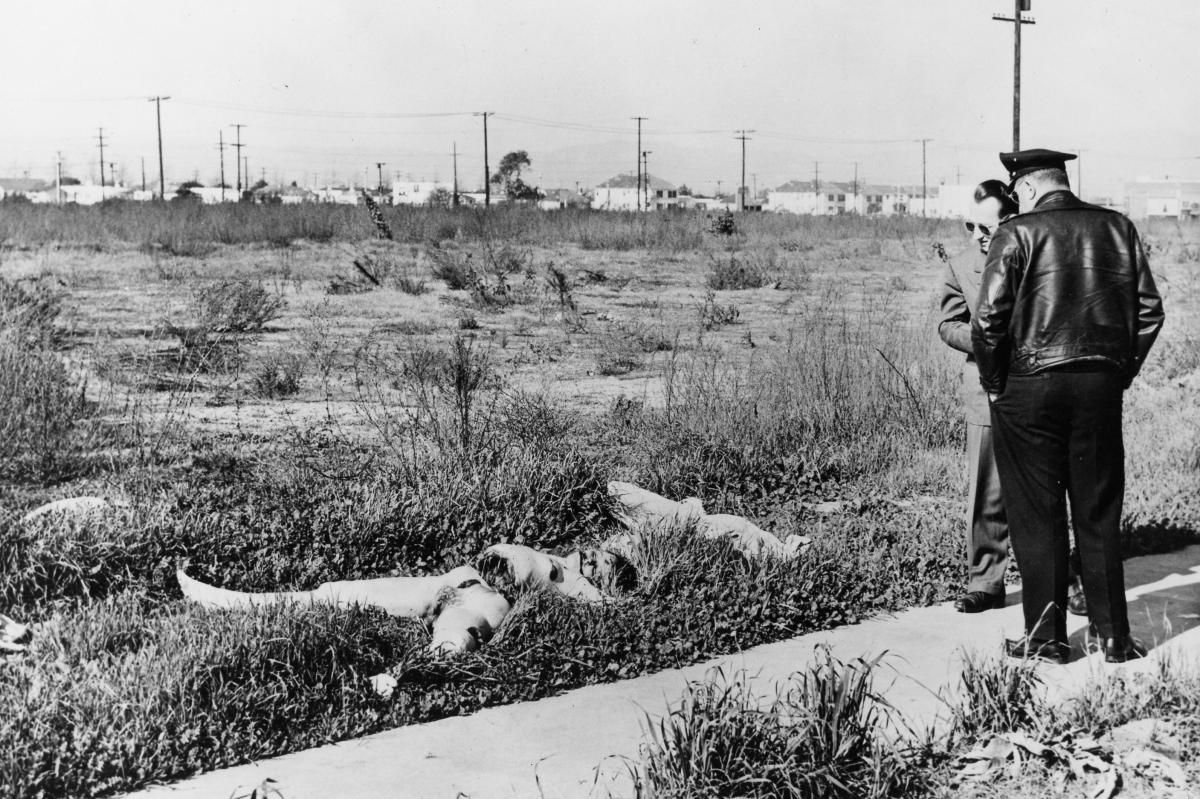
On January 15, 1947, Betty Bersinger pushed her three-year-old daughter in a stroller down a weedy stretch of Norton Avenue in Los Angeles. What she saw that morning — a bright white form in the tall grass — would become one of America’s most enduring murder mysteries. The body of 22-year-old Elizabeth Short, bisected at the waist and drained of blood, launched what became the LAPD’s most extensive investigation in its history. No one was ever charged.
Nearly 80 years later, the case refuses to die. Two new books released within months of each other—historian William J. Mann’s “Black Dahlia: Murder, Monsters, and Madness in Midcentury Hollywood” and Emmy-nominated producer Eli Frankel’s “Sisters in Death”— join a crowded field of investigators, each claiming to have cracked the code.
Meanwhile, an amateur sleuth recently linked the murder to the Zodiac Killer, while Steve Hodel, a former LAPD detective, has spent years arguing his father — Dr. George Hodel, a Los Angeles gynecologist—was the culprit. The theories multiply, the mythology deepens, and the fascination never wanes.
Mann spent five years researching his book not to solve the murder, but to restore dignity to Elizabeth Short herself. What he discovered contradicted nearly everything the public believed about her.
“She was not a sex worker, not a gangster’s moll, not an aspiring actress who wanted to be famous,” the author told the Post. “The media at the time sometimes implied that a sordid lifestyle led to her murder. This wasn’t the young woman I discovered. She was clever, somewhat puritanical, curious, kind, and resilient.”
The mythology began almost immediately. The day after Short’s body was found, the Los Angeles Examiner sold more papers than any day since World War II. Newspapers dubbed her the “Black Dahlia” — a reference to the 1946 film “The Blue Dahlia” and the victim’s dark hair and her fondness for black clothing. Within days, she transformed from “beauteous 22-year-old” to sinister seductress, somehow responsible for her own murder.
This victim-blaming narrative has proven remarkably durable. Mann’s research reveals a different Elizabeth Short: a young woman seeking love and stability, who spent most evenings alone attending radio shows at CBS and NBC studios. She didn’t drink, smoke, or stay out late. She came to Los Angeles to reconnect with her estranged father and for the weather, not for Hollywood stardom.
“Her life was ordinary and unremarkable,” Mann said. “And yet her life is still more important than her death.”
Perhaps the most significant revelation in recent years came not from forensic analysis but from an elderly witness. Frankel tracked down Betty Bersinger, the woman who discovered Short’s body. She was 101 years old when they spoke.
“I started asking her specifically about the body and where it was and where it was placed,” Frankel told the Post. “And then she kind of casually revealed to me exactly what she saw that morning, which completely contradicted every account that had been told before.”
She said the body wasn’t posed inches from the sidewalk in full public view, as every account has claimed. It was hidden twelve feet away in tall weeds, face down.
When he asked why she’d never corrected the record, her answer was simple: “Nobody ever asked.”
The iconic crime scene photos showing Short’s body displayed on grass near the sidewalk came later — the work of the first two responding officers, who moved the body to examine it, inadvertently creating the staged tableau that would define the case.
The revelation changes everything, according to forensic psychologist Dr. Joni Johnston, who’s done criminal investigations since 1991.
“For 79 years, every profile of this killer has been built on the assumption that he posed her out in the open,” she told the Post. “That turned him into a specific type: a narcissist, an exhibitionist, someone who wanted credit. Entire books have been written around that characterization.”
When Johnston looks at what was done to Elizabeth Short, “I don’t see a killer performing for an audience,” she said. “I see someone who was enraged at her specifically. The facial mutilation, the Glasgow smile, the focus on sexual areas. In my experience over the past three decades, this points more to a personal connection. The killer knew her, or at least believed he had a relationship with her.”
The central paradox is that nearly everyone who investigates the case becomes convinced they’ve solved it.
Frankel links Short’s murder to the 1941 killing of Kansas City heiress Leila Welsh, arguing both were committed by Carl Balsiger, a former Air Force baker who knew Short and spent three days with her shortly before her murder.
Mann disagrees, arguing that Balsiger “didn’t have the skills to expertly bisect a body as was done in this case, nor did he have the psychopathic rage and resentment to do what Short’s killer did.”
Mann’s prime suspect is Marvin Margolis, a pre-med student who lived with Short for twelve days and was questioned by police following her murder. Mann presents evidence suggesting Margolis, who died in 1993, “possessed both the surgical skill and psychopathology to fit the signature of the killer,” he told the Post. “I don’t claim to have solved the case, as there remain records the LAPD still holds under lock and key. But according to my analysis, he is by far the most likely to have killed Elizabeth Short.”
Johnston sees a deeper pattern at work. “This case is basically a Rorschach test,” she said. “There’s a massive suspect pool, incomplete physical evidence, 1947 forensic limitations, and decades of contradictory accounts where rumor got treated as fact. When your starting data is that contaminated, you can build a convincing case pointing in almost any direction.”
Once someone commits to a theory, Johnston adds, “confirmation bias does the rest. Everything supports the conclusion, contradictory evidence just sort of fades away. It’s the same cognitive trap that produces wrongful convictions, just running in reverse.”
Frankel himself admits to the mystery’s grip. “I don’t know why I’m so fascinated. I don’t know why I devoted years to it. I think the answer has to do with human psychology at a level and a depth that we probably don’t understand.”
David Mittelman, CEO of Othram, Inc., a Texas-based forensics company that uses DNA sequencing for human identification, offers a sobering perspective. His company helped the FBI identify the Idaho college killer Bryan Kohberger within weeks in 2022, a case that could easily have become “the next Black Dahlia,” he told the Post.
“These crimes don’t have to go cold,” Mittelman said. “The technology exists. The legal framework exists. At this point, we’re at a point where unsolved crime is basically a choice.”
But the Black Dahlia presents unique challenges. “Unless there’s DNA, it’s going to be very difficult,” said Dr. Priya Banerjee, a Board-certified forensic pathologist who’s performed over 2,500 autopsies. “And it does get harder as time goes on. Samples can get degraded or lost.”
The problem extends beyond technology. The killer, if alive, would be over 100 years old. “It’s pretty likely that they’re long gone by now,” she said.
It raises an uncomfortable question. Does our fascination with vintage mysteries like the Black Dahlia distract from solvable contemporary cases? As Mittelman pointed out, there are “tens of thousands of other cases that could be addressed right now. Roughly half of homicides and nearly 70 percent of sexual assaults go unsolved.”
But he still thinks the continued fascination with the Black Dahlia serves a purpose. “If it takes the Black Dahlia or the Zodiac Killer to excite people about bringing killers to justice, so be it.”
In other words, the case reminds us that justice delayed is justice denied, that victims deserve answers, and that unsolved murders represent not just individual tragedies but systemic failures.
Mann, who advocates for “an insistence on facts based on evidence” rather than conspiracy theories, believes Short’s story matters because it reveals how easily victims are transformed into myths that serve everyone’s purposes except their own.
“(Short) was exploring the world the way young men had always done, having adventures and meeting new people before settling down,” Mann said. But in a post-World War II world, “many saw these urban single women as deviant and damaging to the social order. It’s not a coincidence, I think, that the percentage of women murdered in post-war America skyrocketed.”
Nearly 80 years after her death, Elizabeth Short remains frozen at 22, forever the Black Dahlia. The theories will keep coming, each investigator convinced they’ve found the answer that eluded all the others. The fascination will persist because, as Frankel suggests, something in human psychology makes us unable to look away.
Perhaps the real mystery isn’t who killed Elizabeth Short. It’s why we needed to turn her into the Black Dahlia in the first place, and what it says about us that we still can’t let her rest.
Read the full article here


