



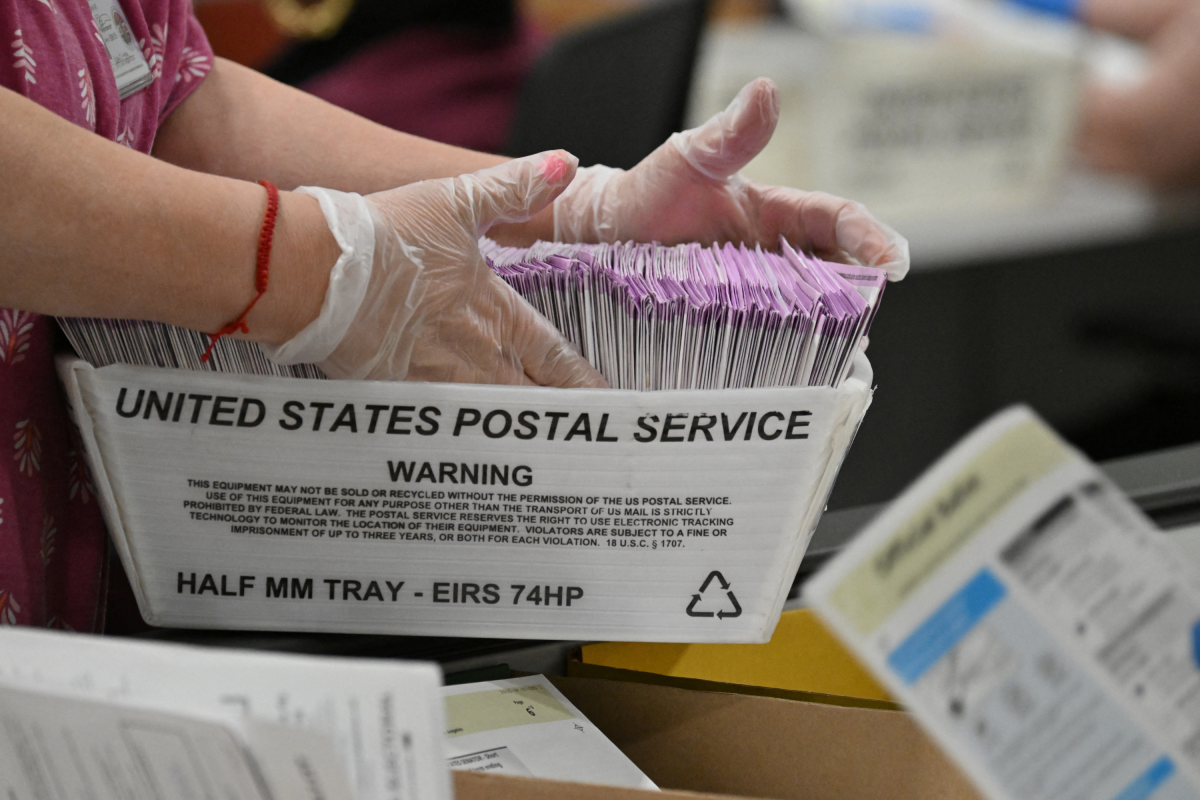
A small group of states that run their elections almost entirely by mail now sits at the center of a fight that could decide whether millions of ballots reach voters this fall.
Pivotal to the clash is a set of proposed rules from the U.S. Postal Service (USPS) tied to President Donald Trump’s March 31, 2026, executive order on election administration.
It would require states to submit detailed lists of mail voters—and could block ballot deliveries for those that do not comply.
The stakes are immediate. More than 48 million Americans cast ballots by mail in the 2024 election, accounting for roughly one in three voters nationwide.
With the 2026 midterms approaching, election officials warn the changes could disrupt the mechanics of voting itself in states where the mail is not a backup option, but the primary system.
A total of 23 Democratic-led states and Washington, D.C., are already suing, and a federal appeals court could rule this summer—just as states gear up for the November midterms.
Newsweek contacted the USPS and the White House for comment via email on Friday morning.
Why It Matters
In March, Trump signed the order, titled “Ensuring Citizenship Verification and Integrity in Federal Elections,” in the latest in a series of moves to assert federal control over elections he has repeatedly, and without evidence, cast as rife with fraud.
Among the order’s key provisions:
- The Department of Homeland Security must compile state-by-state lists of voting-age U.S. citizens.
- The Postal Service must develop rules to ensure ballots are sent only to voters on approved lists.
- Mail ballots must be linked to tracking systems, including unique barcodes.
Because the Constitution leaves election administration largely to the states, a plan that turns mail carriers into gatekeepers of who receives a ballot has triggered an immediate and sprawling legal fight.
A Fundamental Shift
The USPS proposal released in late May operationalizes those directives.
It would require states to submit names, addresses and ballot-specific barcodes for every mail voter, and would allow the agency to reject or return mailings that do not meet the new standards.
That marks a fundamental shift. Historically, USPS has acted as a neutral carrier—delivering election mail based on postage and routing, not voter eligibility.
“The Constitution makes clear: the states and Congress—not the president—set the rules for our elections,” said an ACLU press release describing a lawsuit against the measures, warning the order risks turning the Postal Service into “an arbiter of who may cast a ballot by mail.”
An Unprecedented Role for the Postal Service
The proposed rules would reshape USPS from logistics provider to active gatekeeper in federal elections.
Currently, “Election Mail” includes ballots, registration forms and voting notices sent between officials and voters, and the Postal Service’s role is to deliver those items securely and on time.
That system has been highly standardized—and by USPS’s own data, highly reliable. In 2024, the agency reported delivering at least 99.22 million ballots, with 99.88 percent arriving within seven days.
The new proposal, however, would:
- Require USPS to verify that each recipient appears on a state-submitted voter list before delivering a ballot.
- Create a federal “Mail-In and Absentee Participation List” system administered through a new digital portal.
- Introduce mandatory envelope designs and tracking systems tied to individual voters.
Previously, election officials “kept lists of mail voters, designed the mail ballot packets, and simply used USPS as a reliable vendor for delivery and return,” according to an analysis by legal fellow Stephen Richer for the Cato Institute.
Under the new framework, USPS would help validate those systems—and potentially reject ballots that fail to meet them.
Highlighting this concern, former Postal Service Board of Governors Vice Chair Anton Hajjar told CNN: “If proper postage is paid on a mail piece, the USPS should deliver it…The proposed rule says it’s not regulating elections but that’s what, in effect, it’s doing.”
And postal unions have raised concerns of their own. “If a state does not comply…the Postal Service is going to simply refuse all of those ballots,” warned Brian Renfroe, president of the National Association of Letter Carriers, calling the position it puts carriers in “very, very concerning.”

The States With the Most to Lose
The impact of the proposed rules would not be uniform. It would fall hardest on states where voting by mail is not optional but foundational.
California, Oregon, Washington and Colorado conduct elections largely or entirely by mail, mailing ballots automatically to registered voters. In such systems, the postal network is essential infrastructure—akin to polling places elsewhere.
National data shows how significant that reliance has become. A total of eight states and Washington, D.C., now use “all” or “mostly” mail election systems, while every state offers some form of mail voting.
In these high-mail states, any interruption would not merely inconvenience voters—it would disrupt the core method of participation.
“This would deny eligible people the right to vote. Full stop,” Tobias Read, Secretary of State for Oregon, one of the 23 states suing the administration over the order, told CNN. “This is not in the president’s power.”
Maine Secretary of State Shenna Bellows, a Democrat from a state involved in the coalition challenging the policy in Boston, warned of even broader consequences: if courts uphold the policy, “you will see a virtual elimination of mail-in voting, unless the states supply voter lists to the federal government.”
Battleground States Watching Closely
Beyond the fully mail-based systems, a second group of states—Arizona, Nevada and Michigan—could face high-stakes disruption.
These states:
- Have large populations of mail voters
- Do not rely exclusively on mail voting
- Regularly decide federal elections by narrow margins
Even partial disruption in ballot delivery could affect turnout dynamics. Election officials say the burden would not be evenly distributed.
Larger jurisdictions may already use sophisticated ballot tracking and barcode systems aligned with the proposed rules. But smaller or rural offices could face costly redesigns.
The issue is not just compliance—it is timing. General election ballots are typically mailed weeks in advance, and states must finalize systems months earlier.
A Data Battle at the Core
For many state officials, the deeper conflict is not about envelopes or postage—it is about data.
Trump’s order directs federal agencies to assemble citizenship databases for voters and ties ballot delivery to state-provided lists.
At the same time, the Justice Department has pursued voter data from states, with multiple courts siding against those requests so far, according to the draft.
The USPS rule effectively creates a new pathway: states could be forced to share voter data if they want ballots delivered.
“We already told the Trump administration that they couldn’t have our voter data,” Amanda Gonzalez, clerk of Jefferson County, Colorado, told CNN. “This is just a poorly disguised ploy to get it another way.”
The White House disputes that characterization. Spokeswoman Abigail Jackson told CNN the administration “remains confident that the Executive Order will be implemented by the November election.”
Legal Fight Over Federal Power
The resulting legal battle centers on a core constitutional question: who controls elections?
Under Article I of the Constitution, states set the “times, places and manner” of elections, subject to congressional oversight. Courts have repeatedly emphasized that the executive branch does not hold that authority.
Plaintiffs in multiple lawsuits argue the order violates separation-of-powers principles and federal law by attempting to impose national election rules via executive action.
A federal judge has already declined to block the order for now, ruling that challenges were premature because the policy had not yet been fully implemented.
Appeals are now underway, with the D.C. Circuit expected to play a decisive role.
Legal observers say the outcome could redefine the federal government’s role in elections, especially if the courts allow USPS to condition ballot delivery on federal compliance.
Can USPS Actually Build This System?
Even if the courts allow the rules to proceed, a practical question remains: can USPS execute them in time?
The proposal depends on a new digital portal to manage voter lists and ballot tracking—technology that, according to multiple election officials cited in the draft, does not yet exist.
That raises logistical concerns for an agency already handling millions of election mailpieces under tight deadlines.
In 2024, USPS delivered ballots in an average of under two days from election officials to voters and one day for returns, demonstrating a system optimized for speed and scale.
Expanding that role to include verification, data integration, and compliance enforcement would be a significant operational shift. Critics question whether it is feasible on the current timeline.
“When they don’t have the funding to do their declared mission, how’s anybody reasonably expecting that they can expand that mission?” Matt Crane, executive director of the Colorado County Clerks Association, a body representing the local officials who run elections in the state, told CNN.
What Happens Next
The immediate next step is judicial. The D.C. Circuit Court of Appeals is expected to weigh in this summer, potentially determining whether the USPS rule can move forward before ballots begin going out for the midterms.
Beyond the courts, several key indicators will signal how the conflict unfolds:
- Whether USPS launches a functioning voter-list portal
- Whether DHS releases the promised citizenship lists
- Whether any states comply with federal data demands
The outcome could shape not just this election cycle but the structure of U.S. elections for years to come.
Mail voting is now embedded across the country, used by tens of millions of voters across demographics and political parties.
For states that have built their systems around it, the question is no longer theoretical.
If the Postal Service becomes the gatekeeper of ballot delivery, the machinery of voting itself could change—just months before Americans head to the polls.
Read the full article here


