



“You never really understand a person until you consider things from his point of view…until you climb inside of his skin and walk around in it.” — Atticus Finch, from To Kill a Mockingbird.
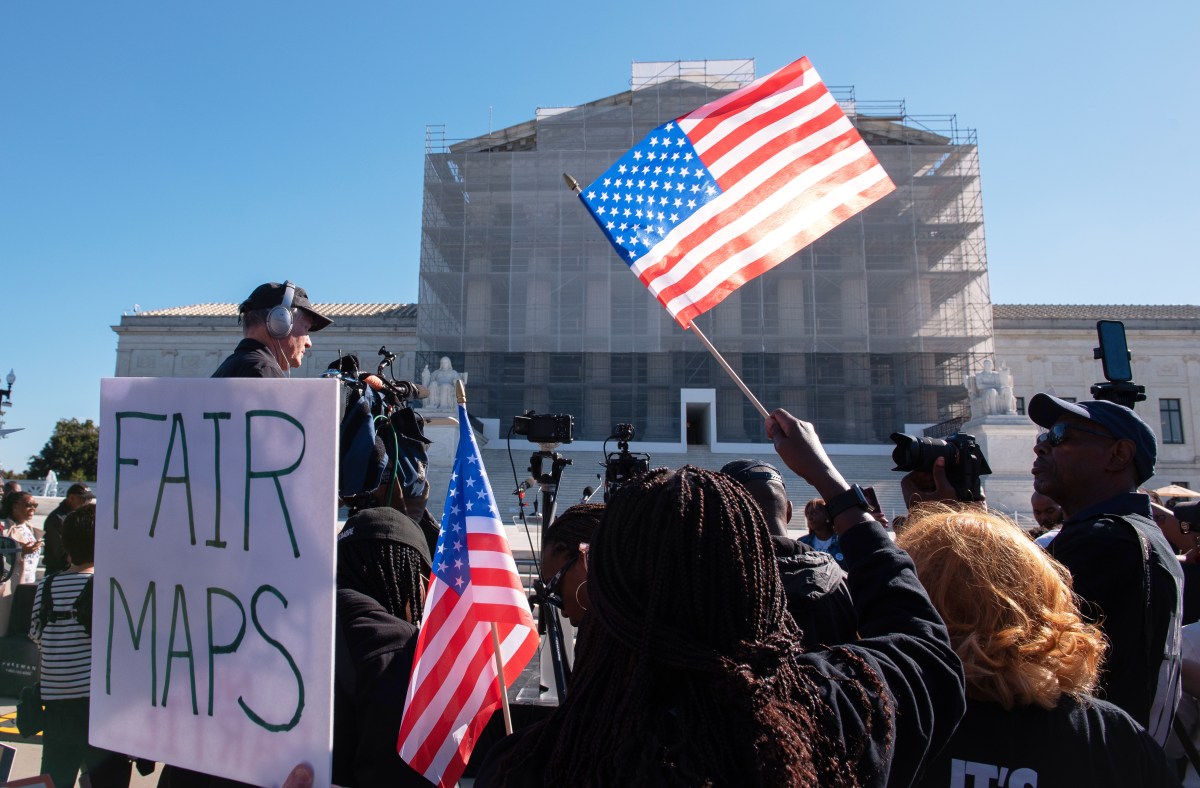
I have struggled mightily to write some words. I am hurt. I am angry. I am sad. That is because the conservative majority of the United States Supreme Court has decided to aid and abet the hateful political energies of this young century and recklessly gut the soul of the Voting Rights Act of 1965. I am hurt, angry, sad because America is the only home I have ever known, and that also goes for my mother’s family and our ancestors, as we can trace our presence on this land mass back to at least the beginnings of this republic, 250 long and cumbersome years ago.
I do not know, directly, the America my ma and grandparents and others survived. But I do know real and whole history, and I know their stories that have been handed to me like precious heirlooms.
I was not alive during the hostile racial segregation of America—known as “Jim Crow” and named after a racist minstrel-show character created in the 1830s by a White entertainer, Thomas Dartmouth “Daddy” Rice. “Jim Crow” laws and practices lasted over a century, from the end of the Civil War to the aftermath of the Civil Rights Movement. During “Jim Crow” not only were voting rights denied to most Blacks, but the hanging of Black bodies from trees, and the wholesale destruction of Black communities, was normalized, was as celebrated as, say, the Super Bowl. That is why I have often wondered, aloud, what America would have looked like if there had not been a Civil Rights Movement.
Obviously, I also have no recollection of the inhumane enslavement of African Americans, of their capture and chained journey to these shores, coined as “The Middle Passage.” What I do know is this country, then and now, would not exist as constructed, without the forced and free labor of the enslaved, from 1619-1865; that our fingerprints and our blood are on every aspect of society—including after slavery—if one is willing to see, feel, seek, hear.
For sure, there are no financial industries or Wall Street without us. There is no Kentucky Derby or space flights to the moon without us. There are no inventions like the electric light or 3D imaging technology without us. There is no country music or rock ‘n’ roll without us. There is no building of major American colleges, like Harvard, Georgetown, or the University of North Carolina, without us. There are no food or snack staples like barbecue or potato chips without us. There are no fashion, language, or cultural innovations of every stripe without us. There is no college or professional basketball or football—by large margins America’s two most popular and lucrative sports—without us. And there is no semblance of freedom, of democracy, of voting rights, even as part of the American vocabulary, without us.
But because this is America, as the rapper Childish Gambino chanted a few years ago, this ugly moment of hate and remixed repression damages not just Black folks, but also Latinx and Asian groups, Indigenous populations, Arab Muslims, Jewish people, women, the disabled, the LGBTQ-plus community, both young heads and senior citizens, immigrants of assorted backgrounds, and, yes, all persons of White America, too. Because in denying my humanity, erasing my right to vote, my books, my history, what is also being killed, intentionally, systematically, illegally, is the notion of dreaming of a different kind of America for, well, everybody.
Dreaming, not in some watered-down manner, or precarious ethos that if you work hard enough, you can achieve. Nope. Dreaming in the tradition of Langston Hughes’ poetry, or Dr. King’s historic speech at the March on Washington in 1963: that despite what we have suffered, we know there can be something better, greater, if we muster hope and the audacity to resist oppression, meanness, evil, if we work for each other, and not against each other.
So, yes, methodically destroying the voting rights of any people is evil. Spending decades, literally, from Dr. King’s assassination on that fateful day, in Tennessee, to the present, whitewashing, bit by bit, the small victories of the Civil Rights era is dastardly. At the end of the day, I know, as a Black person myself, we are a beautifully imperfect people. However, after slavery, after segregation, this is essentially what Blacks have wanted in America: fair and real representation as tax-paying citizens, and full citizenship benefits; opportunities to have opportunities denied to our kinfolk before us because of systemic racism; real safety from being hurt, in any way, because of who we are; and the fundamental right to vote without any obstruction, and whenever possible for candidates who actually represent us.
But, alas, this is where we are. Back in the day, when I was a youth activist during the Reagan years, I helped to reregister voters purged from the rolls in Alabama. I have incredible memories of that experience, of going town to town knocking on doors and sitting and listening to the stories of Civil Rights pioneers and everyday people, too. I think, more than ever, of the many, some known and some nameless and faceless, who lost jobs, careers, homes, families, their very lives, simply for struggling for the right to vote.
Years later, in my adopted hometown of Brooklyn, New York, I ran for Congress in 2008 and 2010. I did not win, but I vividly remember the conversations with voters of various persuasions, those like my mother who proudly vote in each election, and those who were completely indifferent.
That indifference is part of what has landed us here with this infamous Supreme Court decision in 2026. But just like those Alabama residents I encountered who refused to give up, I will not either, in these times. Because this is about voting rights, yes, and it is about true democracy, yes. But far greater, now, is the very soul of us all that we must not allow to be killed, to die.
Kevin Powell is a Grammy-nominated poet, humanitarian, filmmaker, public speaker, frequent contributor to Newsweek, and author of 17 books, including his newest poetry collection, A Poem for Evangeline, And Other Songs (Get Fresh Books Publishing). Kevin lives in New York City. You can find him on social media platforms by typing “poet Kevin Powell.”
The views expressed in this article are the writer’s own.
Read the full article here


